I first brought up The Wild Robot last March in my list of the Top Ten Best Stand-Alone Films. Then, in another list, I brought up the 2024 movie again. This time it was The Best and Worst Movies I Saw in 2025. As I was talking about the second best film I saw last year, I said while it was too early to say how The Wild Robot will stand in the test of time, I think it has potential. With the announcement of a sequel, this second chapter could help strengthen The Wild Robot’s legacy. Jeff Dodge, from ScreenRant, reported the creative talent involved in the upcoming project. The sequel, which is currently titled The Wild Robot Escapes, will be directed by Troy Quane. Directing alongside Troy is Heidi Jo Gilbert, who was promoted from The Wild Robot’s story team. Jeff Hermann will return as one of the sequel’s producers and Chris Sanders will also return to write the film’s screenplay. At the time of this Word on the Street article’s publication, the cast list and release date for The Wild Robot Escapes are still unknown.
As I said in this Word on the Street article, The Wild Robot was the second best film I saw last year. Not only was the animation itself impressive, I was pleasantly surprised by the movie’s emotional depth as well as an abundance of good messages and themes. With all that said, the news about The Wild Robot Escapes is, for me, an intriguing piece of movie news! What’s also intriguing is how The Wild Robot and The Wild Robot Escapes are adaptations of a pre-existing book trilogy. I honestly didn’t know about the book trilogy until I learned about The Wild Robot’s upcoming sequel. It looks like I may have some reading to do while waiting for the release of The Wild Robot Escapes!
What are your thoughts on this piece of movie news? Have you seen The Wild Robot? Tell me in the comment section!
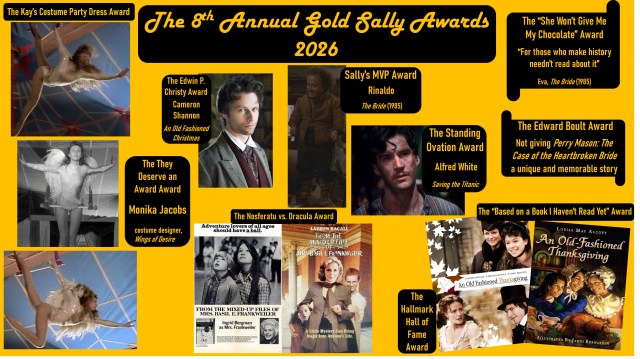
The Gold Sally Awards, a beloved tradition on 18 Cinema Lane, have returned! For those new to my blog, this is an annual post I publish to commemorate my blog’s anniversary. Winners of the Gold Sally Awards are chosen based on movies I saw the previous year. The award categories are created by me, based on topics I’ve brought up on 18 Cinema Lane. Every year, I try to introduce at least one new award category. But in 2026, I’ve brought back two existing categories instead. I will discuss why I chose each recipient, like I’ve done in past award posts. So now, let the 8th Annual Gold Sally Awards begin!
8th Annual Gold Sally Awards Winners created by me, Sally Silverscreen.
The Standing Ovation Award
(Character Most Deserving of Receiving Their Full Potential)
Alfred White from Saving the Titanic
Overcoming a fear takes bravery, determination, and perseverance. When one conquers a fear that was holding them back, it is an accomplishment worth celebrating, especially considering what that person may have gone through to reach that accomplishment. In Saving the Titanic, Alfred White had a fear of heights. He eventually overcame his fear when tasked with reporting everything happening above Titanic’s deck. The fact Alfred faced and conquered his fear during the highly stressful time of Titanic’s sinking is quite amazing. But as Alfred was addressing his fear of heights, he also taught me about the Titanic’s fourth fake funnel, a fact I was unaware of before watching Saving the Titanic. For these reasons, I have chosen Alfred White to receive this year’s Standing Ovation Award!
The Hallmark Hall of Fame Award
(Movie That Feels Like It Belongs in the Hallmark Hall of Fame Collection)
An Old Fashioned Thanksgiving
When I gave Hallmark’s Frankenstein the Hallmark Hall of Fame Award last year, I described the 2004 television movie as an immersive experience. The combination of screenwriting, acting performances, set design, and costume design presented the illusion of transporting me to another time and place. This is exactly how I felt when revisiting An Old Fashioned Thanksgiving! In the case of the 2008 tv film, this illusion was achieved through attention to detail and historical accuracy. Similar to Hallmark’s Frankenstein, I’m surprised An Old Fashioned Thanksgiving wasn’t a Hallmark Hall of Fame presentation. It’s even more surprising none of Louisa May Alcott’s literary work was adapted into Hallmark Hall of Fame titles. So, those are the reasons why I chose An Old Fashioned Thanksgiving for this year’s Hallmark Hall of Fame Award!
The “She Won’t Give Me My Chocolate” Award
(Best Quote from a Movie)
“For those who make history needn’t read about it” – Eva, The Bride (1985)
I will admit this was the most difficult category to choose a winner for. That’s because there were several strong quotes that were deserving of this year’s “She Won’t Give Me My Chocolate” Award. But the quote I ended up selecting was the one Eva told Josef in 1985’s The Bride. Outside the movie’s context, the quote itself is powerful and epic. Within the movie, however, it’s a simplistic yet meaningful acknowledgment of how far Eva came from when she was first introduced in the story. By Eva telling Josef, “For those who make history needn’t read about it”, she’s no longer the blank slate Frankenstein originally created her to be. Instead, Eva can think and speak for herself, even if she did need some help along the way. This quote provides character development in an interesting and memorable way!
The Edwin P. Christy Award
(Most Annoying Character in Film)
Cameron Shannon from An Old Fashioned Christmas
Looking back on 2025, Cameron Shannon, from An Old Fashioned Christmas, sticks out in my memory. But his memorability is for the wrong reasons. As I said in my review of the 2010 tv picture, Cameron was the worst character in An Old Fashioned Christmas. This was due to how annoying he became over the course of the movie. Cameron always acted like he had something to prove, as well as attempting to get the last word in every argument or conversation. So, it was satisfying to see Gad confront Cameron toward the end of the story. Like I also said in my An Old Fashioned Christmas review, the majority of the film emphasized the love triangle between Tilly, Gad, and Cameron. Honestly, I don’t know what Tilly saw in Cameron because his unlikability was static.
The Edward Boult Award
(Missed Opportunity in Cinema)
Not giving Perry Mason: The Case of the Heartbroken Bride a unique and memorable story
Last July, when I reviewed Perry Mason: The Case of the Heartbroken Bride, I criticized the movie for its missed creative opportunities. This major flaw made the twenty-third chapter in the Perry Mason movie series lackluster. In my review, I gave two subplot ideas that could have helped Perry Mason: The Case of the Heartbroken Bride obtain a more memorable story. The first is how Hannah, the sister of Kaitlynn’s fiancé, converted her failed music career into a promising legal career. Kaitlynn’s real personality being quite different from her celebrity persona serves as the second subplot idea. Sadly, these ideas weren’t utilized nor did they contribute to the mystery of Perry Mason: The Case of the Heartbroken Bride. The 1992 television film was Perry Mason’s “bad day at the office”.
The “Based on a Book I Haven’t Read Yet” Award
(Movie Based on Source Material I Have Not Yet Read)
An Old-Fashioned Thanksgiving
Louisa May Alcott is best known for her iconic novel, Little Women. But she has written some short stories throughout her career. One of those short stories was An Old-Fashioned Thanksgiving, which was the source material for the 2008 Hallmark Channel movie of the same name. You’d think with how much I adore An Old-Fashioned Thanksgiving’s film adaptation, I would have read the source material by now. But as of late February to early March, 2026, I still have not read Louisa May Alcott’s short story. Hopefully, I can finally check out An Old-Fashioned Thanksgiving this year!
The Nosferatu vs. Dracula Award
(Two Movies That Feel Like You’re Watching the Same One)
From the Mixed-Up Files of Mrs. Basil E. Frankweiler from 1973 and 1995
If you read my review of 1973’s From the Mixed-Up Files of Mrs. Basil E. Frankweiler, you would know this adaptation, as well as the 1995 version, would likely receive the Nosferatu vs. Dracula Award. This is due to both movies sharing a lot of the same strengths and flaws. Even though each version of From the Mixed-Up Files of Mrs. Basil E. Frankweiler does have its differences, it’s not enough to give the films strong differentiations between them. Even though I slightly prefer the 1995 adaptation over the 1973 version, these movies made me feel like I was watching the same film twice.
The Kay’s Costume Party Dress Award
(Best Outfit from a Movie)
Marion’s Angel Costume from Wings of Desire
In my Comparing with the Critics review of Wings of Desire, I complimented the movie’s costume design. I even described one of Marion’s trapeze artist costumes in detail. That costume is the angel costume Marion wore when she was first introduced in Wings of Desire. The craftsmanship and detail that went into creating the costume allowed the costume itself to stand out long after the movie was over. As I said in my review, the exquisiteness of Marion’s costumes, including her angel costume, makes me wish they were shown in color more consistently.
Sally’s MVP Award
(Character Who Left a Memorable, Showstopping Impression)
Rinaldo from The Bride (1985)
Back in June, 2025, when I reviewed The Bride, I proclaimed Rinaldo was the movie’s MVP. So, when it came time to decide who should receive the Sally’s MVP Award, I already knew the perfect winner! From the moment he meets Viktor, Rinaldo genuinely has Viktor’s best interests at heart. He strives to give Viktor a better life than Frankenstein did, even going so far as to educating Viktor on the importance of his name, which means “He will win”. Rinaldo always refers to Viktor as “his friend”. If it wasn’t for Rinaldo, I don’t believe Viktor would have received the “hero’s journey” he did in The Bride. Similar to when I gave Madmartigan the Sally’s MVP Award last year, Rinaldo became The Bride’s MVP because of David Rappaport’s performance and the screenwriting.
The They Deserve an Award Award
(Someone Associated with a Movie Who Deserves Recognition)
Monika Jacobs (for her costume designs in Wings of Desire)
In the past, I would give this award to actors or actresses who gave a performance that was memorably showstopping. But this year, I decided to expand the They Deserve an Award Award to other departments of film-making. That’s because there are other important components of creating a movie besides acting. When I reviewed Wings of Desire, I praised the film’s costume design, specifically pointing out one of Marion’s trapeze artist costumes. I said I wish Wings of Desire’s costume designer, Monika Jacobs, was nominated for, at least, one award. Costume design isn’t just about crafting attire that’s appealing to the eye. It’s also about creating attire that compliments the actor or actress wearing it. Through Marion’s wardrobe in Wings of Desire, Monika achieved these objectives. Even though Marion’s trapeze artist costumes were stunning, her casual and formal attire made Solveig Dommartin look like the best dressed star of Wings of Desire!
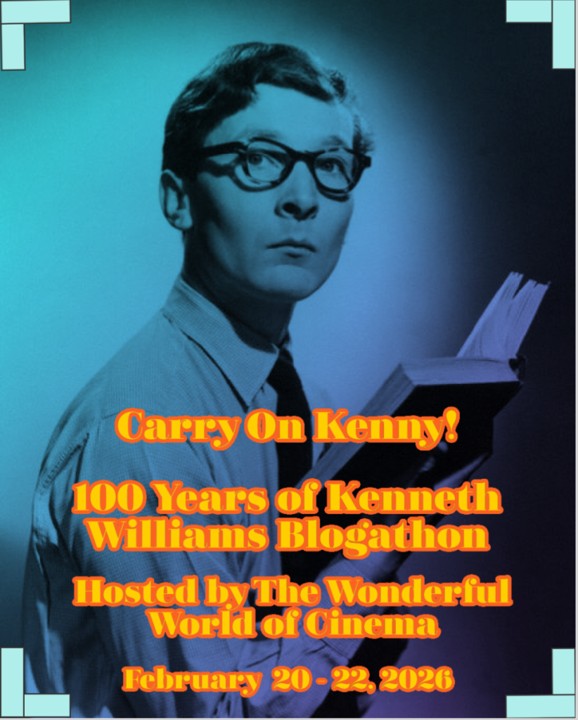
I will admit I wasn’t familiar with Kenneth Williams as an actor before joining the Carry On Kenny! 100 Years of Kenneth Williams Blogathon. But like other blogathons I’ve participated in, I saw the event as an opportunity to expand my cinematic horizons. As I looked through Kenneth’s filmography, I discovered he starred in the 1984 made-for-tv movie, Aladdin and the Forty Thieves. Since I cover my fair share of television films, including those from the 1980s, I chose this production as my blogathon entry! When I recently wrote about Brigadoon, I said the fantasy genre was underrepresented on 18 Cinema Lane. I also said Brigadoon itself was a fine, pleasant presentation. With Aladdin and the Forty Thieves being the second movie from the fantasy genre to be reviewed this year, it almost seems like I’m making up for lost time. And now that I’ve seen the 1984 television film, I can say whether its stronger or weaker than Brigadoon.
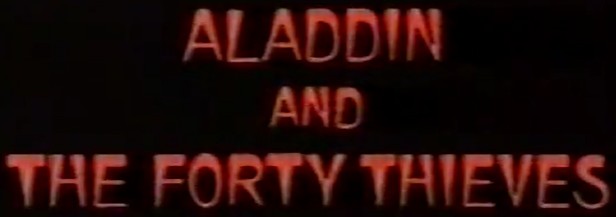
Since Aladdin and the Forty Thieves doesn’t have an offical movie poster, I have to use this title card for my review. Title card created by British Broadcasting Corporation (BBC)
Things I liked about the film:
Kenneth Williams’ performance: Since Kenneth Williams is the reason why I chose to review Aladdin and the Forty Thieves, I’ll talk about his portrayal of Mustapha Drink. In the 1984 movie, Mustapha is a storyteller who shares a tale about two Mandarins named Wing and Wong. Throughout this tale, Kenneth utilizes facial expressions and vocal inflictions to bring the story to life. He even gives the characters distinct voices to add memorability to the tale. Even though Mustapha appeared in only one scene, Kenneth did a good job, acting wise, with the material he was given. I, honestly, wish Kenneth had been the narrator of Aladdin’s story, presenting the illusion he was reading a storybook to the audience.
The costume design: While we’re on the subject of Kenneth’s portrayal of Mustapha Drink, I want to talk about the movie’s costume design. As he told the tale of Wing and Wong, Mustapha wore a long blue jacket with gold trim and detailing. Whether he walked or sat, the jacket sparkled in the light. Mustapha also wore a long red gown boasting an intricate gold design. The elegance of his outfit allowed Mustapha to stand out, even though he appeared in only one scene. This is just one example of the attention to detail and effort that went into the costume design of Aladdin and the Forty Thieves!
Certain ways Aladdin’s story was adapted: I must confess the adaptation of Aladdin’s story I’m most familiar with is the Disney animated picture from 1992. With that said, it was interesting to see how Aladdin and the Forty Thieves adapted Aladdin’s story compared to Disney’s production. The 1984 film features two genies, Genie of the Lamp and Genie of the Ring. Though I think it was a missed opportunity not to have the genies interact with one another, it was still an interesting creative decision to have more than one genie solve the characters’ problems. Toward the end of Aladdin and the Forty Thieves, Aladdin and The Princess Balroubador receive a magic carpet as a wedding gift. From what I remember of the 1992 movie, the magic carpet was more of a sidekick for Aladdin. The iconic “A Whole New World” scene just wouldn’t be the same without the magic carpet. Though Aladdin and the Forty Thieves and the Disney film each approached the same story, they brought it to life in their own unique way!
The musical numbers: Before I selected Aladdin and the Forty Thieves for the Carry On Kenny! 100 Years of Kenneth Williams Blogathon, I had no idea it was a musical. So, you can imagine my surprise when Genie of the Ring started randomly singing and dancing. Though the musical numbers themselves weren’t bad, some of them seemed like they were added to the movie just for the sake of including a musical number. When Aladdin’s Chinese village was first introduced in Aladdin and the Forty Thieves, some of the residents sang “Zip-a-Dee-Doo-Dah”. As I was watching this musical number unfold, I kept wondering what this song had to do with Aladdin and his story, especially considering the song itself was released in 1946. Creative decisions like this musical number left me confused of the creative team’s intent.
Unclear time period: Remember when I questioned the inclusion of “Zip-a-Dee-Doo-Dah” in Aladdin and the Forty Thieves, pointing out how the song was released in 1946? I brought this up to address one of the flaws of the 1984 television film; an unclear time-period. Based on the set and costume design, it appears the story takes place in Ancient China. Yet, in one scene, a vending machine not only served drinks, but also “hot & cold food”. Because of creative choices like the two I described, it makes Aladdin and the Forty Thieves look like it’s having an identity crisis.
The special effects: I know a television movie is, more often than not, going to receive a smaller budget. I’m also aware how cinematic technology from the 1980s is going to be different from today’s cinematic technology. But with all that said, I couldn’t look past the poor special effects throughout Aladdin and the Forty Thieves. One painfully obvious example is when, toward the beginning of the film, Abanazar transforms into a bird. This very fake-looking bird is superimposed over still photographs of landscapes, trying to present the illusion of traveling from one place to another. Making a movie isn’t easy and does require working within your means. However, I think using special effects hurt Aladdin and the Forty Thieves instead of helped it.
Have you ever watched a movie and wondered “what the heck did I just watch”? That’s what I was thinking when I saw Aladdin and the Forty Thieves. Was the 1984 movie supposed to be taken seriously or was it supposed to be silly, goofy fun? Why was it difficult to determine the story’s time period? It’s a shame this wasn’t a stronger picture because there are aspects of it I liked. Kenneth Williams did a good job, acting wise, in his role as Mustapha Drink. In fact, I think Kenneth should have been the one narrating Aladdin’s story. It looked like there was a good amount of effort and detail put toward the set and costume design. I even liked some of the ways Aladdin’s story was adapted in the 1984 film. But I have no idea what I was supposed to get out of Aladdin and the Forty Thieves. Therefore, I hesitate recommending it.
Overall score: 5.3 out of 10
Have you seen Aladdin and the Forty Thieves? Which adaptation of Aladdin’s story is your favorite? Let me know in the comment section!
I’ve been participating in Taking Up Room’s So Bad It’s Good Blogathon since the very beginning. Because I didn’t have a go-to “so bad it’s good” movie at the time, I have seen the blogathon as an opportunity to search for my “so bad it’s good” title, with the search itself becoming a saga on 18 Cinema Lane. In my review of Jesse James Meets Frankenstein’s Daughter, I learned to look for films that were built on a gimmick. Then, after watching Mount Hideaway Mysteries: Heartache and Homecoming, I learned to search for movies that are so bad, they are, at times, unintentionally funny. But for this year’s So Bad It’s Good Blogathon, I chose my selected title differently. I heard from several movie-related Youtubers that Kraven the Hunter possessed qualities that made the film “so bad it’s good”. Remembering their opinions, I picked the 2024 movie with an open mind, hoping I had finally found my “so bad it’s good” title. Though there were moments in the movie that were unintentionally funny, I can’t say Kraven the Hunter will earn the coveted title of “so bad it’s good”. To explain why I feel this way, I will compare the 2024 film to a movie that has been widely regarded as “so bad it’s good”; Mommie Dearest. Even though I will bring up the 1981 movie from time to time, it’s to emphasize the point that Kraven the Hunter didn’t really live up to its “so bad it’s good” potential.
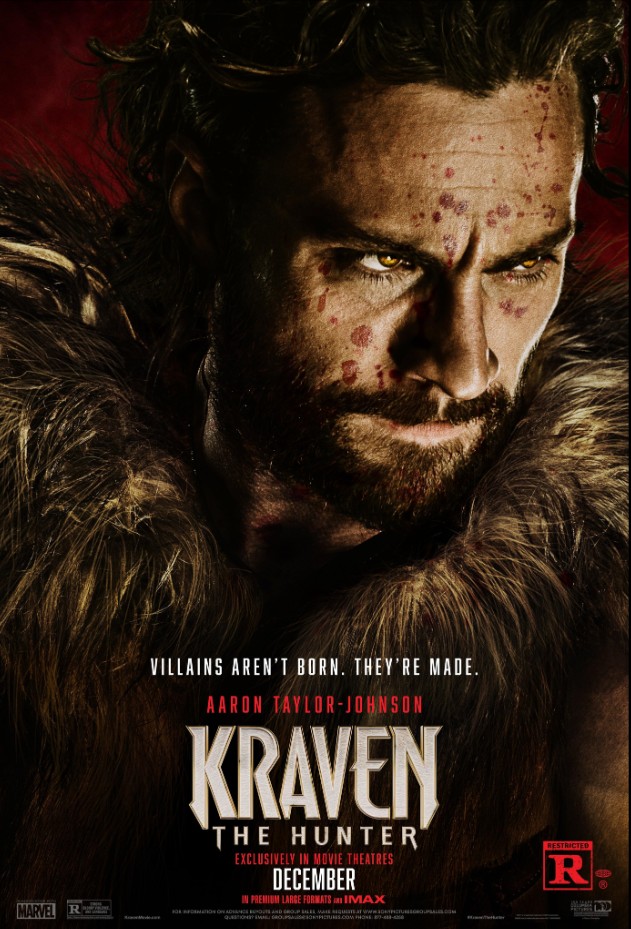
Kraven the Hunterposter created by Columbia Pictures, Marvel Entertainment, TSG Entertainment, Avi Arad Productions, Matt Tolmach Productions, Film in Iceland, and Sony Pictures Releasing
When it comes to Mommie Dearest, I see the movie less as a “so bad it’s good” picture and more of a character study about family dynamics and the motivations behind them. However, I can recognize why the 1981 title is regarded as “so bad it’s good” in the eyes of many. One of these reasons is Faye Dunaway’s over-the-top portrayal of Joan Crawford. Her antics stand out against a backdrop that feels ordinary or mundane. Even her lines like “No wire hangers, ever!” and “Tina! Bring me the axe!” have become iconic because of Faye’s excessively dramatic delivery. But in Kraven the Hunter, the only memorable character is Sergei/Kraven himself, as he is the film’s protagonist. The rest of the characters weren’t given the context in order to stand out. Two of the movie’s villains, the Foreigner and Aleksei/Rhino, seemed interchangeable. They don’t have many discernible characteristics that allow them to embrace uniqueness. Even when Aleksei transformed into his alter ego, Rhino, it was for the benefit of the plot instead of helping Aleksei become a memorable character. Meanwhile, Sergei’s/Kraven’s father, Nikolai, tries to stand out within the story. However, these efforts feel forced, with his lines sounding less like conversation and more like lines found on the movie’s official merchandise.
From what I’ve heard over the years, Mommie Dearest was never intended to be a “so bad it’s good” presentation. In fact, it was meant to provide a chance for Faye to potentially earn an Oscar, let alone a nomination. Despite this good intention, the 1981 film shows its audience how good ideas led to bad results. The simpler reasons for the movie’s existence allow viewers to accept its “so bad it’s good” status at face value. As I watched Kraven the Hunter, however, I kept wondering what the point of the movie was supposed to be. When I brought the film up in my list of Ten Movie Trends I Don’t Understand, I said it was a Spider-verse villain movie without the presence of Spider-Man. But Kraven the Hunter doesn’t take the time to build up Sergei/Kraven as a legitimate threat for Marvel’s friendly, neighborhood superhero. Instead, Sergei/Kraven is reminiscent of Eric Draven and Ashe Corven from The Crow and The Crow: City of Angels; only inflicting violence on villains and criminals that deserve to face accountability. This makes some of the characters’ warnings about karma and the dangers of Sergei/Kraven becoming like his villainous father not make sense. Even the movie’s plot twist was so convoluted, it makes that part of the story pointless. Instead of seeing Kraven the Hunter as “so bad it’s good”, it was so confusing, I found it difficult to understand what the film was trying to say.
One of the most unbelievable moments from Mommie Dearest is when Joan took her daughter, Christina’s, role on the soap opera Christina starred on. While Christina (who was 27 at the time) was recovering from surgery, Joan temporarily starred on Christina’s soap opera as Christina’s character, even though Joan was much older than the character herself. Though this moment seems too good to be true, it actually happened. There’s even a New York Times article about this creative decision. The idea of Joan, who was 60 years old when she appeared on Christina’s soap opera, portraying a character that’s in her twenties seems “bonkers”, adding to Mommie Dearest’s “so bad it’s good” reputation. Kraven the Hunter, on the other hand, doesn’t really have any “bonkers” moments or situations. This is because the film takes itself a little too seriously as an action picture. The concept of a man possessing animalistic instincts, skills, and powers to defeat other characters could sound “bonkers” on paper. Even the idea of a man becoming a rhino seems like a silly gimmick. But the creative team behind Kraven the Hunter didn’t embrace the sillier aspects of the source material they were adapting. While there were moments in the movie that were unintentionally funny, as I mentioned in this review’s introduction, these moments were inconsistent.
According to IMDB, Paramount (the studio that distributed Mommie Dearest) took advantage of their audience’s fascination with Mommie Dearest by billing “the film as a camp classic”. People even “flocked to see the film armed with Ajax and wire hangers to actively “participate” with the film”, in a similar fashion to movies like The Rocky Horror Picture Show. Like I mentioned earlier in this review, Mommie Dearest featured iconic lines like “Tina! Bring me the axe!” and “No wire hangers, ever!”. There are also memorable moments like Joan cutting Christina’s hair. People developed an interest in Mommie Dearest because it was memorably bad. But Kraven the Hunter lacks the memorability Mommie Dearest achieved. One previously mentioned contributor was the lack of stand out characters (besides Sergei/Kraven himself). Another contributor is how, in Kraven the Hunter, there are stretches of time where characters just talk between each other. If these dialogue-heavy moments had been evenly spaced out throughout the story or had the writing itself been a little bit stronger, maybe the dialogue could have added memorability to the movie. But the writing was so flat, it made Kraven the Hunter feel uninspired. The stretches of time featuring dialogue-heavy scenes not only affected the overall pace of the film, it also caused Sergei/Kraven to have less screen-time than the title of the movie would suggest.
Have you ever seen a movie that was just “meh”? That’s how I feel about Kraven the Hunter; too weak to be good or great but not outrageous enough to be bad or disappointing. When I participate in the So Bad It’s Good Blogathon, I expect my selected movie will not be as strong as movies I’ve actually enjoyed. But I hope my experience watching the film will, at least, be somewhat entertaining. While there were entertaining moments because they were unintentionally funny, I can’t say the same for the rest of Kraven the Hunter. The film as a whole was uninspired largely due to the writing. From most of the characters being unmemorable to stretches of time where dialogue-heavy scenes were emphasized, I found myself being underwhelmed, more often than not. But the biggest opportunity missed by the film’s creative team was not embracing the gimmick and its silliness from their project’s source material. If Kraven the Hunter’s creative team hadn’t taken their project so seriously, maybe my movie-viewing experience would have been similar to when I reviewed Tarzan in Manhattan last year. Or maybe finding my “so bad it’s good” movie requires an acquired taste I haven’t quite received yet.
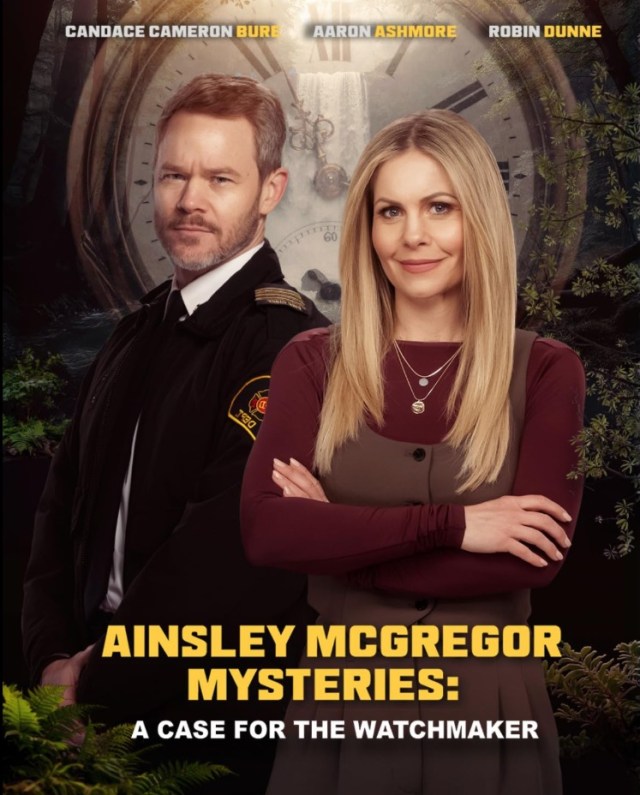
Great American Family’s Ainsley McGregor Mysteries series has become a pleasant surprise for 18 Cinema Lane. My review of Ainsley McGregor Mysteries: A Case for the Winemaker became one of my most popular movie reviews of all time, garnering over seven thousand views in almost two years. The positive reception of this review led me to cover the sequel, Ainsley McGregor Mysteries: A Case for the Yarn Maker. That review has also been well received, obtaining over two hundred views so far. When I discovered Great American Family was not only releasing a third chapter, they were also premiering the third chapter in January 2026, I knew that’d be one of the first movies to be written about in the New Year! Though there’s only been two movies in the Ainsley McGregor Mysteries series, so far, the series as a whole has been quite enjoyable. What has worked in the series’ favor is improving upon the flaws of the previous chapter and providing consistent strengths. Will the third chapter, Ainsley McGregor Mysteries: A Case for the Watchmaker, continue this pattern? Let’s find out in this review!
Subtle hints of Texas: When I reviewed Ainsley McGregor Mysteries: A Case for the Winemaker, I criticized the film for its constant reminders of the story’s Texas setting. To me, these reminders tried to make the movie’s setting a little too obvious for the audience. This flaw was remedied in Ainsley McGregor Mysteries: A Case for the Watchmaker! References to the series’ Sweet River, Texas setting were represented through some of the women’s wardrobe. One of the Book Club members, Maria, sometimes dons turquoise jewelry. Another Book Club member, Lily, wears a sweatshirt featuring a cowboy/cowgirl hat and cowboy/cowgirl boots. Even Ainsley herself can be seen wearing a blouse similar to those worn by country music stars. Besides the wardrobe, there were other subtle hints of Texas found in Ainsley McGregor Mysteries: A Case for the Watchmaker. A great example is when one of the Book Club members uses a pen shaped like a cactus.
Selecting a cold case: While seeking another mystery to solve, the Book Club decides on a cold case. As they mentioned in the movie, the cold case provided a nice change of pace for them. Not only did this decision benefit the Book Club, it also benefitted Ainsley McGregor Mysteries: A Case for the Watchmaker! By having a cold case as the movie’s main mystery, it prevents the series from becoming repetitive, as the previous two chapters revolved around murder mysteries that happened in the present. This creative choice shows other ways mysteries can become solved as well. In the case of Ainsley McGregor Mysteries: A Case for the Watchmaker, most of the clues were found within the dialogue. Selecting a cold case for the characters to solve was definitely an interesting decision for the third film in the Ainsley McGregor Mysteries series!
Rance Moseby: A new character that was introduced in Ainsley McGregor Mysteries: A Case for the Watchmaker was Rance Moseby, the proprietor of a local pawn shop. At first, Ainsley and Jake believe Rance may be up to no good. But as the story progresses, Rance proves that looks can be deceiving. While I was watching Ainsley McGregor Mysteries: A Case for the Watchmaker, I grew to like Rance as a character. David Milchard, the actor who portrayed Rance, had great on-screen chemistry with the movie’s cast. The strength of David’s acting talents helped make Rance seem like he was always meant to exist in the world of the Ainsley McGregor Mysteries series. Rance’s drier sense of humor nicely provided the film’s comic relief as well. If there are more Ainsley McGregor Mysteries movies in the works, I really hope Rance Moseby becomes a part of the series’ regular cast!
An unnecessary subplot: Throughout Ainsley McGregor Mysteries: A Case for the Watchmaker, a subplot revolved around Jake’s past romantic relationship with the mayor of Sweet River, Jane Reval. Even though it was interesting to see how this new character connected to an established character like Jake, I found this subplot unnecessary. Because Jake and Ainsley are currently dating, Jake has no interest in reuniting with Jane. This fact prevents the subplot from going anywhere. It also doesn’t help that the subplot has a loose connection to the main mystery. In my opinion, the least interesting part of Ainsley McGregor Mysteries: A Case for the Watchmaker was the subplot between Jane and Jake.
Inconsistent humor: In my review of Ainsley McGregor Mysteries: A Case for the Yarn Maker, I praised the movie’s inclusion of humor. It was not only sprinkled throughout the story, it was also woven into the dialogue. While there was humor in Ainsley McGregor Mysteries: A Case for the Watchmaker, it wasn’t consistently featured in the story. In fact, most of the movie’s humor was found in the second half of the film, when Rance becomes more involved in the mystery. This flaw kind of makes me wish Rance debuted in Ainsley McGregor Mysteries: A Case for the Watchmaker sooner.
Limited screen-time for George: One of the aspects I liked in Ainsley McGregor Mysteries: A Case for the Winemaker was Ainsley’s dog, George. Moments where Ainsley talks to George gave viewers a break from the heaviness of the story’s murder mystery. Plus, his larger role in the first chapter gave the film a more unique identity. But in the second movie, Ainsley McGregor Mysteries: A Case for the Yarn Maker, George’s screen-time was reduced. I was hoping this flaw would be corrected in Ainsley McGregor Mysteries: A Case for the Watchmaker. But, unfortunately, George received even less screen-time, only appearing in two scenes. The reduction of George’s screen-time as the Ainsley McGregor Mysteries series continues disappoints me, especially since George is one of my favorite parts of this series.
When I talked about Mystery by the Book in my list of The Best and Worst Movies I Saw in 2025, I brought up how Great American Family’s Ainsley McGregor Mysteries series is growing stronger in quality. The third chapter, Ainsley McGregor Mysteries: A Case for the Watchmaker, proves my statement correct, as I found it the best movie in the series so far! Selecting a cold case as the movie’s main mystery prevented the overarching story of Ainsley McGregor Mysteries from becoming repetitive. The creative team behind the 2026 film improved upon flaws from the previous titles, such as making subtle references to the series’ Texas setting. Even though the acting was, once again, one of the strengths of Ainsley McGregor Mysteries: A Case for the Watchmaker, David Milchard’s portrayal of Rance Moseby stole the show. In fact, I’d say Rance was the MVP of this movie! Despite the film having its flaws, the film itself shows the Ainsley McGregor Mysteries series is moving in the right direction. I do hope this series continues, as I believe there are many more stories to tell!
Overall score: 7.5-7.6 out of 10
Have you seen Ainsley McGregor Mysteries: A Case for the Watchmaker? What would you like to see happen if the series continues? Let me know in the comment section!
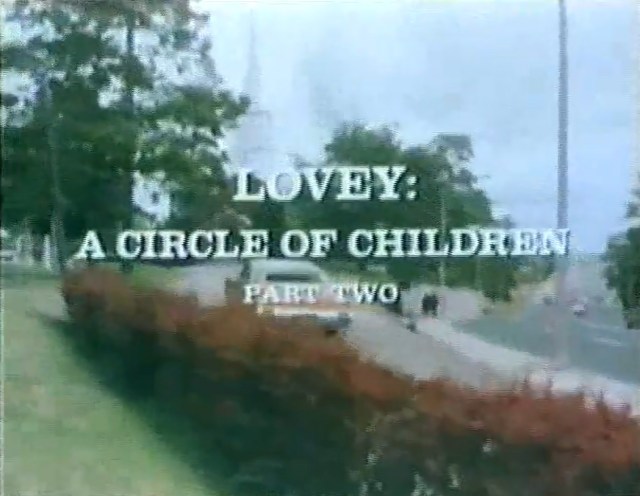
As I explained in my recent review of A Circle of Children, I’m covering the sequel, Lovey: A Circle of Children, Part II for the Film. Release. Repeat. Blogathon. Because I’ve been meaning to review the 1978 television film since 2022, I believed the blogathon was a great time to finally check the movie out! But as I also mentioned in my review of A Circle of Children, I haven’t found a made-for-tv movie from the 1970s I actually like. Whenever I’ve selected this particular type of film to write about, I find the film itself either fine, ok, or underwhelming. This is one of the reasons why I put “1970s Made-for-TV movie” on my Year-Long Bingo card, so I could, hopefully, find a television movie I enjoy from that decade. When I saw and reviewed A Circle of Children, I thought it was just ok. Will its sequel be better? Let’s begin this review to find out!
Lovey A Circle of Children, Part II title card created by Time-Life Television Productions and CBS
Things I liked about the film:
A smaller cast: In my review of A Circle of Children, I mentioned the film containing a large cast of characters. This is one of the reasons why the audience was forced to either only become familiar with the characters or not getting to know them at all. This flaw became remedied in Lovey: A Circle of Children, Part II! In the 1978 sequel, the cast is much smaller. Even Mary’s class contains fewer students. Because the story has less characters to keep track of, it gives the audience an opportunity to truly get to know the characters. The audience also has more time to spend with characters like Mary’s students and even Mary’s boyfriend, Cal, because of a tightly written script.
Progression that’s written gradually: When I reviewed A Circle of Children, I talked about how Sarah’s sudden achieved progress taking place after being a static character for half the movie felt like it was written into the story for the sake of plot and time convenience. Even though I was happy to see Sarah achieving progress, I wish that progress was gradually woven into the script. It seems like the creative team behind Lovey: A Circle of Children, Part II felt the same way I did, as Hannah’s/Lovey’s progression was gradual. Hannah/Lovey joins Mary’s class as an unruly child who is very unpredictable. But as the film goes on, Mary’s influence takes effect on Hannah/Lovey as she becomes more responsive, less violent, and even participates in class. The smaller cast size I talked about earlier certainly influenced this part of the story. It allowed Hannah’s/Lovey’s progression to receive emphasis instead of competing against other stories. The transformative power of Mary’s teaching abilities is also on full display because of the gradually written progression of Hannah/Lovey.
The dialogue: Like I said in my list of The Best and Worst Movies I Saw in 2025, how well-written the dialogue was in The Chalk Garden allowed me to remember what Laurel said about the term “good morning”. The quality of the screenwriting was also a strength in Lovey: A Circle of Children, Part II! Some of the dialogue in the 1978 movie sounded profound without trying too hard to be philosophical. A great example can be heard during a conversation between Mary and a fellow teacher named Patty. Patty feels discouraged over the lack of progress from her students. Mary reassures Patty that her impact on the students has been positive, reminding Patty how hope comes from believing the children can learn something. Patty then tells Mary, “Yeah, but you can’t mop the floors with hope”. Mary experiences her own period of discouragement after Hannah/Lovey has an angry outburst involving paint. In a voice-over, Mary says, “For a moment, my dreams and plans for Hannah shattered. But paint is only paint and never worth a dream. Besides, a teacher’s dream dies hard”. The two examples I provided show how Mary’s and Patty’s frustrations and concerns were eloquently and thoughtfully written into the script.
How Hannah was introduced: As I’ve already said in this review, Hannah/Lovey joins Mary’s class as an unruly child who is very unpredictable. However, I found her introduction in Lovey: A Circle of Children, Part II to be distasteful. As Mary walks down the hallway to retrieve Hannah/Lovey, suspenseful music plays over the scene. The music itself sounds as if it came straight out of a horror movie. The reveal of Hannah’s/Lovey’s face was prolonged because of specific camera angles that were utilized. When Hannah’s/Lovey’s face was finally revealed, a frozen close-up shot was presented to intentionally appear frightening. To me, the introduction I described felt sensationalized to the point of being counterproductive of what Lovey: A Circle of Children, Part II was trying to achieve; making the audience feel empathetic toward Hannah/Lovey by looking past her horrific behavior. I truly believe there was a more tasteful way Hannah/Lovey could have been introduced in the story, especially compared to how some of the students were introduced in A Circle of Children.
Doris’ limited involvement in the story: A Circle of Children introduced Doris as the director of the Children’s School for Special Education. Though she appeared in only a handful of scenes, Doris’ role was pivotal as she literally and figuratively opened the door for Mary to the world of Special Education. Doris was one of the few characters from the first movie to return in the sequel. But she was given even more limited involvement in the second film. While she was still the director of the Children’s School for Special Education, her role in Mary’s story had a reduced significance. I wish Doris received more to do in Lovey: A Circle of Children, Part II because I think she could have made a bigger impact.
Lack of further progression: I said earlier in this review how Hannah’s/Lovey’s progression was written gradually into the story. Even though this was one of the movie’s strengths, I didn’t like how there was a lack of further progression for two of Mary’s students. While Hannah/Lovey was improving her reading skills and Brian (from the first movie) was learning how to board the bus by himself, Rufus and Jamie were at a standstill in their education. With a smaller cast size I talked about in this review, there should have been room in the script to give Jamie and Rufus at least a small victory. At the end of Lovey: A Circle of Children, Part II, Mary reveals through a voice-over what happened to her students. However, not showing Rufus and Jamie achieving further progression in the movie was a missed opportunity.
Sometimes, a sequel ends up becoming better than its predecessor. Lovey: A Circle of Children, Part II just so happens to be one of those films! Some of the flaws of A Circle of Children were improved upon in the second chapter, such as containing a smaller cast and the script featuring a gradual progression for Hannah/Lovey. The sequel even had its own unique strengths from its predecessor, like how well-written the dialogue was. But despite these positive aspects, Lovey: A Circle of Children, Part II did have its flaws. I believe there are more respectful ways Hannah/Lovey could have been introduced into the story, as her debut in the film was too sensationalized for my liking. I not only wish Jamie and Rufus had received further progression in the movie, I also wish Doris was given a greater significance in the script. But similar to what I said in my review of A Circle of Children, I’m grateful Lovey: A Circle of Children, Part II exists at all. The 1978 film gives the audience a glimpse into what Special Education was like in the 1970s. It’s a made-for-tv movie that was spared from getting lost to time as well.
Overall score: 7.2 out of 10
Have you seen Lovey: A Circle of Children, Part II? Are there any made-for-tv movies from the 1970s you’d like to see me cover on 18 Cinema Lane? Please tell me in the comment section!
Back in 2022, I wrote a list of the Top 10 Movies I’d Love to Review. Each chosen film was categorized based on how accessible they are. Reflecting on this list, I realized that as of early January 2026, the only more “accessible” titles not yet covered on my blog were A Circle of Children and Lovey: A Circle of Children, Part II. With the Film. Release. Repeat. Blogathon (an event about remakes and sequels) on the horizon, I finally found a reason to review the 1978 sequel. However, I’ve never seen its predecessor, A Circle of Children. So, in preparation for my review of Lovey: A Circle of Children, Part II, I’m also writing about the first film. As I said in my list of the Top 10 Movies I’d Love to Review, both A Circle of Children and Lovey: A Circle of Children, Part II are based on the true story of a teacher named Mary MacCracken. Like I also said in my list, Mary’s books were not only the source material for these movies, Mary was also one of the screenwriters for both films. But over these eight years of 18 Cinema Lane’s existence, I haven’t found a made-for-tv movie from the 1970s I actually like. Will A Circle of Children change that? Let’s begin the first movie review of 2026 to find out!
A Circle of Children (1977) title card created by Edgar Scherick Productions, 20th Century Fox Television, and CBS
Things I liked about the film:
The acting: In A Circle of Children, the protagonist, Mary, visits the mother of a student named Brian O’Connell. During Mary’s conversation with Mrs. O’Connell, Brian’s mother consistently has a worn look on her face. Not only did Mrs. O’Connell’s eyes look heavy, her mouth was set in a straight line as well. Her voice almost sounded monotone, lacking emotion over her situation. Though she admits to Mary that she’s tired, Mrs. O’Connell was able to express how tired she was without relying too much on dialogue. That’s because Judy Lewis, the actress who portrayed Mrs. O’Connell, effectively utilized vocal inflection, facial expression, and even her eyes to emphasize what her character was going through.
Speaking of Brian O’Connell, I want to talk about Matthew Labyorteaux’s performance! I am familiar with his portrayal of Albert on Little House on the Prairie. Therefore, Matthew’s acting capabilities are already known to me. Mary teaching Brian to speak presents a great display of Matthew’s acting talents. When Mary is using a tape recorder in order to help Brian learn to speak, Brian has a blank look on his face. But when a teacher named Dan sings a song to the students, he offers the microphone to Brian. This time, Brian has a determined look on his face, as he intensely looks at the microphone and makes a great effort of trying to repeat Dan’s song. The next scene shows Brian receiving a second chance to speak into the microphone. His eyes become really wide and a smile spreads across his face, excited by the opportunity given by Mary and Dan. As I watched A Circle of Children, it made me believe Little House on the Prairie’s creative team chose wisely when they cast Matthew as Albert!
Since A Circle of Children is based on the true story of Mary MacCracken, I must discuss Jane Alexander’s portrayal of Mary. Throughout the movie, Jane’s performance brought empathy and relatability to her role. One great example happens when Mary encourages Brian to say his name. Brian puts together a puzzle resembling a short story he was reading earlier in the film. Because one of the characters in that story was named Brian, Mary uses this fact to motivate Brian to say his name for the first time since coming to the Children’s School for Special Education. When this plan fails, Mary develops a look of defeat on her face. Her mouth is turned into a frown and her eyes present a mixture of sadness and concern. This medium shot of Mary’s face not only says so much without saying anything at all, it also shows the audience how much she cares about the students, especially Brian.
The chemistry of Mary and Dan: When Mary first visits the Children’s School for Special Education, she meets a teacher named Dan. Over the course of A Circle of Children, Dan and Mary develop a friendship that is shown in only a handful of scenes. Despite this, their chemistry highlights how the two have become kindred spirits, bringing thoughtfulness and understanding to their friendship. The chemistry between Mary and Dan works because the on-screen chemistry between Jane Alexander and David Ogden Stiers (the actor who portrays Dan) works! The strength of their acting abilities allows David and Jane to effectively present a friendship that looked and felt believable. Because of how well they seemed to get along, I was hoping Dan and Mary’s friendship would gradually become a romance. Mary and Dan’s chemistry was such a pleasant surprise in A Circle of Children!
Creating a complex character: One of the teachers at the Children’s School for Special Education is Helga. At first, she and Mary don’t see eye to eye due to how Helga treats the students. Some examples include making a child plunge the toilet and intentionally hiding a young girl’s (literal) security blanket. But as the story goes on, Mary, as well as the audience, learns Helga actually has good intentions for the students. In fact, she wants the children to succeed just as much as Mary does. It would have been so easy for A Circle of Children’s creative team to present Helga as a one-dimensional mean teacher. Instead, the screenwriting and Rachel Roberts’ performance created a character that was complex, representing how, sometimes, approaches to education aren’t straightforward. Helga’s complexity made her a memorable character as well!
Only becoming familiar with characters: A Circle of Children consists of a large cast of characters. That’s because most of the characters are students from the Children’s School for Special Education. But A Circle of Children has a run-time of an hour and thirty-six minutes, leaving the audience with not enough time to truly get to know the characters. The film’s run-time actually forces the audience to either only become familiar with the characters or not getting to know them at all. Had A Circle of Children received a longer run-time, more opportunities to show Mary getting to know her students and help them could have been provided in the story.
Scene transitions that weren’t smooth: If a movie features smooth transitions between scenes, they can not only help the audience process the story unfolding, they can also maintain the film’s overarching pace. But in the case of A Circle of Children, choppy scene transitions sometimes created emotional whiplash. In one glaring example, Mary and her husband, Larry, confess to their daughter, Liz, of their recent separation. This confession is so upsetting, Mary herself appears to be on the verge of crying. However, the very next scene shows Mary being interviewed for a teaching aide position at the Children’s School for Special Education. This scene is intended to be less sad than the scene I previously described. To me, the transition between these two scenes felt jarring because the transition itself was choppy and abrupt.
Solutions happening for the sake of plot and time convenience: Within the first fifteen minutes of A Circle of Children, a young girl named Sarah is enrolled at the Children’s School for Special Education. According to Sarah’s mother, Sarah is unable to stand or walk. She’s also so attached to a blanket that she continuously screams at the top of her lungs if the blanket is taken away from her. For half the movie, though, Sarah is a static character. She’s either shown lying on the floor sucking her thumb or screaming because she can’t find her blanket. But at a Christmas party that takes place a little more than halfway through the movie, Sarah not only randomly starts walking, she also willingly trades her blanket for a doll. While I was happy to see Sarah achieving progress, I wish this progress was gradually woven into the script. Because Sarah suddenly achieved progress after being a static character for half the movie, the moment itself felt like it was written into the story for the sake of plot and time convenience.
In the introduction of this review, I said I haven’t found a made-for-tv movie from the 1970s I actually like. Sadly, A Circle of Children will not be the film to change that. The 1977 production isn’t a bad movie. In fact, it has its merits, especially when it comes to the acting performances. But I found the story itself to be too “slice of life” for my liking. Plus, there were other flaws that stood out to me, such as the run-time and choppy scene transitions. Looking back on A Circle of Children, however, I will admit my gratitude for its existence at all. This movie is like a time capsule when it comes to Special Education, giving viewers a glimpse into how this specific topic was approached in the 1970s. Though the film only shares one teacher’s perspective, it does express themes of helping others reach their full potential, working together to achieve a common goal, and not giving up on others. The creative team behind A Circle of Children definitely had their hearts in the right place. Now that I’ve finally seen this movie, it’ll be interesting to see where the story in Lovey: A Circle of Children, Part II goes from here.
Overall score: 6 out of 10
Have you seen A Circle of Children? Are you looking forward to my review of Lovey: A Circle of Children, Part II? Let me know in the comment section!
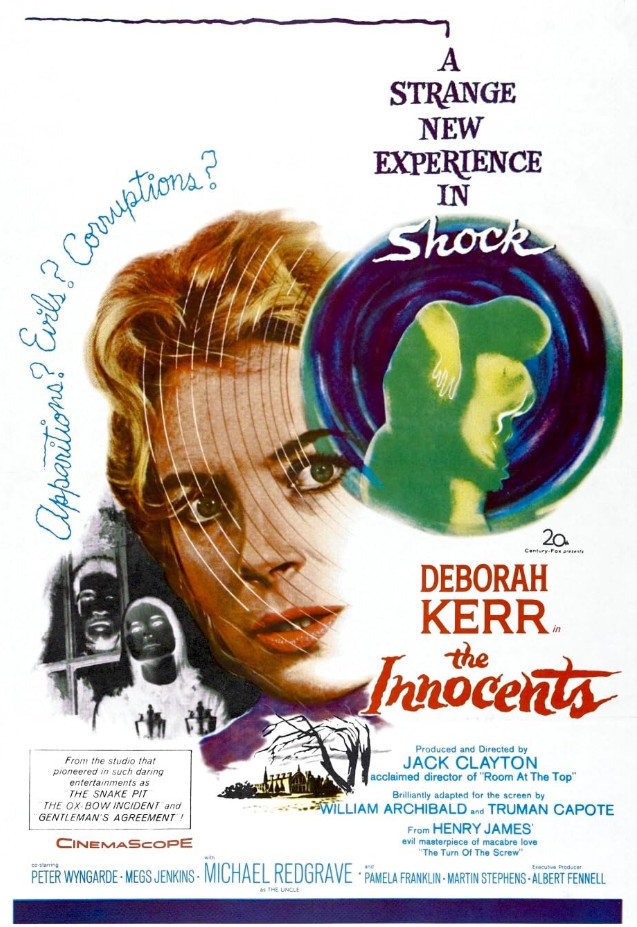
Film recommendations from my readers are welcomed here at 18 Cinema Lane. These suggestions are then placed on a Pinterest board, which I use as a reference for upcoming reviews. Some movies have been on the board for so long, they’re at the very bottom. One of these titles is 1961’s The Innocents. Recommended by Maddy (from Maddy Loves Her Classic Films), this is a Deborah Kerr starring production that is quite different from the other projects of hers I’ve reviewed on my blog. That’s because The Innocents is classified as a horror film. Because of this distinct, I’ve been trying to find the right opportunity to talk about the movie. Hoofers and Honeys’ 4th Annual Spooky Classic Movie Blogathon became that opportunity! Deborah’s films covered on 18 Cinema Lane have fluctuated in quality. While I liked titles like The Chalk Garden and The King and I, I wasn’t a fan of Marriage on the Rocks. What will my opinion be of The Innocents? Keep reading my review to find out!
The Innocents(1961) poster created by Achilles, Flair Communications, Twentieth Century Fox, and Twentieth Century Fox Film Company
Things I liked about the film:
The acting: A large portion of The Innocents prominently features two young characters: Miles and Flora, as Deborah’s character, Miss Giddens, believes they are in danger. In stories like this, where younger characters play a significant role, it’s important to cast actors and actresses that can, acting wise, carry some of the film. Flora reminded me somewhat of Eloise (from the 2003 adaptations, Eloise at the Plaza and Eloise at Christmastime), marching to the beat of her own drum with a bit of a mischievous spirit. Meanwhile, Miles possessed the precociousness of Cedric from Little Lord Fauntleroy and the sweetness of Tiny Tim from A Christmas Carol. These concepts were displayed well through Pamela Franklin’s and Martin Stephens’ performance! Vocal inflections, facial expressions, and even body language worked in their favor, making Miles and Flora captivating characters. Because of Martin’s and Pamela’s acting talents, their convincing portrayals kept me invested in their characters’ story!
As I mentioned before, Deborah Kerr portrays Miss Giddens, who becomes Flora and Miles’ new governess. Looking back on her films, including The Innocents, I’ve noticed how expressive Deborah’s performances have been. Specifically speaking about the 1961 film, Deborah uses her eyes to display thoughts and feelings instead of just relying on dialogue. In one scene, Miss Giddens learns the truth about Miss Jessel and Peter Quint, the governess and valet who worked at the estate before Miss Giddens’ arrival. While she discovers this information from a housekeeper named Mrs. Grose, Miss Giddens’ eyes show concern, sadness, and even fear. She also raises her eyebrows from time to time, emphasizing how shocking the information about Peter Quint and Miss Jessel is. This example of Deborah’s expressiveness elaborates Miss Giddens adapting to the strange things she’s been seeing and hearing during her time at the estate. Similar to Martin’s and Pamela’s performance, Deborah’s portrayal of Miss Giddens was convincing!
The set design: The Innocents mostly takes place at the Bly estate, which belongs to Flora and Miles’ uncle. Though this story was character-driven, the set design was an underrated yet impressive component of the movie. The fireplace in the main sitting room appeared marble with a carved design. Each room features tall windows, implying the large scope of the rooms themselves. Though shown during brief moments, a detailed tapestry hung on a wall near the main stairway. Elaborate tapestry even covered a long seat in one of the rooms. Details like the ones I described emphasized how financially well-off Miles and Flora’s family is. They also helped make Bly estate visually appealing!
Mise-en-scène: In my recent review of 2010’s Let Me In, I talked about how the movie’s mise-en- scène (the way a film’s scene is presented to the audience) was one of the strengths of the movie. This was also a strength in The Innocents, as some scenes’ presentation added intrigue to the story! One evening, Miles confesses to Miss Giddens how his uncle doesn’t have time for him and his sister. At first, the conversation is shown in a medium shot. The very next shot is a close-up of Miles’ face, with light shining on his cheek to reveal a tear rolling down. Through this visual presentation, the audience is told how his uncle’s lack of acknowledgement deeply troubles Miles. It also provides possible motivation for Miles’ actions later in the film.
Limited horror elements: I mentioned in my review’s introduction how The Innocents is classified as a horror film. Because of this classification, I expected the script to emphasize the horror elements within the story. But these elements, like potential ghost sightings and unexplained noises, had such a limited presence in the film, they were featured in “don’t blink or you’ll miss it” moments. In fact, the script placed more emphasis on the “slice-of-life” parts of the story. As a movie blogger who doesn’t review horror movies often, I found this creative decision disappointing. Some of my interest in The Innocents waned because I don’t really find “slice-of-life” stories compelling.
Scenes that feel like padding: One evening at Bly estate, Miss Giddens stays up in the middle of the night in order to discover the cause of the strange happenings throughout the home. The majority of the scene takes place in the upstairs hallway. But the overall scene lasts over five minutes. Moments when Miss Giddens attempts to open doors and walks through the hall seem repetitive due the how long the scene is. With The Innocents having a run-time of an hour and thirty-nine minutes, some of those five minutes could have been trimmed to make the movie about an hour and thirty-four minutes. This is just one example of scenes feeling like padding.
Conclusion with little to no evidence: For this part of my review, I will spoil The Innocents. If you haven’t seen this movie and are planning on watching it, skip ahead to the part of my review titled “My overall impression”.
After witnessing what she believes is the ghost of Miss Jessel, Miss Giddens comes to the conclusion Flora and Miles are possessed by the spirits of Miss Jessel and Peter Quint. She even comes up with a plan to make the children admit this is true. But up until that point, the film doesn’t show how Miss Giddens reaches her conclusion. Little to no evidence is presented, denying the audience an opportunity to see Miss Giddens putting the pieces together. I, personally, couldn’t take her conclusion too seriously because of the lack of evidence. Miss Giddens’ weaker conclusion also added confusion to the overall story, leaving me wondering what I had just watched.
I’m going to be brutally honest, The Innocents is one of the most confusing movies I’ve ever covered on 18 Cinema Lane. When the film ended, I audibly said, “What the heck did I just watch”? Without spoiling The Innocents, all I’ll say is I recognize how the movie’s creative team tried to give their project an ambiguous ending. But when the 1961 picture is also classified as a mystery film, that type of ending doesn’t work due to the genre being known for reaching definitive resolutions. Another flaw that contributes to The Innocents’ confusion is a conclusion with little to no evidence. That lack of evidence prevented me from taking the conclusion too seriously. Despite this confusion, the movie was intriguing enough to keep me invested in the story. The strength of the acting performances and the mise-en-scène are two factors that worked in the film’s favor. Out of Deborah’s films reviewed on 18 Cinema Lane, The Innocents was just ok. While there are things about the movie I liked, the overall execution could have (and should have) been stronger.
Overall score: 6.5 out of 10
Have you seen 1961’s The Innocents? What “classic” horror movies do you like watching? Let me know in the comment section!
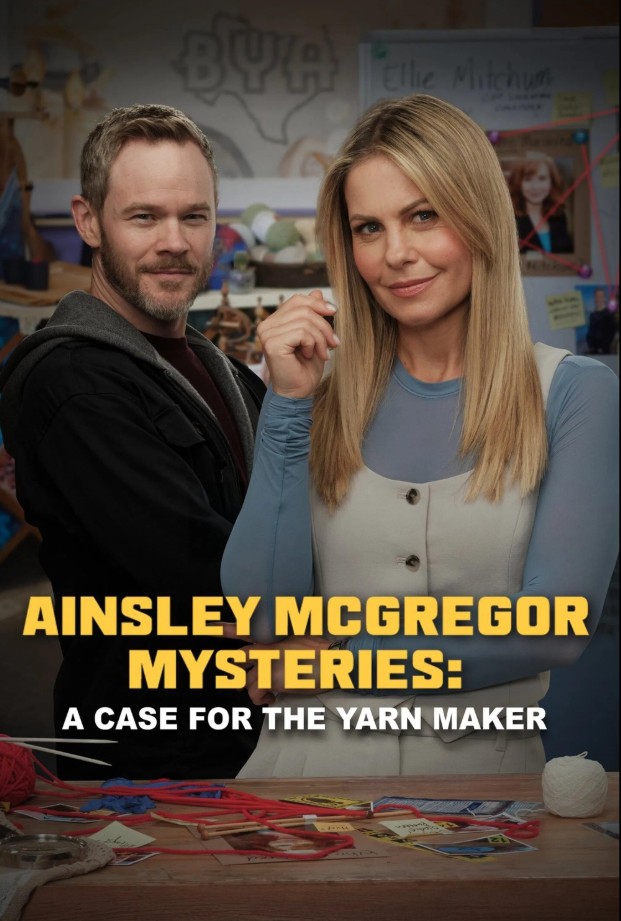
Last year, I reviewed Ainsley McGregor Mysteries: A Case for the Winemaker. At the time, I knew there would be people interested in the film, as Great American Family has found its audience over the past few years. But I was shocked by how popular that review became. In a year’s time, my review of Ainsley McGregor Mysteries: A Case for the Winemaker has garnered over 6,000 views and counting! When I learned a sequel was on the horizon, I immediately made plans to write about it. Now that review has come to fruition, as I have recently seen Ainsley McGregor Mysteries: A Case for the Yarn Maker! In my review of Ainsley McGregor Mysteries: A Case for the Winemaker, I said it looked like this series had the potential to tell many more stories. From exploring another artisan avenue to progressing Ainsley and Jake’s relationship, the sequel proved my statement right. But how does it compare to its predecessor? Keep reading my review to solve this mystery!
The chemistry among the cast: If you’re creating a book, tv, or movie series, it’s important to maintain chemistry among the characters. If this chemistry is believable, interactions and relationships between characters become more enjoyable to watch unfold. A lot of the same cast members from Ainsley McGregor Mysteries: A Case for the Winemaker returned in the sequel. That worked in Ainsley McGregor Mysteries: A Case for the Yarn Maker’s favor! The chemistry among the cast was so strong, it not only made every situation between the characters feel realistic, it also made their connections seem genuine! One of the best examples is the friendship of Jake and Ryan. Ainsley’s brother, Ryan, carries a serious, “business comes first” attitude due to being a police officer. Meanwhile, Jake’s personality is laid-back and a bit sillier. These characters’ differences allowed their friendship to be complimentary, especially when it came to Jake and Ryan’s comedic timing. This friendship was, honestly, one of the best parts of Ainsley McGregor Mysteries: A Case for the Yarn Maker!
Inclusion of humor: As I watched Ainsley McGregor Mysteries: A Case for the Yarn Maker, I took note of how the film’s creative team improved upon the flaws of the previous movie. One of those improvements was the inclusion of humor. Sprinkled throughout the story, humor was woven into the dialogue. How this humor was written and delivered prevented the story from becoming too dark. One great example is when Gladys, one of the members of the “book club”, is being questioned by the police. Because Gladys knew Ellie Mitchum (the murder victim), she is considered a potential suspect. During her interrogation, the police ask Gladys if she was aware of any allergies Ellie might have had, as allergies are ruled as a likely cause of death. In a sassy yet matter-of-fact way, Gladys tells the police, “She was allergic to being a nice person”. To me, this was one of the funniest lines in the movie, as it was a great comeback to the question!
Ellie Mitchum’s house: Ellie Mitchum is a successful businesswoman who visits her former school in Sweet River, Texas. But, unfortunately, she becomes the murder victim in Ainsley McGregor Mysteries: A Case for the Yarn Maker. Ellie’s funeral reception takes place at her house, where Ainsley, Jake, and Ryan attend. While not much of the house’s exterior is shown, it did contain an impressive stone porte-cochère (covered entryway). That entryway made the house look like a castle. One of the interior spaces presented in the movie was the foyer. This space was circular, featuring intricately designed stained-glass windows, stone railings with carved designs, and a deep cherry-stained wood floor under an ornate rug. Even the house’s deck, though only shown in one scene, had a stone arch framing a beautiful view of the luscious green backyard and what appeared to be a lake. I wish more scenes had taken place at Ellie Mitchum’s house, as it was so gorgeous.
Heart of yarn image create by macrovector at freepik.com.
What I didn’t like about the film:
Learning very little about the protagonist: In the second movie of a film series, the project’s creative team can present more information to help the audience learn more about the protagonist. Whether in the form of dialogue or flashbacks, this information can expand the protagonist’s backstory, give them extra motivation to solve a problem, or provide an overarching component of a story. But in Ainsley McGregor Mysteries: A Case for the Yarn Maker, very little new information was revealed about Ainsley McGregor herself. While her reason for leaving Chicago was given, Ainsley didn’t share this until almost an hour into the movie. That means the audience had to wait a long time to learn anything new about the titular character. Had more information been provided about Ainsley, the story would have become a bit more enriched.
Not enough George: When I reviewed Ainsley McGregor Mysteries: A Case for the Winemaker, I talked about how much I liked Ainsley’s dog, George. He played a larger role in the first movie, giving that film a more unique identity. While watching the sequel, Ainsley McGregor Mysteries: A Case for the Yarn Maker, I noticed George’s screen-time was reduced. Though I recognize how difficult it can be to incorporate an animal into a film production, I was disappointed by this creative decision. In my opinion, George steals every scene he’s in. Plus, times when Ainsley talks with George give the audience light-hearted moments that take a break from the heaviness of the murder mystery. Without George, the Ainsley McGregor Mysteries series wouldn’t be the same.
Limited time spent with the “book club”: I mentioned in my Ainsley McGregor Mysteries: A Case for the Winemaker review how Ainsley’s book club turns into an investigation club. The dynamic shared between Ainsley and these members is what encourages her to solve the mystery in the first film. Even though the “book club” still holds their meetings in Ainsley McGregor Mysteries: A Case for the Yarn Maker, Ainsley didn’t consult with them as much as she did in the first movie. In fact, there were only two scenes where a “book club” meeting was featured. In the sequel, Ainsley relied more on Ryan and Jake to help her solve the case. I hope Ainsley finds a balance between turning toward Jake and Ryan and discussing the mystery with the “book club” in future films, as each perspective makes a positive impact on the story.
In some film series, the second chapter is better than the first one. Ainsley McGregor Mysteries: A Case for the Yarn Maker is a movie where that statement holds true! The sequel improved upon some of the flaws of its predecessor, such as including humor. Strong chemistry among the cast has become a consistent strength of this series, with Jake and Ryan’s friendship being one of the best parts of chapter two. While I won’t spoil the second film, I will say I liked how there were no obvious choices for the mystery’s culprit. That creative decision leaves the audience guessing whodunit. Though I liked Ainsley McGregor Mysteries: A Case for the Yarn Maker more than the first chapter, there is still room to grow. I wish the sequel gave the audience more information about Ainsley and showed George in a few more scenes. This film series is based on a book series, with one of those books titled A Case for the Toy Maker. Perhaps we could get a Christmas mystery movie from Great American Family?
Overall score: 7 out of 10
Have you seen Ainsley McGregor Mysteries: A Case for the Yarn Maker? Would you like to see Great American Family create a Christmas mystery movie? Let me know in the comment section!
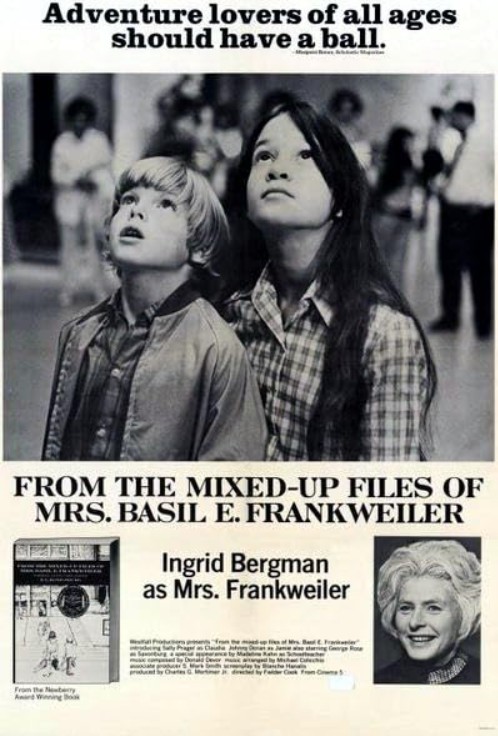
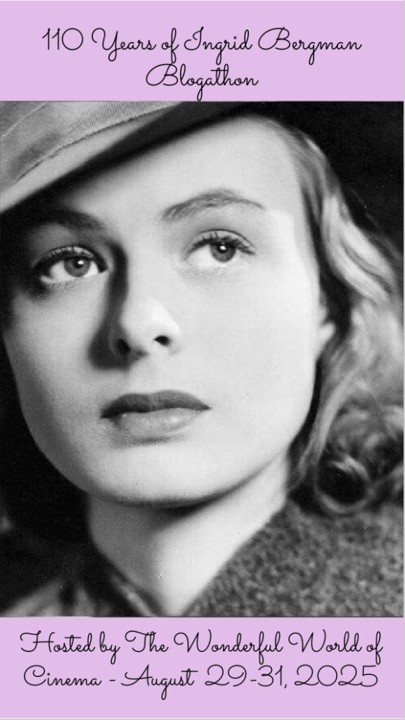
All the way back in 2019, I reviewed the 1995 adaptation of From the Mixed-Up Files of Mrs. Basil E. Frankweiler. After I shared my thoughts on the film, Gill, from Realweegiemidget Reviews, recommended the 1973 adaptation, which is sometimes titled The Hideaways. Whenever Virginie, from The Wonderful World of Cinema, has hosted the Ingrid Bergman Blogathon, I have wanted to check out the 1973 adaptation, due to Ingrid Bergman starring in the film. Now, for the 110 Years of Ingrid Bergman Blogathon, I finally received the opportunity to write about the movie! While I still haven’t read the book, I am familiar with the story because I covered the 1995 adaptation on 18 Cinema Lane. Back in 2019, I said the film was just ok, as one of my biggest criticisms was the underutilization of Lauren Bacall’s acting talents. Will I give similar criticisms to the 1973 adaptation of From the Mixed-Up Files of Mrs. Basil E. Frankweiler? To solve this mystery, keep reading my review!
Sally Prager’s and Johnny Doran’s acting performance: Starring in From the Mixed-Up Files of Mrs. Basil E. Frankweiler as the protagonists, Claudia and Jamie Kincaid, Sally Prager and Johnny Doran carry about 95% of the film. Because of how strong their performances were, they successfully carried the movie by presenting their characters believably! One example takes place toward the beginning of the film. Jamie is telling his sister, Claudia, about a movie he had recently seen. As he talks about the movie, his speech becomes increasingly animated. Even after Claudia kicks him out of her room, Jamie talks even louder, his excitement never faltering. After Jamie and Claudia arrive in New York City, they go to the Metropolitan Museum of Art. When Jamie asks her why she wants to go to the museum, Claudia enthusiastically describes the museum as a castle like the tales of King Arthur. This scene perfectly showcases how Sally effectively portrayed Claudia as precocious; containing enough self-awareness to know exactly what she wants, yet displaying that sense of wonder one would expect from a child her age.
The cinematography: When I reviewed the 1995 adaptation of From the Mixed-Up Files of Mrs. Basil E. Frankweiler, I complimented the film’s cinematography. That adaptation’s creative team made some interesting choices when presenting certain scenes, like using close-ups to present the museum’s artifacts. The 1973 adaptation of From the Mixed-Up Files of Mrs. Basil E. Frankweiler features good cinematography as well! Similar to the 1995 adaptation, some scenes were shown from Claudia and Jamie’s perspective. While hiding on the school bus, Jamie constantly peeks from behind the seat to see if the bus driver has spotted them. A few shots look like they’re from Jamie’s point of view, with the camera peering around the seat to catch a glimpse of the bus driver. When Jamie and Claudia are at the Metropolitan Museum of Art, they look over the railing at the museum’s employees and security guards in the lobby. Once again, the scene is presented from the point of view of the children. The camera peers over the museum’s railing, looking down at the security guards and employees. Shots like the ones I described make the audience feel like they’re with the characters, creating the illusion of immersion.
The dialogue: A pleasant surprise in 1973’s From the Mixed-Up Files of Mrs. Basil E. Frankweiler was the dialogue! Some lines were so well-written, they became a memorable part of the movie. In one scene, as Jamie navigates through the museum, a janitor asks him where he came from. Speaking confidently in a matter-of-fact way, Jamie tells the janitor, “My mother said I came from Heaven”. I not only found this response a clever comeback, it was also a creative way to answer the question. Another scene shows Jamie sharing with Claudia one of the reasons why he ran away with her. While spending a night in the museum, Jamie tells his sister how concerned he was by the thought of her traveling alone, as he believed she would be afraid. Claudia responds to her brother’s belief by saying, “Being self-sufficient doesn’t automatically make a person brave”. This quote showcases an eloquent way of addressing how anyone at any age can be afraid of something.
Angelic statue image created by Marcelo Gerpe at freeimages.com. “FreeImages.com/Marcelo Gerpe.”
What I didn’t like about the film:
Telling instead of showing: In both adaptations of From the Mixed-Up Files of Mrs. Basil E. Frankweiler, Jamie and Claudia go to Mrs. Basil E. Frankweiler’s house, searching for an angel statue’s legitimacy. From what I remember of the 1995 movie, a scene shows Claudia and Jamie looking for answers about the statue by rummaging through Mrs. Basil E. Frankweiler’s mixed-up files. The 1973 version, on the other hand, has Mrs. Basil E. Frankweiler telling the answer of the mystery instead of showing the children putting the mystery’s pieces together. Because the creative team behind the 1973 adaptation chose telling over showing, some of the excitement of seeing the protagonists achieve their goal was taken away.
Less emphasis on the mystery: An overarching part of From the Mixed-Up Files of Mrs. Basil E. Frankweiler’s story is the mystery surrounding an angelic statue. However, this mystery received less emphasis in both the 1973 and 1995 adaptations. Specifically speaking about the 1973 version, the story focused more on Claudia and Jamie’s adventures in New York City. In fact, the angel statue doesn’t make an appearance until 44 minutes in an hour and forty-five-minute film. Like I said in my review of the 1995 version, this creative decision took a lot of intrigue out of the film, causing the story not to be as engaging or interactive.
The underutilization of Ingrid Bergman: During this review’s introduction, I brought up one of my biggest criticisms of 1995’s From the Mixed-Up Files of Mrs. Basil E. Frankweiler; the underutilization of Lauren Bacall’s acting talents. Sadly, I have the same criticism for the 1973 version. Just like the 1995 adaptation, Ingrid Bergman is the top-billed actor in the adaptation from 1973. Yet she doesn’t appear in the story until an hour and fourteen minutes in an hour and forty-five-minute movie. I recognize the 1973 version of From the Mixed-Up Files of Mrs. Basil E. Frankweiler premiered toward the end of Ingrid’s career. I also acknowledge the story prioritizes the adventures of Claudia and Jamie Kincaid. But as I said about Lauren Bacall in my review of the 1995 movie, this underutilization not only does Ingrid’s acting talents a disservice, it also comes across as misleading.
For the 5th Annual Gold Sally Awards, I introduced the Nosferatu vs. Dracula Award. This award is given to two movies that feel like you’re watching the same one. Looking back on my experience watching the 1973 adaptation of From the Mixed-Up Files of Mrs. Basil E. Frankweiler and reflecting on my review of the 1995 adaptation, the Nosferatu vs. Dracula Award will likely be brought back for 2026’s edition of the Gold Sally Awards. The 1973 movie shares a lot of the same strengths and flaws as the 1995 version. These similarities made me feel like I was watching the same film twice. I knew what to expect from the story, due to seeing From the Mixed-Up Files of Mrs. Basil E. Frankweiler from 1995. However, I still wish both adaptations contained stronger differentiations between them. The films I’ve seen of Ingrid Bergman’s from the 1970s have, in my opinion, been underwhelming. While I found A Walk in the Spring Rain a flavorless picture, I think A Matter of Time and now From the Mixed-Up Files of Mrs. Basil E. Frankweiler are just ok.
Overall score: 6 out of 10
Have you seen 1973’s From the Mixed-Up Files of Mrs. Basil E. Frankweiler? Which book adaptation do you wish starred a “classic” film star? Tell me in the comment section!












 18 Cinema Lane