
You probably think it’s strange how, after a week and a half long hiatus, my first review back on my blog would be for a Christmas film (in the middle of August). However, I have a very good explanation for this choice. The first reason is how the 1967 animated movie, Cricket on the Hearth, is what I selected for Realweegiemidget Reviews’ (Aaron) Spellingverse Blogathon, as Aaron Spelling was one of the film’s executive producers. The second reason is how animated movies are reviewed so infrequently on my blog. In fact, Cricket on the Hearth is the first animated film to be reviewed on 18 Cinema Lane in 2024. When I chose to participate in the (Aaron) Spellingverse Blogathon, I knew I wanted to write about a made-for-tv movie. So, when I discovered the 1967 film on Aaron’s IMDB filmography, I felt I found the perfect movie for the blogathon, especially for the previously mentioned reasons! But did Cricket on the Hearth end up being the perfect choice to write about? Keep reading my review to find out!
Things I liked about the film:
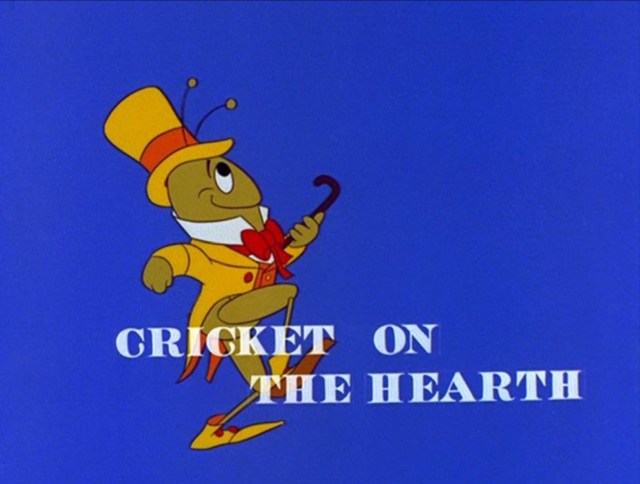
The animation: Some of the best animated movies boast bright, colorful hues. These hues can be utilized in various ways, from creating imaginative worlds to providing interesting visual contrasts. Cricket on the Hearth was a very kaleidoscopic production! Scenes either burst with a bundle of color or at least one bold color sparkled against a darker background. Presenting Cricket Crocket in a mustard yellow suit jacket and shoes, paired with an orange vest and a red bowtie, was a smart creative decision. It forces the audience to focus on Cricket Crocket, especially when he’s standing on a dark wood table or a deep green top hat. The toys in Caleb’s toy shop come to life during the song, ‘Smiles Go With Tears’. Despite the title’s contraction, the song’s tone is joyful because the song is about someone shedding tears due to being happy. The joyful nature of ‘Smiles Go With Tears’ is wonderfully depicted in the presentation of the toys. From a doll’s bubble-gum pink dress and bonnet to a pair of bright yellow and blue elephants, this scene was great to look at!
While looking for a place to live, Caleb considers moving into a poor house. Because Cricket Crocket is perched on Caleb’s top hat, Cricket Crocket hangs upside down in order to face Caleb. While looking upside down, Cricket Crocket sees a nearby toy factory. As he is readjusting himself, the image of the toy factory flips from appearing upside down to becoming right-side up. Animated films from the 1960s, especially those that were made-for-tv productions, were created with limited resources compared to animated pictures from the twenty-first century. Therefore, scenes like the one I just described seem ahead of its time.
The songs: Before reviewing Cricket on the Hearth, I had never seen the 1967 movie. So, I was pleasantly surprised when I discovered the movie was a musical! The songs featured in this film sounded like relics of the late ‘60s, the time when Cricket on the Hearth was released. But these sounds, from emotional ballads to cheery tunes, felt nostalgic. Danny Thomas, who voices Caleb, sings a ballad titled ‘Through My Eyes’. Throughout this song, Caleb expresses his desire for his daughter, Bertha, to see the world how he wishes he could present it to her. The combination of Danny’s vocals and the orchestral music felt reminiscent of Judy Garland’s ‘Somewhere Over the Rainbow’ and Louis Armstrong’s ‘What a Wonderful World’, songs that exude a sense of hope and contain timeless elements. Another song of Danny’s I liked was ‘The First Christmas’! Before this song, Caleb wonders how he will provide the kind of Christmas Bertha hopes for. He learns how to resolve his conflict as the song carries on. The lyrics of ‘The First Christmas’ illustrate how Christmas doesn’t have to look the same for those who celebrate the holiday. The inclusion of the Norman Luboff Chorus added gravitas to this song!
The religious aspects of Christmas: Based on what I know about Charles Dickens and his stories, A Christmas Carol, one of his most well-known pieces of literature, is typically not known for addressing the religious aspects of Christmas. Though it was briefly incorporated in Cricket on the Hearth, I was pleasantly surprised by the recognition of Christmas’ religious aspects! As I previously said while talking about ‘The First Christmas’, the lyrics of the song illustrate how Christmas doesn’t have to look the same for those who celebrate the holiday. This point is emphasized by reminding the audience how Jesus had very little in terms of decorations and presents during the First Christmas. By the end of the song, the message is made clear; it’s not about what you have, but who you spend Christmas with that’s important. Before closing out the movie, Danny quotes a poem by Edmund Cooke. The quote itself goes “Tis not the weight of jewel or plate, or the fondle of silk or fur, ‘tis the spirit in which the gift is rich, as the gifts of the Wise Men were. And we are not told whose gift was gold or whose was the gift of myrrh”. Edmund’s poem brings up an excellent point, as the Nativity story does not specify which gift came from which Wise Man. This quote also highlights the point made earlier about Christmas being about who you spend the holiday with.
What I didn’t like about the film:
Scenes that serve as padding: In order to satisfy a film’s run-time, a film’s creative team will, sometimes, choose to pad the story out by incorporating additional scenes or establishing shots. This creative decision was utilized in Cricket on the Hearth, mostly in between songs. During the song, ‘Through My Eyes’, a scene of Bertha dancing in a ballgown lasts for almost thirty seconds. The song itself takes up two minutes and twenty-three seconds of the movie’s run-time. I don’t think Cricket on the Hearth needed padding, especially since it lasted a little over forty-nine minutes.
The randomness of the ‘Fish and Chips’ song: I liked the featured songs in Cricket on the Hearth. However, there is one song that, in the context of the story, felt random. A cat named Moll, voiced by Abbe Lane, sings a song about the finer things in life called ‘Fish and Chips’. This song is sung to a jazzy, ragtime tune. During the performance, Moll dances in a red, low-cut, sleeveless dress and even attempts to flirt with the male characters in her audience. The animation in this scene didn’t look bad. Abbe Lane also did a good job with the material given to her. But the story appearing to take place somewhere in the 1800s and with the movie’s tone being mostly heartwarmingly gentle, Moll’s ‘Fish and Chips’ song feels out of place in Cricket on the Hearth.
Parts of the story that don’t make sense: For this part of my review, I will spoil Cricket on the Hearth. If you have not seen the 1967 film and are interested in watching it, please skip ahead to the part of my review titled ‘My overall impression’.
Cricket on the Hearth’s antagonist, Tackleton, has a pet bird named Uriah. More often than not, Tackleton and Uriah are inseparable. After Tackleton orders Uriah to get rid of Cricket Crocket, Uriah and two of his friends kidnap Cricket Crocket and try to sell him to a sea captain. During the scene of Uriah’s attempted business transaction, it is heavily implied Uriah and his friends died. Fast forward toward the end of the movie, Tackleton is upset by Bertha’s rejection of his marriage proposal. In fact, he’s more upset about Bertha’s rejection than the absence of his bird. If Tackleton and Uriah were as inseparable as they appeared to be earlier in the movie, wouldn’t Tackleton wonder what happened to Uriah? Wouldn’t Tackleton ask the other characters if they know where Uriah is? This is just one part of Cricket on the Hearth that, to me, didn’t make sense.

My overall impression:
As I watched Cricket on the Hearth, I was reminded of The Best Christmas Pageant Ever, the 1983 Christmas movie I reviewed last December. Both films are not only made-for-tv productions, they both feel more like television specials than movies. It’s expected to suspend some disbelief in stories from animated films. But Cricket on the Hearth tried to suspend disbelief to the point parts of the story didn’t make sense. Despite the movie being under an hour long, some scenes, including those in between songs, served as unnecessary padding. Throughout Cricket on the Hearth, however, I could tell the movie’s creative team tried their best to make their project as special as possible. The songs were not only well performed, the music and visuals provided a good combination for the song itself. Though briefly incorporated, I also liked the recognition of Christmas’ religious aspects. I have not read Cricket on the Hearth’s source material. But based on what I know about Charles Dickens’ work, this story seems different from his other adaptations, as Cricket on the Hearth relies more on elements of fantasy and magical realism.
Overall score: 6.5 out of 10
Have you seen or read Cricket on the Hearth? Which adaptation of Charles Dickens’ stories would you like to see me review? Please tell me in the comment section!
Have fun at the movies!
Sally Silverscreen
 18 Cinema Lane