Take 3: The Innocents (1961) Review

Film recommendations from my readers are welcomed here at 18 Cinema Lane. These suggestions are then placed on a Pinterest board, which I use as a reference for upcoming reviews. Some movies have been on the board for so long, they’re at the very bottom. One of these titles is 1961’s The Innocents. Recommended by Maddy (from Maddy Loves Her Classic Films), this is a Deborah Kerr starring production that is quite different from the other projects of hers I’ve reviewed on my blog. That’s because The Innocents is classified as a horror film. Because of this distinct, I’ve been trying to find the right opportunity to talk about the movie. Hoofers and Honeys’ 4th Annual Spooky Classic Movie Blogathon became that opportunity! Deborah’s films covered on 18 Cinema Lane have fluctuated in quality. While I liked titles like The Chalk Garden and The King and I, I wasn’t a fan of Marriage on the Rocks. What will my opinion be of The Innocents? Keep reading my review to find out!

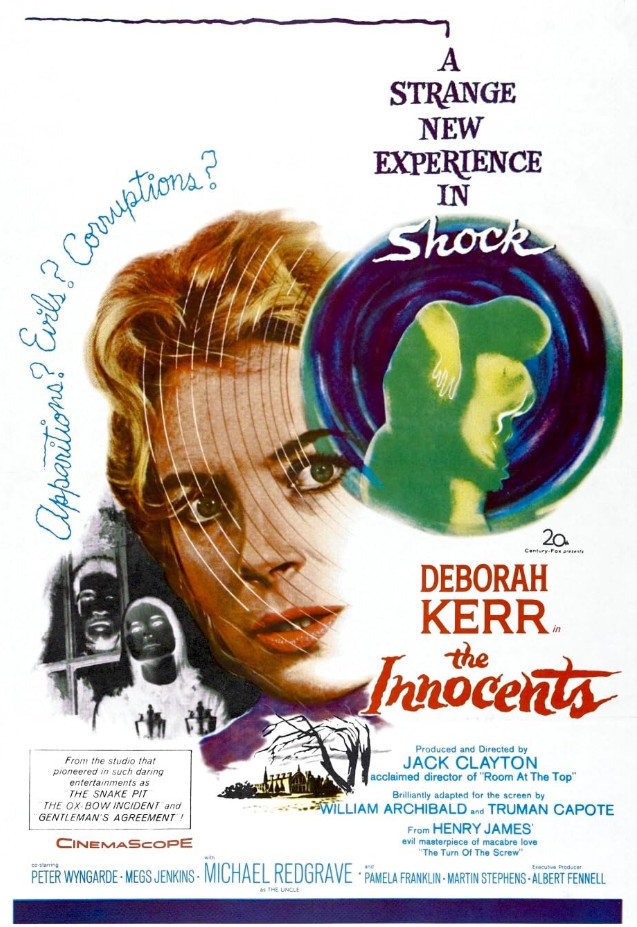
The Innocents (1961) poster created by Achilles, Flair Communications, Twentieth Century Fox, and Twentieth Century Fox Film Company

Things I liked about the film:

The acting: A large portion of The Innocents prominently features two young characters: Miles and Flora, as Deborah’s character, Miss Giddens, believes they are in danger. In stories like this, where younger characters play a significant role, it’s important to cast actors and actresses that can, acting wise, carry some of the film. Flora reminded me somewhat of Eloise (from the 2003 adaptations, Eloise at the Plaza and Eloise at Christmastime), marching to the beat of her own drum with a bit of a mischievous spirit. Meanwhile, Miles possessed the precociousness of Cedric from Little Lord Fauntleroy and the sweetness of Tiny Tim from A Christmas Carol. These concepts were displayed well through Pamela Franklin’s and Martin Stephens’ performance! Vocal inflections, facial expressions, and even body language worked in their favor, making Miles and Flora captivating characters. Because of Martin’s and Pamela’s acting talents, their convincing portrayals kept me invested in their characters’ story!

As I mentioned before, Deborah Kerr portrays Miss Giddens, who becomes Flora and Miles’ new governess. Looking back on her films, including The Innocents, I’ve noticed how expressive Deborah’s performances have been. Specifically speaking about the 1961 film, Deborah uses her eyes to display thoughts and feelings instead of just relying on dialogue. In one scene, Miss Giddens learns the truth about Miss Jessel and Peter Quint, the governess and valet who worked at the estate before Miss Giddens’ arrival. While she discovers this information from a housekeeper named Mrs. Grose, Miss Giddens’ eyes show concern, sadness, and even fear. She also raises her eyebrows from time to time, emphasizing how shocking the information about Peter Quint and Miss Jessel is. This example of Deborah’s expressiveness elaborates Miss Giddens adapting to the strange things she’s been seeing and hearing during her time at the estate. Similar to Martin’s and Pamela’s performance, Deborah’s portrayal of Miss Giddens was convincing!

The set design: The Innocents mostly takes place at the Bly estate, which belongs to Flora and Miles’ uncle. Though this story was character-driven, the set design was an underrated yet impressive component of the movie. The fireplace in the main sitting room appeared marble with a carved design. Each room features tall windows, implying the large scope of the rooms themselves. Though shown during brief moments, a detailed tapestry hung on a wall near the main stairway. Elaborate tapestry even covered a long seat in one of the rooms. Details like the ones I described emphasized how financially well-off Miles and Flora’s family is. They also helped make Bly estate visually appealing!

Mise-en-scène: In my recent review of 2010’s Let Me In, I talked about how the movie’s mise-en- scène (the way a film’s scene is presented to the audience) was one of the strengths of the movie. This was also a strength in The Innocents, as some scenes’ presentation added intrigue to the story! One evening, Miles confesses to Miss Giddens how his uncle doesn’t have time for him and his sister. At first, the conversation is shown in a medium shot. The very next shot is a close-up of Miles’ face, with light shining on his cheek to reveal a tear rolling down. Through this visual presentation, the audience is told how his uncle’s lack of acknowledgement deeply troubles Miles. It also provides possible motivation for Miles’ actions later in the film.

The 4th Annual Spooky Classic Movie Blogathon banner created by Kristen from Hoofers and Honeys

What I didn’t like about the film:

Limited horror elements: I mentioned in my review’s introduction how The Innocents is classified as a horror film. Because of this classification, I expected the script to emphasize the horror elements within the story. But these elements, like potential ghost sightings and unexplained noises, had such a limited presence in the film, they were featured in “don’t blink or you’ll miss it” moments. In fact, the script placed more emphasis on the “slice-of-life” parts of the story. As a movie blogger who doesn’t review horror movies often, I found this creative decision disappointing. Some of my interest in The Innocents waned because I don’t really find “slice-of-life” stories compelling.

Scenes that feel like padding: One evening at Bly estate, Miss Giddens stays up in the middle of the night in order to discover the cause of the strange happenings throughout the home. The majority of the scene takes place in the upstairs hallway. But the overall scene lasts over five minutes. Moments when Miss Giddens attempts to open doors and walks through the hall seem repetitive due the how long the scene is. With The Innocents having a run-time of an hour and thirty-nine minutes, some of those five minutes could have been trimmed to make the movie about an hour and thirty-four minutes. This is just one example of scenes feeling like padding.

Conclusion with little to no evidence: For this part of my review, I will spoil The Innocents. If you haven’t seen this movie and are planning on watching it, skip ahead to the part of my review titled “My overall impression”.

After witnessing what she believes is the ghost of Miss Jessel, Miss Giddens comes to the conclusion Flora and Miles are possessed by the spirits of Miss Jessel and Peter Quint. She even comes up with a plan to make the children admit this is true. But up until that point, the film doesn’t show how Miss Giddens reaches her conclusion. Little to no evidence is presented, denying the audience an opportunity to see Miss Giddens putting the pieces together. I, personally, couldn’t take her conclusion too seriously because of the lack of evidence. Miss Giddens’ weaker conclusion also added confusion to the overall story, leaving me wondering what I had just watched.

Image of ghost reading created by Freepik at freepik.com. <a href=”https://www.freepik.com/free-photos-vectors/book”>Book photo created by freepik – http://www.freepik.com</a>. Image found at freepik.com.

My overall impression:

I’m going to be brutally honest, The Innocents is one of the most confusing movies I’ve ever covered on 18 Cinema Lane. When the film ended, I audibly said, “What the heck did I just watch”? Without spoiling The Innocents, all I’ll say is I recognize how the movie’s creative team tried to give their project an ambiguous ending. But when the 1961 picture is also classified as a mystery film, that type of ending doesn’t work due to the genre being known for reaching definitive resolutions. Another flaw that contributes to The Innocents’ confusion is a conclusion with little to no evidence. That lack of evidence prevented me from taking the conclusion too seriously. Despite this confusion, the movie was intriguing enough to keep me invested in the story. The strength of the acting performances and the mise-en-scène are two factors that worked in the film’s favor. Out of Deborah’s films reviewed on 18 Cinema Lane, The Innocents was just ok. While there are things about the movie I liked, the overall execution could have (and should have) been stronger.

Overall score: 6.5 out of 10

Have you seen 1961’s The Innocents? What “classic” horror movies do you like watching? Let me know in the comment section!

Have fun at the movies!

Sally Silverscreen

Take 3: Susannah of the Mounties Review + 465 Follower Thank You

When it comes time for movie reviews, I try to select titles that will either encourage my readers to check them out for the first time or give my readers a reason to re-visit them. I also select titles in the hopes they are good films. While looking for a movie for this Blog Follower Dedication Review, I realized I hadn’t written about a Shirley Temple film since 2019. Because of that and with When Calls the Heart’s tenth season on the horizon, I felt Susannah of the Mounties was a suitable choice for this review! Anytime I think of Shirley’s movies, her musicals typically come to mind. Susannah of the Mounties is a different production from her filmography, as the 1939 film is a western. On 18 Cinema Lane, the western genre is underappreciated. Though I do try to review a western movie every now and then, I haven’t written about a western film since February, when I reviewed The White Buffalo. As I write this Blog Follower Dedication Review, I want to thank every follower of 18 Cinema Lane! Your enthusiasm for these movie reviews is always appreciated!

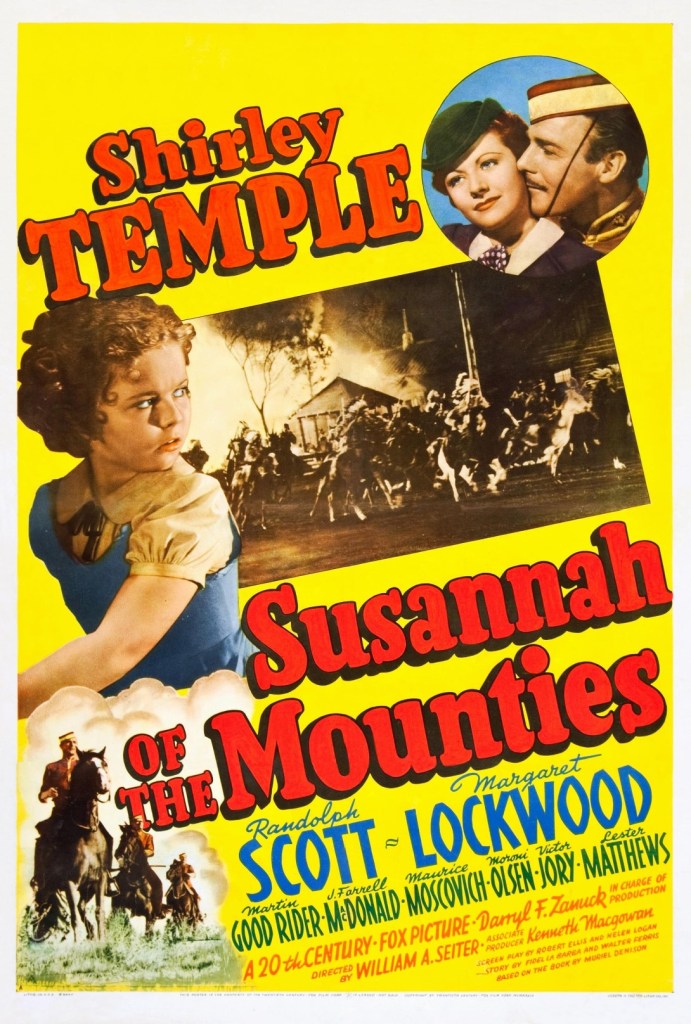
Susannah of the Mounties poster created by Twentieth Century Fox

Things I like about the film:

The acting: Out of Shirley’s movies I’ve seen, including Susannah of the Mounties, I recall her performances containing a certain amount of genuine sincerity. This aspect makes Shirley’s characters worthy of support from the audience. At the beginning of the movie, the Mounties discover Susannah is the only survivor of an attack on a wagon camp. She is understandably terrified, shrinking away from the Mounties in order to get away from them. Susannah is tearfully telling the Mounties to leave her alone, as her grandfather died during the attack. Through this portrayal, the heartbreak and fear Susannah experiences can be seen and heard. Her reaction to the Mounties’ encounter visually represents how a child might respond to a traumatic situation. With everything said, the audience is given a reason to feel sympathetic toward the film’s protagonist.

Randolph Scott portrays Inspector Angus “Monty” Montague, one of the Mounties who rescues Susannah. Throughout the story, he serves as Susannah’s father figure, teaching her good values and trying to protect her from danger. In one of the film’s funniest scenes, Monty and Susannah are eating breakfast. During breakfast, Susannah doesn’t hesitate to ask if he’ll marry Vicky, a woman who is temporarily staying at Monty’s Mountie camp. Snapping to attention, Monty gives Susannah a startled expression, his reaction to Susannah’s question on point for the situation. This scene serves as a good example of how Randolph’s performance never missed a beat!

Another performance that didn’t miss a beat was Martin Good Rider’s! Portraying Little Chief, son of Chief Big Eagle, Martin’s performance was consistent throughout the movie. During his time in the Mountie camp, Little Chief carries himself with a serious demeanor. Any time he explained an aspect of his culture to Susannah, his tone of voice and facial expression are stern. However, Little Chief does express happiness from time to time. When he is calling Susannah a baby in his language, he is smiling and even giggling at Susannah’s frustrations over not knowing how to ride a pony. One of the reasons why I liked seeing Little Chief and Susannah’s friendship progress in this story is because of Martin’s and Shirley’s performance!

The cinematography: In Susannah of the Mounties, there were three shots I thought were captured very well through a cinematic lens. One morning, as the British flag is raised over the Mountie camp, a Mountie is shown, through a medium shot, standing on the balcony of a nearby log cabin. As the flag rises in the air, its shadow is reflected off the cabin and even the Mountie himself. Another scene shows Susannah smoking a pipe for the first time. When she is looking out on the Mountie camp, the shot of the camp is captured through a fuzzy, uneven lens. This creative decision was made to show this location from Susannah’s perspective, as she is light-headed after smoking the pipe. Later in the movie, some members of the Blackfoot tribe are horseback riding near a body of water. While riding during dusk, a blue-purple sky and a large, white-gray mountain are in the scene’s background. In a sweeping long shot, the riders are reflected against the mirror stillness of the water. These details allowed this scene to be the most beautiful one in the movie!

Messages of fairness and learning from one another: After meeting Little Chief for the first time, Susannah becomes frustrated by the way he treats her. She doesn’t think she and Little Chief could be friends. But during a heart-to-heart conversation, Monty explains to Susannah how the Mounties try to learn from Little Chief’s Blackfoot tribe in order to work with them. Before Little Chief stays at the Mountie camp, the Mounties and his Blackfoot tribe attempt to find a solution to the film’s overarching conflict. During this meeting, the Mountie’s Superintendent, Andrew Standing, makes it clear that the Mounties are not blaming Chief Big Eagle’s tribe for the crimes committed near the Mountie camp. Andrew explains how the Mounties are turning to Chief Big Eagle’s tribe for help catching the perpetrator. Susannah of the Mounties was released in the late 1930’s, with a story taking place in the 1880s. Therefore, I was not expecting the inclusion of timeless messages such as fairness and learning from one another.

Mountie face image created by Bakar015 at freepik.com. <a href=’https://www.freepik.com/free-vector/a-set-of-canada-icons_1050671.htm’>Designed by Freepik</a>. <a href=”https://www.freepik.com/free-photos-vectors/food”>Food vector created by Bakar015 – Freepik.com</a>. Image found at freepik.com.

What I didn’t like about the film:

Susannah’s dislike for Vicky: Vicky Standing is a woman who visits her father at his Mountie camp. Portrayed by Margaret Lockwood, she ends up capturing Monty’s heart. Susannah does not like the idea of Monty and Vicky falling in love. In fact, Susannah dislikes Vicky so much, she wants Vicky to go back home to Toronto. Susannah’s negativity toward Vicky felt out of character for a Shirley Temple film. When a male and female parental figure are romantically interested in each other, Shirley’s character will typically find a way for those characters to fall in love. Her character does this in an attempt to gain a family for her to belong to. Because Susannah is an orphan, it would have made more sense for her to want Monty and Vicky to become a couple, in the hopes they will get married and adopt Susannah.

A disjointed story: An overarching story in Susannah of the Mounties is the Mounties figuring out who is murdering and looting near their camp. They work with a local Blackfoot tribe in their efforts to catch the perpetrator. This part of the story is serious, complicated, and even violent. With Susannah being one of the few children in the story, the film’s protagonist isn’t able to provide much assistance to the Mounties. Instead, Susannah spends her time befriending Little Chief, Chief Big Eagle’s son. Susannah’s story and the Mountie’s story felt like two separate stories that belonged in their own movies. The contrasting tones of these stories kind of made the film feel tonally inconsistent.

A misleading title: As I just mentioned in this review, Susannah isn’t able to provide much assistance to the Mounties as they attempt to stop crime. This is because a) Susannah is a child and b) the Mountie’s story is serious and even violent at times. Yet this movie is titled Susannah of the Mounties, implying the protagonist and the Mounties would work together to save the day. I know the film is based on a novel of the same name by Muriel Denison. However, I still feel the title is misleading.

Canada postage stamp image created by Ibrandify at freepik.com <a href=’https://www.freepik.com/free-vector/canadian-flag-stamp-template_836872.htm’>Designed by Freepik</a> <a href=”https://www.freepik.com/free-photos-vectors/template”>Template vector created by Ibrandify – Freepik.com</a> Image found at freepik.com

My overall impression:

In the western genre, a component that is typically present is higher stakes. This is when a conflict is large enough in scope to affect the well-being of the characters. Susannah of the Mounties is a story with higher stakes, as the lives and careers of the characters are in danger. Because of this, it doesn’t give the movie’s protagonist, Susannah, much to do. In fact, Susannah’s story and the Mountie’s story feel like separate tales from their own films. When I look back on Shirley’s movies I liked, such as Rebecca of Sunnybrook Farm and Heidi, I think about what made those titles work. Then I remember how those stories had lower stakes, which allowed Shirley’s character to play a larger role in the story. I also reflect on other aspects of Susannah of the Mounties I didn’t like, such as the misleading title and Susannah’s dislike for Vicky. With everything I said in this review, I think this is one of Shirley’s weakest movies I’ve seen.

Overall score: 6.6 out of 10

Have you seen Susannah of the Mounties? Are there any western films you’d like to see me review? Let me know in the comment section!

Have fun at the movies!

Sally Silverscreen
Take 3: Charlie Chan at Treasure Island Review

‘Movies featuring beaches or waterfront scenes’ is March’s theme for Genre Grandeur. I could have selected a Hallmark title, but I chose a different film instead. This seems to be a recurring theme on 18 Cinema Lane this year. Back when I published my editorial, Oh, The Places She’ll Go: A Map of Esther Williams’ Travels, Paddy Lee suggested I check out Charlie Chan at Treasure Island. Since then, I’ve been trying to find the right time to watch the film. When I searched through my movie recommendation board on Pinterest, I knew it would be the perfect movie to write about for this month’s Genre Grandeur! Before Paddy Lee’s suggestion, I had never heard of the Charlie Chan series. From what I’ve gathered, this is a mystery series from the 1920s to the 1940s. A made for TV movie, The Return of Charlie Chan, was released in 1972 and the last movie in the series, Charlie Chan and the Curse of the Dragon Queen, premiered in 1981. Starting this journey in the middle of the series, it’s time to review Charlie Chan at Treasure Island!

Charlie Chan at Treasure Island poster created by Twentieth Century Fox

Things I liked about the film:

The acting: I’ve seen a handful of Cesar Romero’s projects from his filmography. Out of those projects, he has carried his character with charisma. In Charlie Chan at Treasure Island, Cesar portrayed a magician named Rhadini. Not only did Rhadini have the charisma I’ve come to expect from Cesar’s performances, he also contained a strong amount of showmanship you’d expect from a magician! Consistency worked in Cesar’s favor, with his performance appearing effortless. Another acting performance that came across as effortless was Victor Sen Yung’s! Portraying Charlie’s son, Jimmy, Victor gave his character a great on-screen personality. His expressions while interacting with other cast members wove together seamlessly. A great example is when Jimmy is helping Charlie get ready for a dinner party. As he is interacting with his father, Jimmy’s emotions transition from pride to confusion to determination without missing a beat! Despite appearing in the film for a limited amount of time, I liked Billie Seward’s portrayal of Bessie Sibley! She had great control over her character’s emotions, allowing her talents to go toe-to-toe with the talents of the other cast members.

The inclusion of magic: As I just mentioned in this review, Rhadini is a magician. He performs magic tricks on a few occasions within the story. These tricks range from a disappearing bird to a levitating table. There were even times when the secrets behind these tricks were revealed, showing the audience how the illusion was achieved. This was a pleasant surprise for me, as I didn’t expect any magic to be featured in the movie. Its inclusion in the story added a unique aspect to the film’s identity!

The humor: In past reviews, I’ve brought up how some mystery films have incorporated humor into their story, as humor gives the audience a break from the heaviness of the mystery itself. Honestly, I was surprised by the inclusion of humor in Charlie Chan at Treasure Island. This is because I was not expecting this aspect to be as strong as it was in the story. In Charlie Chan at Treasure Island, Jimmy was the comic relief. Some of the things he said were genuinely hilarious. During Rhadini’s magic show, Jimmy is recruited to participate in the levitating table trick. Horrified at the idea of being lifted off the ground, Jimmy tells his father, “Oh, but flying makes me seasick, Pop”.

Image of magic show essentials created by Macrovector at freepik.com. <a href=”https://www.freepik.com/free-photos-vectors/card”>Card vector created by macrovector – http://www.freepik.com</a>. Image found at freepik.com.

What I didn’t like about the film:

A misleading title: Charlie’s adventures in Treasure Island are the reason why I chose this movie for March’s Genre Grandeur. Because of the film’s title, I expected Charlie to primarily spend his time at the titular location. But when I watched the movie, I discovered that wasn’t the case. While there was an aerial shot of Treasure Island, not much time was spent there. In fact, the characters talked about Hawaii, specifically Honolulu, more than Treasure Island. With that said, it made me wonder why this movie didn’t take place in Hawaii?

Charlie’s outdated “quirk”: In my editorial, Why ‘Francesca Quinn, PI’ is the Worst Hallmark Movie I’ve Ever Seen, I talked about how fictional detectives have a “quirk”, something that sets a detective apart from other sleuths. Charlie Chan does have his own “quirk”. However, it seems very outdated. Throughout the story, Charlie speaks in proverbs. His speech also sounds like broken English. I know the 1930s was a different time compared to the 2020s. But these factors make Charlie’s “quirk” seem stereotypical.

A limited amount of urgency: The main mystery in Charlie Chan at Treasure Island is a murder mystery, as a guest on a plane mysteriously dies during the trip. Charlie and the San Francisco police department discover a series of deaths that took place around the time of the aforementioned murder. But most of the story focuses on the mystery of who “Dr. Zodiac” is, a physic who is ripping off his clients. This focus caused the overall story to have a limited amount of urgency.

Image of Hawaiian poster created by Freepik at freepik.com. <a href=”https://www.freepik.com/free-photos-vectors/poster”>Poster vector created by freepik – http://www.freepik.com</a>. Image found at freepik.com.

My overall impression:

As someone who actively seeks out programs from the mystery genre, I’m always looking for titles I can recommend to my readers. However, I am aware of how mystery films and shows are not created equally. Charlie Chan at Treasure Island was my introduction to the world of Charlie Chan. Unfortunately, this introduction was not as strong as it could have been. While there were aspects of the movie I liked, such as the acting and the humor, the story itself was weak. The misleading title made me wish the film had taken place in Hawaii. Charlie’s “quirk” also makes the story dated on arrival. I’m not sure if I’ll continue watching this series. Perhaps if a particular title fits a blogathon theme, then maybe I will check another film out.

Overall score: 6.7 out of 10

Have you seen any films from the Charlie Chan series? Are there mystery films you’d like to see reviewed on 18 Cinema Lane? Tell me in the comment section!

Have fun at the movies!

Sally Silverscreen
Take 3: Anna and the King Review

I know what you’re thinking, “What does Anna and the King have to do with the number five”? Well, I’m glad you asked! As Rebecca has stated in the announcement post for the Fifth Broadway Bound Blogathon, all entries had to have something to do with the number five, to commemorate the event’s fifth anniversary. For my selection, Anna and the King, which stars Bai Ling, was released in 1999, five years after The Crow premiered. From what I’ve heard, The Crow was Bai Ling’s first American/English film. Last year, when I reviewed the 1956 adaptation of The King and I, I mentioned Anna and the King was a non-musical version of the story. As I write this review, I realize I haven’t seen many non-musical film adaptations of musicals. Sure, I’ve heard of these types of productions. But, off the top of my head, a non-musical adaptation doesn’t immediately come to mind. So, with this review, I will expand my cinematic horizons!

Anna and the King poster created by Fox 2000 Pictures, Lawrence Bender Productions, and 20th Century Fox

Things I liked about the film:

The acting: Anna and the King is a drama film with a more serious tone. Therefore, Jodie Foster’s portrayal of Anna is sterner in nature. However, Anna also comes across as being fair. A great example of this is when she is disciplining both her son and King Mongkut’s eldest son. In the evening, when the royal family is bringing Anna dinner, Jodie presents a mild-mannered sweetness that feels genuine. As she’s realizing the dinner is for her and not King Mongkut’s son, Anna never displays any meanness toward her student, as she truly wants to teach him a valuable lesson. King Mongkut himself is also a stern, yet fair character. Chow Yun-fat balances the seriousness and loving sides of his character consistently throughout the film. In one of their many conversations, King Mongkut is asked by Anna if his wives ever get jealous of one another. Even though this question is a personal one, King Mongkut never appears offended. Instead, his calm, collected, and approachable demeanor make the conversation less awkward than it could have gotten. One of these aforementioned wives is Tuptim. Portrayed by Bai Ling, Tuptim is an emotional character that expresses herself in subtle ways. It’s not until she faces a life-or-death moment where more of her emotions are drawn forward. While I won’t spoil Anna and the King for those of my readers who might be interested in seeing it, Bai delivers on the emotional intensity needed for a moment like the one I just mentioned. But even outside of that moment, Bai knows how to use emotion in her and her character’s favor.

The set design: Anna and the King is a beautiful looking film! One of the reasons why is its set design. Everywhere you look, exquisite detail and impressive structure helped elevate the world around Anna and King Mongkut. The royal family takes a trip in a massive river boat. This boat was a deep blue with gold etched artwork. At the head of the boat, a set of giant golden dragons adorn this beautiful mode of transportation. On the walls of King Mongkut’s palace, a full-length mural consistently coats the interior perimeter of rooms and even a hallway. The mural itself appears painted, depicting the natural landscape of Siam. Smaller elements like the ones I mentioned added to the overall beauty of the set design!

The costume design: Similar to the 1956 adaptation, the costume design in Anna and the King was simply elegant! One notable example was Anna’s reception gown. At this event, Anna wore a full length, white gown. The off the shoulder bodice and sparkly skirt was not only eye-catching, it also felt reminiscent of Belle’s gown from the 1991 animated film, Beauty and the Beast. At this same reception, King Mongkut’s wives also wear beautiful gowns. Tuptim’s was especially pretty, a simple yet classy red dress. What also complimented Tuptim’s ensemble was a sparkly gold and bronze crown that adorned her dark hair. The exquisiteness of the costume design carried the spirit of The King and I story!

The Fifth Broadway Bound Blogathon banner created by Rebecca from Taking Up Room

What I didn’t like about the film:

The war story-line: Because Anna and the King is a non-musical version of The King and I, there needs to be something to replace the musical numbers. In the 1999 adaptation, that replacement was a subplot about a war between the Siamese and the Burmese. While it was interesting to explore the tense side of ruling a country, I found this subplot to be the weakest one. That subplot was drawn-out, getting resolved at the very end of the movie. With the run-time being two hours and twenty-eight minutes, the war story-line felt longer than it really was.

Under-utilized characters: Anna and the King contains a larger cast of characters. Therefore, some of them are bound to receive less screen-time than others. Tuptim was, once again, one of those characters. After seeing how under-utilized Rita Moreno’s talents were in the 1956 adaptation, I was hoping Bai Ling would receive more screen time. Sadly, she only appeared in a handful of scenes. In the 1956 adaptation, Tuptim created a play based on Uncle Tom’s Cabin, giving her a reason to stay on screen a little bit longer. Because there is no Uncle Tom’s Cabin play in the 1999 adaptation and because only King Mongkut’s oldest son reads Uncle Tom’s Cabin, Tuptim, in Anna and the King, has less reasons to stay on screen.

No musical Easter eggs: Before I wrote this review, I was well aware Anna and the King was not a musical film. But because the film is an adaptation of a musical, it was a missed opportunity to not include musical related Easter eggs. In the 1956 adaptation, King Mongkut says “Et cetera, et cetera, et cetera” on multiple occasions, whenever he had something important to say. In the 1999 adaptation, however, King Mongkut never says the aforementioned quote. One of the songs from the 1956 adaptation is ‘Shall We Dance?’. During both versions of this story, King Mongkut and Anna dance with one another. However, it would have been nice to hear one of them say “shall we dance.”

Hand-written letter image created by Veraholera at freepik.com. <a href=”https://www.freepik.com/free-photos-vectors/background”>Background vector created by Veraholera – Freepik.com</a>. <a href=’https://www.freepik.com/free-vector/love-letter-pattern_1292902.htm’>Designed by Freepik</a>. Image found at freepik.com.

My overall impression:

Anna and the King is a fine, competently made film. The movie’s creative team clearly knew what they doing, displaying the clear direction they wanted to take their adaptation. But compared to the 1956 musical, I find myself liking the musical more. Without the musical numbers, it feels like the story is missing something. Even though the 1999 adaptation found a replacement for the lack of musical numbers, I was wishing they hadn’t been omitted. I would have even accepted Easter eggs related to the musical, such as quotes from the songs woven into the dialogue. But despite its shortcomings, Anna and the King does attempt to make meaningful changes that were not in the 1956 musical. One of these changes is giving Anna’s son, Louis, and some of King Mongkut’s children their own unique personalities and a little more involvement in the overall story. As for Bai Ling’s involvement in the film, I wish she was given more on-screen appearances. But because Anna and the King is based on The King and I, which also showed Tuptim in only a handful of scenes, maybe I was naïve to think more material was available?

Overall score: 7.2 out of 10

Have you seen Anna and the King or The King and I? Can you think of any musicals that received a non-musical adaptation? Let me know in the comment section!

Have fun at the movies!

Sally Silverscreen
Take 3: The Song of Bernadette Review

Shock and sadness. That’s how I felt when I discovered the passing of Patricia, from Caftan Woman, on Twitter. Upon hearing the announcement of the Caftan Woman Blogathon, I wanted to participate as a way to pay my respects to a fellow blogger. Over the years, Patricia has recommended several films for future reviews. So, it was only fitting for me to choose one of her suggestions for the event. Since the blogathon is commemorating a loss, I felt The Song of Bernadette was the most appropriate choice out of the recommendations on my Pinterest board. This also compliments other religious/faith-based films I’ve reviewed in the past, such as Ben-Hur and The Carpenter’s Miracle. With all that said, let’s start this review of The Song of Bernadette.

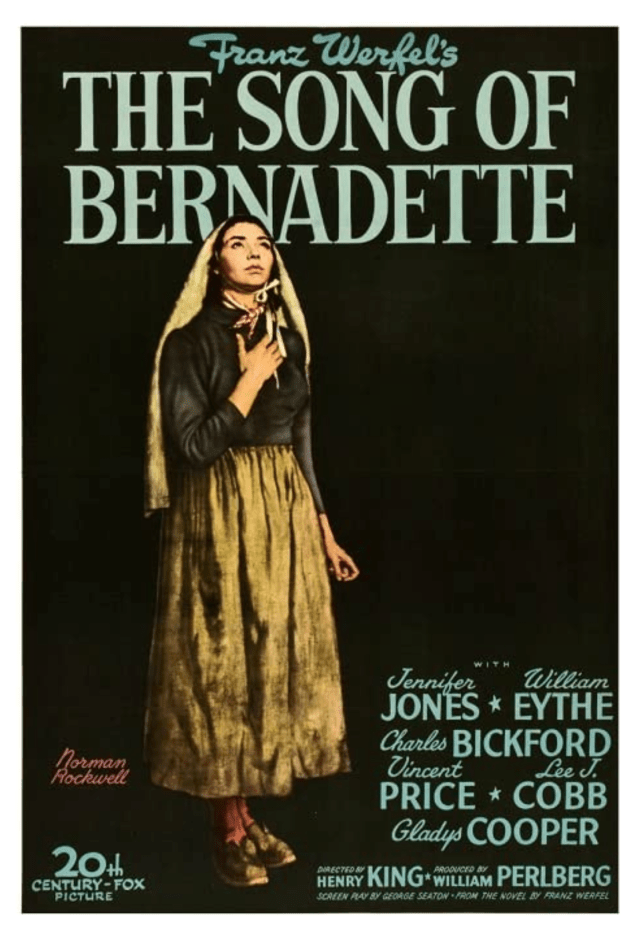
The Song of Bernadette poster created by 20th Century Fox

Things I liked about the film:

The acting: One of my favorite movies is Portrait of Jennie. Jennifer Jones’ consistent and captivating performance is one of the reasons why I love that film so much. In The Song of Bernadette, Jennifer’s portrayal of the titular character reminded me of her portrayal of Jennie. This is because she has a talent for pulling off an innocent demeanor without coming across as childish or immature. Throughout the film, Bernadette claims she is dumb. Yet, when asked what a sinner is, she tells the local reverend a sinner “is someone who loves sin”. The reverend even comments how Bernadette chose to say “loves sin” instead of “commits sin”. Personality wise, Jennifer brought a gentleness to her character. When speaking with one of Lourdes’ members of police, the policeman gets details of Bernadette’s story wrong. In a polite manner, Bernadette corrects him, pointing out the policeman’s errors in a soft-spoken voice. This innocence and gentleness allowed Bernadette to be taken seriously by the audience.

On 18 Cinema Lane, I have reviewed several of Vincent Price’s films. In most of these movies, Vincent portrays a character that can exude a sense of fear for the audience. But in The Song of Bernadette, his role of Vital Dutour was very different from his other roles. One reason is how Vincent is a part of an ensemble instead of a main focus in the story. Another reason is how Vital’s actions and choices were not chosen to cause fear. Despite all of this, Vincent carries his character with elegance and arrogance. In an effort to get to the bottom of Bernadette’s “visions”, Vital questions her story in his office. He speaks to Bernadette with a stern voice and presents a no-nonsense attitude. By interacting with her in this way, Vital is attempting in enforce his authority, thinking he will get his way. But because of Bernadette’s strength in her faith and her innocent demeanor, she is able to stand up to Vital. With that, both Jennifer Jones and Vincent Price are able to, acting-wise, go toe-to-toe with each other!

The set design: The Song of Bernadette takes place in the French countryside of 1858. But according to IMDB, the movie was filmed in California. Despite this, the set didn’t look like a set. Instead, it looked like a small French town from the 1850s! The architecture of Lourdes’ buildings was simple. Materials such as stone cover these structures. A traditional roof shingle design is displayed on top of these buildings. Like any well-researched production, the attention to detail was not overlooked! Vital’s office boasts two impressive things: a large desk and fireplace. The desk is a big piece of furniture that is coated in darker wood. Small, gold detailing can be found on the side of the desk. The fireplace is a massive marble structure, with etched detailing just below the mantle. Attention to detail and thorough research made this on-screen world an immersive environment!

Correlations with Biblical stories: When I reviewed the 1959 film, Ben-Hur, I talked about how certain Biblical events were incorporated into the overall story. With The Song of Bernadette, I could pick out moments that felt like unintentional correlations with some stories from the Bible. Toward the beginning of the film, Bernadette’s father is hired to dispose dirty rags from hospital patients. Shortly after being hired, Bernadette’s father can be seen pulling the wagon filled with dirty rags up a hill. This scene reminded me of the Crucifixion story, when Jesus is carrying the cross. The scene can also serve as a reminder how everyone has their own cross to bear, literally or figuratively. After Bernadette sees her first “vison”, Bernadette’s neighbors offer Bernadette’s family extra food they had acquired. The neighbors’ multiplying of food is reminiscent of the story where Jesus multiplied two fish and five loaves. Because this scene takes place after the first “vision”, I saw it as a miracle similar to the aforementioned Biblical story.

Using little to no dialogue: In two scenes, the movie’s creative team did a great job using little to no dialogue! One of them was the aforementioned scene where Bernadette’s father climbed up the hill. Orchestral music replaces any dialogue, which captures the emotions of Bernadette’s father. A long shot showcases the journey, elaborating how small Bernadette’s father is compared to the hill. This scene visually explained how difficult his life is. Another scene that used no dialogue is when Bernadette experiences her first “vision”. Not only is orchestral and choir music incorporated, the creative team uses a spotlight to accentuate Jennifer’s facial expressions. At one point in this scene, wind blew unexpectedly, signaling something was about to happen. Both scenes were able to say so much while saying so little!

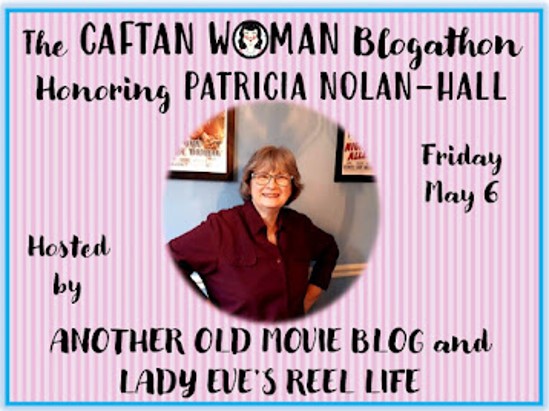
The Caftan Woman Blogathon banner created by Lady Eve from Lady Eve’s Reel Life and Jacqueline from Another Old Movie Blog

What I didn’t like about the film:

The under-utilization of Antoine and his mother: In The Song of Bernadette, the titular character appears to be friends with a man named Antoine. Antoine also appears to be close with his mother. These two characters were only shown in a handful of scenes. Even when they were included in the story, their significance in the overall plot was weaker. The under-utilization of Antoine and his mother was disappointing, as I felt they could have offered more to the story. But since this movie was based on a book I haven’t read, I’m not sure if the limited presence of these characters is close to the source material.

A few ignored details: Toward the beginning of the movie, a friend of Bernadette’s explains to their teacher how Bernadette has asthma. This diagnosis is brought up on a few occasions by Bernadette’s family throughout the movie. But, for the most part, this detail was ignored and had little significance in the story. There were times when Vital Dutour was seen wiping his nose with a handkerchief. At one point in the story, he claims it’s “influenza”. However, it isn’t clearly explained what he’s medically dealing with. As I already said, The Song of Bernadette is based on a book I haven’t read. But if the creative team knew they weren’t going to utilize these details, it makes me wonder why they would include them in the movie?

Rose illustration image created by Freepik at freepik.com. <a href=”https://www.freepik.com/free-photos-vectors/background”>Background vector created by freepik – http://www.freepik.com</a>. Image found at freepik.com.

My overall impression:

Incorporating faith into film can be a tricky task. On the one hand, you don’t want to run the risk of alienating those who aren’t religious. At the same time, you want to acknowledge the beliefs of those who choose to include religion in their lives. The Song of Bernadette finds a way to achieve “the best of both worlds”! Bernadette’s story is shown as a procession, a good exploration of how religious phenomena can affect a small town. The film doesn’t seem to take sides when it comes to the actual topic. Yes, some people make fun of Bernadette because of her “visions”. But there’s no antagonist or villain in the movie. Lourdes’ mayor and his friends don’t believe Bernadette. However, none of the men are religious, approaching the situation from a legal and literal perspective. Even the town’s reverend isn’t quick to assume the “visions” are religious. Out of all the movies I’ve seen this year, so far, I’d say The Song of Bernadette is the strongest one! If you are interested in checking this film out, I think Easter would be an appropriate time to see it. Personally, I wish I had seen it sooner, especially since I can no longer thank Patricia for the recommendation.

Overall score: 8.2-8.3 out of 10

Rest in Peace Patricia

Sally Silverscreen

The 4th Annual Gold Sally Awards Has Arrived!

18 Cinema Lane recently celebrated its fourth anniversary! To commemorate such an important milestone, I am, once again, hosting the Gold Sally Awards! As I said last month, each award post will feature two polls at a time. This decision was made to help the voting process move at a faster pace. With that said, this year’s Gold Sally Awards will begin with the Best Movie and Story polls! Because I didn’t post any announcements for the Gold Sally Awards, the first two polls will be available for two weeks; from February 16th to March 2nd. Like years past, you are allowed to vote for more than one nominee. But you can only vote once per person. The link to the polls will be located under each poll. Just click on the word ‘PollMaker’.

Similar to last year, I thought featuring this anniversary image was appropriate for the start of the Gold Sally Awards! Anniversary image created by WordPress.
What was the Best Movie of 2021?
1. The Karate Kid (1984)
2. The Three Musketeers (1948)
3. The Love Letter
4. Perry Mason: The Case of the Telltale Talk Show Host
5. Sincerely, Yours, Truly
6. Rigoletto
7. Holly and Ivy
8. The King and I (1956)
9. A Star Is Born (1937)
10. Poisoned in Paradise: A Martha’s Vineyard Mystery
 
Created with PollMaker
What was the Best Story of 2021?
1. The Karate Kid (1984)
2. The Three Musketeers (1948)
3. The Love Letter
4. Perry Mason: The Case of the Telltale Talk Show Host
5. Sincerely, Yours, Truly
6. Rigoletto
7. Holly and Ivy
8. The King and I (1956)
9. A Star Is Born (1937)
10. Poisoned in Paradise: A Martha’s Vineyard Mystery
 
Created with PollMaker

Have fun voting!

Sally Silverscreen

Take 3: Kingdom of Heaven Review

This is my second year participating in the Rule, Britannia Blogathon. In 2020, I reviewed the 2002 adaptation of Nicholas Nickleby, a movie I ended up liking so much, I now want to read the source material. For the 8th annual event, I chose to write about another film from the 2000s; 2005’s Kingdom of Heaven. This is a movie I have heard about, but never got around to seeing. Until this blogathon, it had sat on my DVR for three years. Since the movie stars Orlando Bloom, a British actor, the Rule, Britannia Blogathon seemed like the perfect opportunity to finally check the film out. One of the few things I knew about this movie was that it had something to do with the Crusades. This is a time period I know very little about. However, this didn’t stop me from giving the film a fair chance. What did I think of this 2005 title? Keep reading if you want to find out!

Kingdom of Heaven poster created by Scott Free Productions, Inside Track, Studio Babelsberg Motion Pictures GmbH, 20th Century Fox, and  Warner Bros. Pictures

Things I liked about the film:

The acting: As I said in the introduction, Orlando Bloom’s involvement in this project is one of the reasons why I chose to review Kingdom of Heaven. Prior to watching the film, I had seen the Pirates of the Caribbean trilogy, where Orlando consistently portrayed Will Turner. While the character of Balian is similar to Will, each role is distinct. To an extent, Orlando’s performance in Kingdom of Heaven reminded me of Vincent Perez’s portrayal of Yanko from Swept from the Sea. While Balian is a masculine character, he also displayed a gentle charm. A good example is when Balian arrives in Jerusalem. He gives his prize horse to the servant of his opponent. When the servant asks why Balian would make this decision, Balian replies how he doesn’t want the horse to suffer.

In Kingdom of Heaven, Eva Green portrayed a queen named Sibylla. Despite appearing in the movie for a limited amount of time, I did enjoy watching her performance! I noticed how fluid Eva’s emotions were. This allowed her to adapt to any situation her character faced. It also helps that she was able to excel, acting wise, alongside her co-stars. Another character I wish appeared in the film more was King Baldwin IV. Portrayed by Edward Norton, this character was a leper. Therefore, he was completely covered and wore a mask. Edward’s use of body movement and expressive eyes make up for the lack of facial expressions. His approach to his role made King Baldwin IV a compelling character to watch!

The scenery: “Sword and sandal” movies are known for featuring breath-taking scenery. Kingdom of Heaven also brings beautiful scenery to the table, showcasing desert, oceanic, and forest landscapes. Toward the beginning of the movie, Balian resided in the French countryside. This area was surrounded by deep green forestry, the ground and trees lightly covered in snow. As Balian travels to Messina, the city is met with a clear, blue ocean. The hue of the water beautifully complimented the warm sandstone of the nearby buildings. While Jerusalem is in the middle of a desert, palm trees brought a pop of color to the environment. These plants helped make Jerusalem appear as an oasis.

The historical accuracy: I’m not familiar with this particular period in history. But based on the limited information I do know, the movie appeared to be historically accurate. Throughout the film, knight’s armor could be seen. Helmets, swords, and other related gear adopted an older style. Some of the swords boasted jewels, with Balian’s sword displaying a giant ruby. Even the attack towers from one of the film’s battles looked as if it came directly from the time of the Crusades. As I’ve said about other period films, details like the ones I mentioned show how much the creative team cared about the presentation of their project!

The 8th Annual Rule, Britannia Blogathon banner created by Terence from A Shroud of Thoughts.

What I didn’t like about film:

Sibylla’s unclear motives: During Balian’s time in Jerusalem, Sibylla becomes romantically interested in him. But she’s already married, a fact that Balian himself is aware of. Balian’s reason for going to Jerusalem was to seek forgiveness for his and his deceased wife’s sins. After meeting Sibylla, he, more often than not, doesn’t object to Sibylla’s romantic interest for him. I was left confused on what her motives were for wanting to be with Balian. At times, I wondered if Sibylla’s situation was similar to Rose’s from Titanic, simply stuck in a loveless relationship and desperately looking for a way out. Other times, I thought Sibylla was attempting to seduce Balian toward sin. I wish these motives were clarified in the script.

A limited incorporation of religion/faith: Because Kingdom of Heaven takes place around the time of the Crusades, I was expecting religion/faith to be one of the cornerstones of this story. While the topic is included in the film, its incorporation is very limited. Before watching this movie, I thought the story was going to be similar to 1959’s Ben-Hur, with the protagonist trying to live his life as a man of the people and of faith. But we never get to see Balian’s internal struggle with these responsibilities. Instead, the audience sees Balian resolve smaller non-religious conflicts which lead to a much bigger conflict. Even though people can be seen praying, there is more to religion/faith than prayer. The script relied more on who would rule Jerusalem than how religion/faith played a role within that world.

A more episodic story: When it comes to “sword and sandal” movies, there is usually an overarching conflict the characters work to resolve over the course of the story. But in Kingdom of Heaven, most of the story is episodic. As I said earlier, Balian wants to go to Jerusalem to seek forgiveness for his and his deceased wife’s sins. Once he has achieved his goal, he moves on to another conflict that is resolved within a short amount of time. This is how the story plays out for about the first half of the movie. There is a major conflict that receives a lot of attention in the film’s second half. However, it feels more like a climax than an event the characters are working towards.

White horse image created by Gabor Palla at freeimages.com. “FreeImages.com/Gabor Palla.”

My overall impression:

Two years ago, I reviewed 1959’s Ben-Hur, a classic “sword and sandal” film. Despite seeing it for the first time, I was over the moon by the strength of the movie’s quality. With Kingdom of Heaven, I didn’t feel the same way. Yes, the 2005 title is a fine, well-made production. But there were times I was confused as I followed along with the story. Like I mentioned in my review, Sibylla’s motives for being romantically interested in Balian were not made clear. However, this is one example of my confusion. Even though this movie was released over ten years ago, I won’t spoil it for anyone who hasn’t seen it. But I will say that something happens toward the end of the film that left me wondering if everything the characters worked for was worth it. As someone who knows very little about the Crusades, I was hoping to use my movie viewing experience as a learning opportunity. While I did learn some information, I feel there’s far more I need to discover. I’ve heard there is a director’s cut of Kingdom of Heaven. If this information is true, maybe I’ll check it out and see which version I like more.

Overall score: 7.2 out of 10

Have you seen Kingdom of Heaven? What is your favorite “sword and sandal” film? Tell me in the comment section!

Have fun at the movies!

Sally Silverscreen
Take 3: The King and I (1956) Review

For the Fourth Broadway Bound Blogathon, I chose to review the 1956 version of The King and I! Years ago, I had seen the 1999 animated adaptation of the musical. Since I vaguely remember it, I can’t provide an honest opinion of that movie. Because I had only seen pieces of the 1956 film and because it was recommended to me by Maddy from Maddy Loves Her Classic Films, I now found a good excuse to finally check the film out! While I knew the play itself was successful, I was surprised to discover it had won a Tony award. As this year’s blogathon focuses on Tony winners, it gave me an opportunity to learn something new. This is one of the reasons why I love participating in blogathons! Now, let’s start this review of 1956’s The King and I!

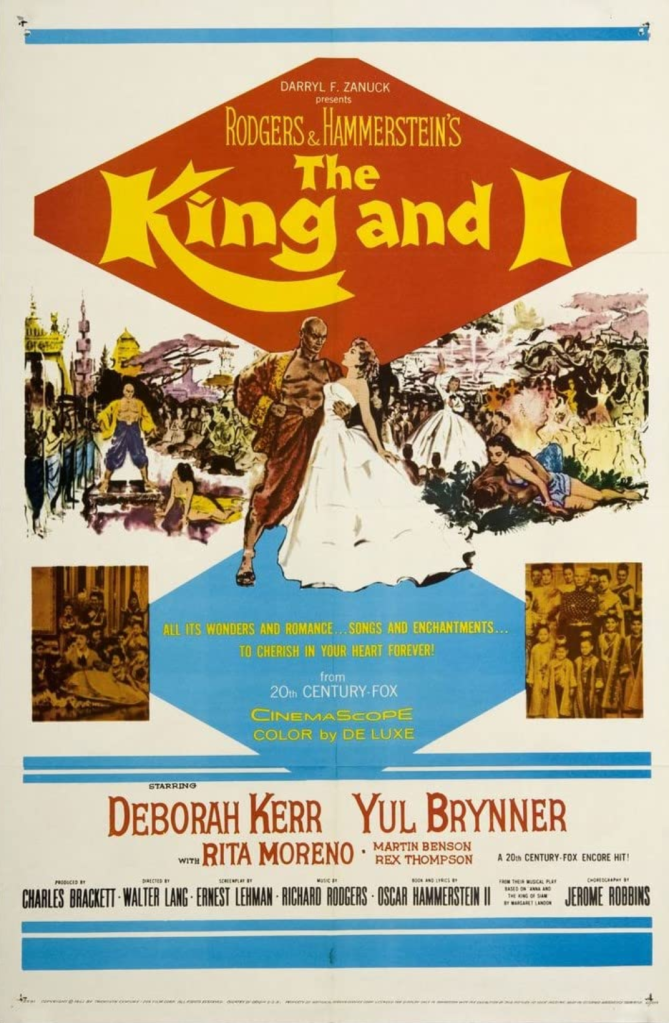
The King and I (1956) poster created by 20th Century-Fox.

Things I liked about the film:

The acting: Deborah Kerr is a dramatic actress, as her strengths can be seen in drama films. Because there were plenty of dramatic moments in The King and I, this allowed the best of Deborah’s acting abilities to be placed on display! In scenes that allowed Anna to stand up to King Mongkut, Deborah adopts a serious persona without any sarcasm. Her tone of voice is stern, while also standing up straight and looking directly at King Mongkut. Because there were light-hearted moments as well, it gave Deborah an opportunity to incorporate humor into her performance. This balance made the role suit Deborah well! This is the first time I had ever seen any of Yul Brynner’s performances. However, I was quite impressed by his portrayal of King Mongkut of Siam! Similar to Deborah Kerr’s role, there was a good balance of drama and comedy. In a scene where King Mongkut is talking to his son about what he learned in school, Yul speaks with a serious tone of voice. He also moved around the set with a posture that reflects his character’s royal power. However, when he introduced Anna to his children, King Mongkut would make silly faces in order to get them to smile. Before watching The King and I, the only film of Rita Moreno’s I had seen is West Side Story. Because of this, it was interesting to see Rita work with different material. While Anita, Rita’s character in West Side Story, is sassy and confident, Tuptim is more reserved and sensitive. When Rita didn’t have speaking lines, facial expressions and body language helped convey what Tuptim was thinking. As I liked her portrayal of Tuptim, it makes me wish Rita had appeared in more scenes.

The musical numbers: A musical is only as good as its musical numbers. With The King and I, I found the musical numbers to be entertaining! The most interesting one is the Siamese interpretation of Uncle Tom’s Cabin. Because Tuptim is reading a copy Anna gave her, she decides to write a play based on her own version of the novel. This particular number features traditional dancing, stylized face masks, and practical effects, such as a white sheet representing ice. It served as a good example of how everyone can view a text differently. The rest of the musical numbers in The King and I ranged from dramatic to comedic. One of them is ‘Getting to Know You’. In this scene, Anna dances with one of King Mongkut’s wives. Some of the children circled around their mother in order to mimic Anna’s skirt. This was a simple way humor was incorporated into some of the musical numbers.

The costume design: The King and I is known for being an elaborate musical, with elegance being found within the costume design. Bright colors were worn by almost all the characters. In a scene where Anna is introduced to King Mongkut’s children, the children’s outfits featured hues of pink, red, and green. The members of the royal family sometimes wore plaid, which complimented the rich color palette of the movie. Metals like gold could also be seen in the royal family’s attire. Some of King Mongkut’s jackets featured gold embroidery, a reminder of his wealth and affluence. Bronze coated the children’s headpieces as well. With the costume design being so exquisite, I wonder how much of this movie’s budget was devoted to it?

The Fourth Broadway Bound Blogathon banner created by Rebecca from Taking Up Room.

What I didn’t like about the film:

The under-utilization of Rita Moreno: As I mentioned earlier, the only film of Rita’s I had seen is West Side Story. Therefore, I was looking forward to seeing her performance in The King and I. I was disappointed to see Rita’s talents under-utilized. In this two hour and thirteen-minute movie, Rita appeared in a handful of scenes. While she did participate in the story’s musical components, she was only given one duet and the narration during the Uncle Tom’s Cabin play. I understand The King and I was released five years before West Side Story. But if the 1961 film has taught me anything, it’s how Rita is, talent wise, capable of so much more.

Drawn out storylines: The storylines in The King and I were drawn out because of the film’s two hour and thirteen-minute run-time. King Mongkut’s story, where he attempts to save his reputation, is one example. For about half the movie, King Mongkut wants to prevent other world leaders from thinking he is “barbaric”. Since this particular storyline lasted for so long, the resolution/payoff was fine, but somewhat anti-climactic. Lun Tha and Tuptim’s storyline took place throughout the whole movie. However, by the end of the film, it was left unresolved. It makes me wonder if it would have been resolved if The King and I’s run-time had been shorter?

Songs interrupting the story: In a typical musical, the musical numbers help progress the story forward. But in The King and I, the musical numbers interrupt the over-arching story, causing the transition between story and song to feel less seamless. After an elegant party at the palace, King Mongkut discovers Tuptim is missing. King Mongkut’s search is disrupted by Anna singing ‘Shall We Dance?’. This then turns into a private dance between Anna and King Mongkut, which is interrupted by a guard. The guard informs King Mongkut that Tuptim has been found. Moments like this one cause the story to pause for the sake of a musical number.

String of musical notes image created by Freepik at freepik.com. <a href=’https://www.freepik.com/free-vector/pentagram-vector_710290.htm’>Designed by Freepik</a> <a href=”https://www.freepik.com/free-photos-vectors/background”>Backgroundvector created by Freepik</a>. Image found at freepik.com.

My overall impression:

So far, I have seen four of Deborah Kerr’s movies. Out of those titles, I’d say The King and I is her best one! As I said in my review, the material complimented her acting abilities. There was enough drama to show off her strengths, while also having enough comedy to let Deborah have fun with the role. The film gave me a chance to see interesting performances and musical numbers, from Rita’s portrayal of Tuptim to a Siamese interpretation of Uncle Tom’s Cabin. The exquisite costume design and sets are definitely photogenic, highlighting the wealth and power within the royal family. Even though the movie as a whole is good, there are musicals I would choose over it. The songs interrupting the story instead of progressing it forward is one reason why I feel this way. I’ve heard Anna and the King is a non-musical version of this particular story, so I’d be interested in seeing how lack of musical numbers affects the overall story-telling. I’d also be interested in watching Deborah Kerr and Yul Brynner’s other film, The Journey.

Overall score: 7.7 out of 10

What are your thoughts on The King and I? Which version is your favorite? Let me know in the comment section!

Have fun on Broadway!

Sally Silverscreen

Take 3: Heaven Knows, Mr. Allison Review

Easter is just around the corner. Because of this, Pure Entertainment Preservation Society is hosting The Faith in Film Blogathon! This event has given me the perfect opportunity to review Heaven Knows, Mr. Allison, which was recommended to me by Maddy from Maddy Loves Her Classic Films. Since the movie features a Nun as one of the main characters, I knew there would be some religious themes within this script. However, I have never seen this film before, so I didn’t know what these themes would be. Choosing Heaven Knows, Mr. Allison also gave me an excuse to watch more movies from Deborah Kerr’s filmography. So, let’s start this review to see where this film ranks!

Heaven Knows, Mr. Allison poster created by 20th Century Fox.

Things I liked about the film:

The acting: Because Robert Mitchum and Deborah Kerr are the only two actors in this movie’s main cast, those are the only two performances I will be discussing in this review. This is the third film of Deborah Kerr’s I’ve seen, with the previous two being Edward, My Son and Marriage on the Rocks. The one consistent part of Deborah’s acting abilities is how she uses emotions and expressions to her advantage. This allows her to make each of her roles seem well-rounded! While Sister Angela, Deborah’s character, and Mr. Allison are fishing, Mr. Allison tries to catch a turtle with a tool he built himself. When Mr. Allison falls into the ocean, Sister Angela appears shocked and horrified, as the situation happened so quickly. Later in the film, Sister Angela and Mr. Allison are discussing their plans if they leave the island. As Mr. Allison is talking about how he has grown closer to Sister Angela, tears can be seen forming in Sister Angela’s eyes. Deborah’s face in that scene said so much more than dialogue could. Robert Mitchum is an actor I’ve heard of, but am not familiar with. Even though I have seen pieces of El Dorado and Scrooged, I don’t remember his performance in those projects. As I watched his portrayal of the titular character, it appeared as a combination of the laid-back personality of Clark Gable and the tough persona of John Wayne. But for Robert, his eyes contained emotion throughout his performance. As Sister Angela falls ill, you can tell Mr. Allison is genuinely concerned for her. Robert’s eyes are what worked in his favor, as they held a sense of sympathy for Sister Angela and longing for her well-being. The first scene of this movie contained no dialogue, as it focused on Mr. Allison’s reaction when he first arrives on the island. Because of this, Robert had to rely on his facial expressions and body language to explain what his character was going through. I found these creative decisions gave the film a good first impression, as it brought some realism to this story!

The scenery: According to IMDB, Heaven Knows, Mr. Allison was filmed in Trinidad and Tobago. Even though the location is not specified in the film, the scenery made the movie very photogenic! There is so much foliage to be seen, from the tall palm trees to the smaller bushes. The ocean boasted a consistent shade of blue, which was definitely appealing to the eye. Sandy beaches and dark brown rocks complete the natural look this space had to offer. Based on appearances alone, this island looked inviting!

The parallels between the religious order and the Marines: Within Mr. Allison and Sister Angela’s conversations, parallels between the Marines and the religious order are brought up. One of the them is discussed while they are building a sail for their raft. Sister Angela addresses the preparations she had to go through in order to become a Nun. She even talks about one mentor within the religious order she wasn’t a fan of. Meanwhile, Mr. Allison shares his basic training before he officially became a Marine. He also brings up a drill Sergeant that he didn’t like. I never thought about these parallels until I saw this film, so I like how this story was somewhat thought-provoking. The parallels between the religious order and the Marines also showed how Sister Angela and Mr. Allison were similar than they first realized.

The Faith in Film Blogathon banner created by the Brannan sisters from Pure Entertainment Preservation Society.

What I didn’t like about the film:

The limited presence of faith: While I did like seeing the parallels between the religious order and the Marines, I was disappointed by how limited faith’s presence was. Before watching Heaven Knows, Mr. Allison, I expected faith to be a cornerstone of this story, similar to films like Ben-Hur. Because the movie takes place during World War II, a correlation with the David and Goliath story would make sense. Seeing one of the characters question their faith or have their faith tested would be appropriate, given their circumstances. But faith in Heaven Knows, Mr. Allison was served in small doses.

A basic conflict: In movies, television shows, or books, I like conflicts that contain more depth. But the conflicts in Heaven Knows, Mr. Allison were more basic than I hoped. In theory, the idea of a Marine and a Nun surviving on an abandoned island sounds interesting. But as the story progresses, the conflict is the same as other films of this nature. Even when Japanese soldiers invade the island, survival is still a major conflict. Because of everything I mentioned, few new ideas were brought to this particular table.

Lack of resolution: At one point in the film, Sister Angela explains to Mr. Allison how some women change their minds when it comes to the religious order. Several scenes later, Mr. Allison tries to dissuade Sister Angela from taking her final vows by telling her he loves her. She even starts to weigh her options when it came to her future. However, we never find out what her final decision was. A brief explanation in the script would be solved this problem. But because this explanation was nowhere to be found, a sense of closure was missing.

Cute Easter image created by Freepik at freepik.com. <a href=”https://www.freepik.com/free-photos-vectors/background”>Background vector created by freepik – http://www.freepik.com</a>. Image found at freepik.com.

My overall impression:

Heaven Knows, Mr. Allison is a fine movie. Even though I found it better than Edward, My Son and Marriage on the Rocks, I was expecting more from this third film. I was hoping faith would have a bigger role in the story, especially since Heaven Knows, Mr. Allison was released two years before Ben-Hur. However, as I said in my review, faith was served in small doses. The conflict itself was typical for a movie that involves characters being stranded on an island. Because I like conflicts with more depth, this creative decision was disappointing. But the movie did have its strengths, such as the acting and the thought-provoking parallels. With all this said, this is a film I would still recommend to older viewers just in time for Easter!

Overall score: 7.2 out of 10

Have you seen Robert Mitchum’s or Deborah Kerr’s films? If so, which ones would you recommend? Let me know in the comment section below!

Have fun at the movies!

Sally Silverscreen
Take 3: Teenage Rebel Review (Ginger Rogers and Fred Astaire Double Feature Part 1)

I haven’t seen many films from Ginger Rogers’ and Fred Astaire’s filmography. Despite this, I joined the third Fred Astaire and Ginger Rogers Blogathon, in the hopes of expanding my cinematic horizons! Because I figured other participants would cover Ginger’s musicals, I chose one of her movies that wasn’t a part of the musical genre. As the title says, I’ll be reviewing Teenage Rebel! The aftermath of a divorce/custody battle is rarely explored in film. This is what made me take notice of this particular title. What I also thought was interesting was how this story discussed the subject of divorce during a time when the concept was not as talked about as it is today. While I have reviewed the 1939 movie, In Name Only, that film revolved around the divorce itself and what led up to it. Now, let us begin part one of my Ginger Rogers and Fred Astaire Double Feature!

Teenage Rebel poster created by 20th Century Fox.

Things I liked about the film:

The acting: Ginger Rogers is an actress from what would be considered the “Golden Era” of Hollywood. This particular period in time is often depicted with a sense of glamour. Because of this, Ginger carried herself in Teenage Rebel with that same sense of glamour I just brought up. Not only that, her emotionality really shined through in her role as Nancy Fallon! Some of her best scenes featured her interacting with Dorothy/Dodie. Both actresses go toe-to-toe with each other, acting-wise, and make their characters feel believable and genuine. Out of context, Dorothy/Dodie could be written off as a spoiled brat. But Betty Lou Keim’s performance, plus the aftermath of the divorce, makes the audience feel bad for Dorothy/Dodie. While Betty’s portrayal is consistent, she is given enough flexibility to add emotion. This highlights the idea that Dorothy/Dodie is simply human, with thoughts and feelings that need to be expressed. Warren Berlinger portrays Dick, one of the Fallon’s next-door neighbors. What I liked about his performance is how animated it is. This animation livened Warren’s portrayal without coming across as over-the-top. Instead, it gave him a wide range of emotions to work with. His conversation with his family about his long distance girlfriend is a perfect example of this.

The use of symbolism: One night, as a literal storm is brewing in the neighborhood, Nancy finds Dorothy/Dodie sitting outside by herself. The wind outside is strong and doesn’t have any plans to calm down. During their conversation, the sound of cracking lightening can be heard in the background. When Dorothy/Dodie and Nancy return to the house, rain starts to fall. These elements represented the personal turmoil taking place between mother and daughter.

The messages and themes: In films where younger characters are the center of the story, there is always a place for meaningful messages and themes. This is certainly the case for Teenage Rebel. One of the notable themes of this movie is having compassion for others. No matter how closed-off Dorothy/Dodie was, Nancy never gave up on her daughter. Even though Nancy does express feelings of frustration and stress, she always tried her best to make Dorothy/Dodie feel welcome and loved. Even Dick and his sister, Jane, show compassion for Dorothy/Dodie. They invite her to teenage functions like dances and a local car race. Because of the time they spend with her, Dorothy/Dodie allows herself to open her heart to others. The reason why Dorothy/Dodie distances herself from people is because she has lost her trust in them due to the divorce. As the story progresses, Dorothy/Dodie changes her life around. In one scene, Nancy gives her daughter a lecture about how she needs to stop living in isolation.  That speech and the overall message of opening your heart comes across in this story as genuine.

The Third Fred Astaire and Ginger Rogers Blogathon banner created by Crystal from In the Good Old Days of Classic Hollywood and Michaela from Love Letters to Old Hollywood.

What I didn’t like about the film:

A very misleading title: This film is called Teenage Rebel. Paired with the quotes on the movie’s poster, the film is advertised as a cautionary tale about teenagers going “over the edge”. However, none of the teens in this story rebel or misbehave. Even when there is a car race, the event itself appears to be well organized and legal. While Dorothy/Dodie has a bad attitude and runs away from home, she does these things to 1.) put on a brave face to protect her true feelings and 2.) find some alone time to get away from the tension between her and her mother. The title and marketing built this movie up to be something it wasn’t.

The character of Larry: Larry Fallon, portrayed by Rusty Swope, is Nancy and Jay’s son. He had some funny lines in this movie, such as when he said “a man” after Dorothy/Dodie asks him what he wants to be when he grows up. However, after a while, Larry kind of overstays his welcome. I don’t fault Rusty for this, as there was only so much he could do for an actor of his age. This specific flaw is the result of the screenwriting. Larry doesn’t have much to do in the overall story. In fact, he has little to no significance within the main plot. Prior to watching Teenage Rebel, I was expecting to see an interesting dynamic between half-siblings who didn’t grow up together. But, in reality, Dorothy/Dodie and Larry only interacted once. Either Rusty needed more material to work with or the character should have been written out of the movie completely.

An abrupt transformation: When Dorothy/Dodie is introduced in the film, she carries herself with a chip on her shoulder. It gets to the point where she and her mother have an emotionally fueled, tension filled conversation. As I mentioned earlier, Dorothy/Dodie’s attitude was caused by an ugly divorce with an even uglier custody battle. After the aforementioned conversation between Dorothy/Dodie and Nancy, Dorothy/Dodie runs away, where Dick finds her and takes her to a local soda shop. When she returns home, she acts nice toward her mother, like their previous conversation never happened. Similar to what I said about Larry, this flaw was the result of the screenwriting. This change in character should have been a consistent progression throughout the film as a whole.

Breaking heart image created by Kjpargeter at freepik.com. <a href=’https://www.freepik.com/free-vector/broken-heart-valentine-background_1041991.htm’>Designed by Freepik</a>. <a href=”https://www.freepik.com/free-photos-vectors/background”>Background vector created by Kjpargeter – Freepik.com</a>. Image found at freepik.com.

My overall impression:

Teenage Rebel is an ok film. However, its dishonest title and poster doesn’t help its case. In a time when teen centered films were on the rise, the studio wanted to capitalize on that. While a significant part of this story focused on a teenage perspective, it was marketed as something different than what it honestly was. Instead of selling the movie as a meaningful drama exploring the aftermath of divorce, they decided to make the film sound like it was about misbehaving youngsters, despite never being found in the story. Even though it seems like the creative team had their hearts in the right place, I was not a fan of how the story was more “slice of life” than I had wanted. I don’t find these types of stories intriguing, but I appreciate Teenage Rebel’s incorporation of its messages and themes. If you want to watch a teen movie with similar ideas, I’d recommend The Boy Who Could Fly. Not only does it emphasize showing compassion to others, but it’s a much stronger film.

Overall score: 6.3 out of 10

Have you seen Ginger Rogers’ movies? Which film about divorce would you recommend? Tell me in the comment section!

Have fun at the movies!

Sally Silverscreen