Films are a way to visually tell a story. The subjects can range from the fictional to the historical. With movies belonging in the non-fiction genre, that story can introduce viewers to a particular person, event, or time period. This is the case for the 1985 made-for-TV film, Shadowlands! I will admit I knew very little about C.S. Lewis prior to The Two Jacks Blogathon, hosted by Taking Up Room. While I was aware of his contribution to literature, creating the Chronicles of Narnia series, my knowledge of the author was surface-level. By participating in this blogathon and by choosing to review Shadowlands, I hoped to learn more about C.S. Lewis and the literary world he created! Now, it’s time to open the wardrobe door and step into this review!
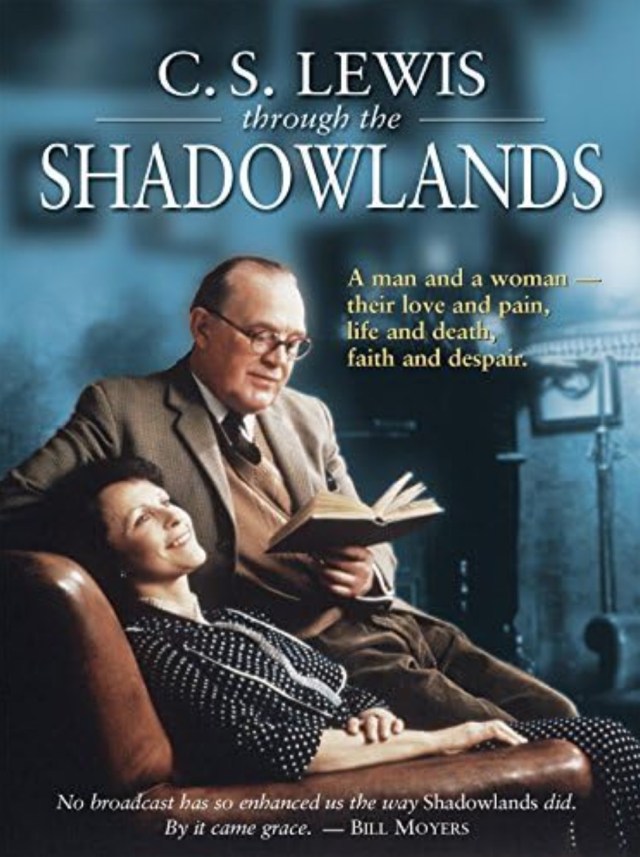
For some reason, Shadowlands has two titles: Shadowlands and C.S. Lewis Through the Shadowlands. Because the movie doesn’t have an offical poster on IMDB, I chose this poster for my review. Shadowlands (1985) poster created by British Broadcasting Corporation (BBC) and BBC Enterprises.
Things I liked about the film:
The acting: In past reviews, when I talked about a movie’s acting performances, I’ve mentioned the believability of those portrayals. This believability comes from the actors displaying an understanding for their roles, as well as for the talents of their co-stars. As I watched Shadowlands, I could sense the believability from the cast. This element was so strong, it allowed the interactions to come across as realistic. Whenever C.S. Lewis and Joy Gresham shared conversations with one another, it seemed like they shared a mutual connection, being on the same page and even on the same paragraph. The combination of Joss Ackland and Claire Bloom’s talents allowed these performances to compliment each other! There were other interactions that appeared realistic in Shadowlands. When a medical situation takes place in the family, Douglas, portrayed by Rupert Baderman, asks C.S. Lewis about the situation itself. Douglas’ eyes display a longing look, desperate for things to get better. As C.S. Lewis reveals the answer, he has a serious expression on his face. These emotional expressions from both actors brought a sense of honesty to the interaction.
C.S. Lewis’ perspective: Because Shadowlands is based on a part of C.S. Lewis’ life, some of his perspectives are included in the script. The delivery of these perspectives and how they were incorporated into the story was insightful and thought-provoking. In a letter to Joy, C.S. Lewis explains how Narnia is a part of something bigger. From how I interpreted this statement, C.S. Lewis is pointing out how Narnia is a key component of the overarching story. It was interesting to hear Narnia referenced this way, as that world plays such a large role in its series, it seems like the star of the show. Amongst a group of colleagues during Christmastime, C.S. Lewis acknowledges how the birth of Jesus is considered a miracle. But he also points out how Springtime is a miracle, when plants are reborn and the world around the characters comes alive. Looking back on C.S. Lewis’ statement, it can be easy to take Springtime for granted, as it is a natural occurrence that happens on its own.
Historical accuracy: The historical accuracy in a historical/period drama can be found in the visual details. These details can also provide clues for the specific time a story takes place. Several scenes of Shadowlands show a rotary dial phone on a desk or on a table. The phones in the film are black, even though these types of phones can boast any colorful hue. In a scene where one of the characters is in the hospital, the bed is built with a silver metal frame. Even the knobs on a medical machine feature a simplistic design and make a loud, clicking sound. With these observations in mind, it appears that Shadowlands takes place in the 1950s or 1960s.
Sudden jumps in time: Shadowlands has a run-time of an hour and thirty-two minutes. This means progression of time is forced to be condensed for the sake of satisfying the run-time. Within the film’s first thirty minutes, however, the condensation of time was jarring, causing events to happen too quickly. After C.S. Lewis and Joy Gresham first become acquainted with each other, she tells him that she’ll return to England with her sons, in order for them to meet C.S. Lewis. In the very next scene, Joy has returned to England with her children. Several scenes later, Joy makes plans with C.S. Lewis about spending Christmas with him. A scene after that, Christmastime was already arrived.
An overshadowed brother: When I talked about this film’s sudden jumps in time, I mentioned Joy having two sons. These sons, David and Douglas, travel with their mother to England and eventually make England their permanent residence. Throughout the story, Douglas’ perspective is the one that is prioritized, as he is a fan of the Chronicles of Narnia series. The audience even sees how Douglas deals with a tragic situation. David’s thoughts about this tragic situation are referenced, but never showcased. I know there is only so much story to tell in an hour and thirty-two minutes. But I wish David’s perspective hadn’t been ignored.
Things left unexplained: In my review’s introduction, I said I hoped to learn more about C.S. Lewis by watching Shadowlands. While I did learn some things about the famous author, the story assumed the viewer already had basic knowledge about him. One example of this is how some things were left unexplained. There is a scene where C.S. Lewis is lecturing a group of students in a classroom. No explanations were provided for why he was lecturing these students or why he was teaching in the first place. It wasn’t until after I saw the movie that I learned C.S. Lewis was a professor at Oxford.
A person or event featured in a movie may be so fascinating, they deserve their own documentary. Some examples are the events that inspired Over the Edge and Evel Knievel. C.S. Lewis is one of these people that deserves a documentary, as he is an interesting literary figure. In fact, I think the story of Shadowlands should have been a documentary instead of a film. Even though I learned some information about the famous author, the movie assumed the audience already knew about him. This was the cause of things within the story not being explained. If the story of Shadowlands had been a documentary, important events could be discussed and prioritized without the program’s run-time being a concern. But reflecting on Shadowlands as a film, there are aspects of the project I can appreciate, such as the acting performances and hearing about C.S. Lewis’ perspective. With all that said, I thought the movie was just ok.
Overall score: 6 out of 10
Have you seen 1985’s Shadowlands? Would you like to see me talk about C.S. Lewis’ stories on my blog? Please tell me in the comment section!
Welcome to the Familyathon Blogathon! With Thanksgiving on the horizon and the Christmas/holiday season on the way, the theme of family is recognized and celebrated! Even outside of special occasions, family has been a popular topic in entertainment media for decades. From these on-screen families, familiar faces and beloved characters have won over the hearts of fans. Their stories have served valuable lessons and even stood the test of time. Every entry in this event showcases how the subject of family has been incorporated into movies and television! From the underrated tv films to silver screen classics, let the blogathon begin!
Familyathon blogathon banner created by Sally Silverscreen of 18 Cinema Lane
Three years ago, I created a tier rank list of every Hallmark Hall of Fame movie I’d seen. These films were categorized by my overall impression of each presentation. In honor of 18 Cinema Lane turning five, I promised my readers I would revisit one of my past articles. I’ve seen more Hallmark Hall of Fame movies since I published my original tier rank list, so that’s the article I’ve selected! Along with adding more Hallmark Hall of Fame productions, I changed the names of each tier category. This decision was made to better reflect whether a film is worth its retail price of twenty dollars a DVD compared to its quality. The new tier category names are the following:
Bottom of the Barrel – Not Even Worth a Dime
Ok – Catch it on TV/Youtube
Decent/Fine – Bought It at a Garage Sale for a Dollar
Good – Get It On Sale for Half Off
Great – Where Do I Pay Full Price?
For each movie I added or moved to a different tier, I will share my thoughts on them. If I wrote about a movie on my blog, I will add the link to this article.
Screenshot taken by me, Sally Silverscreen
Bottom of the Barrel – Not Even Worth a Dime
Durango
Reviewed for the Legends of Western Cinema Week Blogathon, I stated Durango should have been a David and Goliath story. That’s because a David and Goliath reference was placed within the last nineteen minutes of the movie, the creative team’s attempt to include a higher stake into the story. But this attempt didn’t work because the majority of the film had lower stakes. The protagonist and his plan to transport cattle worked out perfectly, too perfectly for the standards of the western genre. This takes away any room for concern the audience could have for the characters and their well-being.
As I explained in my list of the top ten worst movies I saw in 2022, the audience was not given a reason to care about the characters and their story in Journey. This flaw was achieved because the film’s creative team didn’t provide explanations for the characters’ choices. It also did not help how annoying Grandpa Marcus was, his photography hobby becoming an obsession. A major theme of Journey is memories being irreplaceable. That theme was poorly delivered in Journey, as Marcus’ hobby creates a plot hole within the story. Also, I’ve seen Hallmark Hall of Fame movies express this theme better, such as The Lost Valentine.
A Place for Annie
When it comes to movies that are products of their time, they can fit into one of two categories: movies that serve as visual time capsules and those that are dated on arrival. A Place for Annie, sadly, falls into the latter category. The majority of the story focuses on the medical information of HIV/AIDS that was known during the late ‘80s to mid ‘90s. That focus causes the film to show its age more obviously. The way foster care/adoption is discussed in this story is so oversimplified, I couldn’t take that part of the movie seriously. Similar to what I said about Journey, the theme of adoption is expressed better in other Hallmark Hall of Fame stories, like Redwood Curtain.
The Corsican Brothers
Alexandre Dumas’ stories are, more often than not, filled with adventure, intrigue, and suspense. But in the case of The Corsican Brothers, these elements were lacking. Granted, I still haven’t read the book this movie is based on. Though I do wonder how similar the 1985 adaptation is to the source material? If the original story primarily revolves around Louis attending fancy events in Paris, that would explain why the adaptation is so underwhelming. However, the original story could explain some of the confusing parts of the movie, such as the woman giving some of the characters fates.
The 1996 movie, The Summer of Ben Tyler, feels like Hallmark Hall of Fame wanted to create their own version of To Kill a Mockingbird. Upon reflection of this film, it doesn’t seem like the creative team displayed a strong understanding for what made Harper Lee’s story work. If anything, it feels like ideas are copied from Harper’s novel and pasted into the Hallmark Hall of Fame presentation, making The Summer of Ben Tyler a little too similar to To Kill a Mockingbird. This is a case of if you’ve seen one movie, you’ve basically seen the other. So, if you’ve seen the adaptation of To Kill a Mockingbird, you’ve already seen The Summer of Ben Tyler.
Decoration Day
The way I feel about Decoration Day is similar to Promise; the majority of the story is very “slice-of-life”. To me, this makes both films less memorable than other Hallmark Hall of Fame titles. However, I did find Gee Pennywell’s dilemma over receiving the Congressional Medal of Honor the most interesting part of the movie. In fact, I wish Decoration Day had solely revolved around that dilemma.
Foxfire
Hallmark Hall of Fame has a history of adapting plays into films. Sometimes, a movie’s creative team will take advantage of the expansive nature of cinema, allowing the story to move beyond the boundaries of the stage. For Foxfire, though, the story was confined to the four walls of Annie’s house. A smaller cast and a condensed story also caused the 1987 Hallmark Hall of Fame project will feel more like a televised play. If I choose to watch Hallmark Hall of Fame film, I expect to watch a film. Foxfire subverted my expectations, but in a disappointing way.
Calm at Sunset is one of those movies where better, more interesting ideas were woven into the fabric of this story. One example is when the protagonist spots a cruise ship and imagines the types of people aboard that ship. Honestly, I wish Calm at Sunset was about that cruise ship instead. Similar to what I said about The Corsican Brothers, I haven’t read the book this movie is based on, so I don’t know which parts of the production came straight from the source material. If the book is pretty close to the film, it would explain why the adaptation was lackluster.
Witness for the Prosecution
Based on the adaptations of Agatha Christie’s books I’ve seen, the protagonist will play an active role in solving the mystery. Witness for the Prosecution is the exception to this statement, as Wilfred focuses more on the legal case he’s working to resolve. In a story where the protagonist doesn’t actively solve the story’s mystery, it can be difficult to get the audience invested in the story itself. Because Wilfred’s case is the primary focus of the story, the film is more dialogue heavy, putting emphasis on telling instead of showing. Hallmark Hall of Fame’s Witness for the Prosecution is a mystery that is light on the mystery.
In my editorial about the adaptation of The Flamingo Rising, I explained how the story should have been adapted into a television show or a multi-part mini-series. This is because the story itself is drawn out over the course of the protagonist’s life. Reflecting on the adaption, it felt like Hallmark Hall of Fame tried to fit The Flamingo Rising into their brand of storytelling. In this attempt, several parts of the source material were omitted or changed due to them not being “Hallmark appropriate”. As I did in the aforementioned editorial, I questioned why Hallmark Hall of Fame would choose to adapt Larry Baker’s story over a story that was more “Hallmark appropriate”?
Having read the source material and seen the adaptation of O Pioneers!, I can say the movie is respectful toward the book. With that said, if you’ve seen the film, you’ve already read the novel. Speaking of the adaptation, I said in my review how the story should have been adapted into a mini-series or a television show. With so many characters and so many parts of the story, maybe O Pioneers! would have benefitted from receiving more time. The 1992 Hallmark Hall of Fame presentation is a western that didn’t leave a memorable impression on me.
I’ve stated before on 18 Cinema Lane how the 1972 adaptation of Harvey is better than the original from 1950. While this statement is still true, the 1972 and 1950 versions of this story felt like a copy of one another. It makes me wonder why Hallmark Hall of Fame would choose to adapt Harvey if they knew they were going to make a lot of the same creative decisions as the original film? Despite the similarities, I did like the changes in the 1972 adaptation. One example is how the made-for-tv movie chose a dramatic tone for their version of the story instead of being both a drama and comedy.
Decent/Fine – Bought It at a Garage Sale for a Dollar
The Locket
For a movie titled The Locket, the locket itself is treated as an afterthought. What the story focuses on instead is the protagonist and his hardships. But from what I remember, the 2002 project addressed the importance of elder care. Since that topic is rarely brought up in Hallmark’s programming, I appreciate that creative decision. Marguerite Moreau is one of the reasons why I chose to watch The Locket. Her performance was so good, she ended up outshining the other actors in the movie! Unfortunately, Marguerite was kind of under-utilized in this film, as her on-screen appearances were not as consistent as I expected.
I said in my review of Saint Maybe how the adaptation is faithful to the source material. However, there are changes the film made from the book. One notable example is how religion/faith is downplayed in the Hallmark Hall of Fame presentation. Meanwhile, religion/faith played a significant role in the novel. For years, Saint Maybe was included in Hallmark Movies & Mysteries’ ‘Miracles of Christmas’ marathon. Now that I have seen the adaptation, I understand why the network would make this decision. Personally, I wouldn’t call Saint Maybe a Christmas story/movie, as the story itself takes place over several years.
The Lost Child serves as a good introduction to Native American culture, specifically the Navajo culture. Through dialogue and character interactions, the audience receives a glimpse into life on a Navajo reservation. For the story itself, The Lost Child didn’t leave a strong impression on me. The most interesting part of the film, Rebecca’s search of her family, wasn’t emphasized as much as her adjustment to reservation life. Also, Rebecca’s search for her twin brother was abandoned after she meets her biological family.
I’ve finally seen Loving Leah in its entirety! The way I feel about the 2009 movie is similar to The Lost Child; it’s a good introduction to Jewish religion and culture. Throughout the story, the audience receives a glimpse into the many aspects of Jewish life. Like The Lost Child, Loving Leah didn’t leave as strong of an impression as other Hallmark Hall of Fame titles. From what I remember, the story was a little too drawn out. But from what I also remember, it was nice to see the protagonists’ relationship unfold. With all that said, the movie was pleasant!
Good – Get It On Sale for Half Off
An American Story/After the Glory
Since publishing my review of An American Story/After the Glory, it has become one of my most popular reviews, garnering 1,838 views and counting! The innovative and compelling nature of the project is likely the reason why this particular title is so well-received on 18 Cinema Lane! Like I said in my review, An American Story/After the Glory felt kind of ahead of its time. This feeling is achieved by incorporating the discussion of veterans’ mental health into the script. The way veteran related topics are included in the story is reverent and respectful. An American Story/After the Glory is definitely one of Hallmark’s better military themed productions!
The Love Letter is one of Hallmark Hall of Fame’s more unique titles, as fantastical elements are rarely found in this collection of films. Yet this part of the story worked in the 1998 movie, helping to create a love story that was simple yet intriguing! The characters were not only well written, but also well-acted! Since the protagonists were multi-dimensional, their connection throughout the film was interesting to watch. I also liked the historical accuracy in The Love Letter, as the attention to detail was handled with care!
In my five years of movie blogging, I have discovered very few films that were better than their respective source material. Hallmark Hall of Fame’s Redwood Curtain is one of those films, as I found myself liking it over the play! The movie’s creative team took advantage of the expansive nature of cinema, broadening the horizons in Geri’s life. More characters were added to the story, giving them characterization that the play didn’t provide. Geri’s personality was more likable in the movie, which made me like her as a character. Redwood Curtain is a Hallmark Hall of Fame presentation I wish was re-released on DVD.
As of the publication of this list, Caroline? is, so far, the best movie I’ve all year! That’s because the 1990 production is a close to perfect example of what a Hallmark Hall of Fame presentation can and should be. From the younger actors’ performances to the differentiation of time, I could tell there was a lot of effort and care put into this project! Even though the story of a long-lost family member’s return is nothing new, the way Caroline? was written was creative, allowing this story to have its own identity. This movie is one I wish more Hallmark fans acknowledged!
During my blogging years, I have seen Charles Dickens adaptations I have liked. The 1980 version of A Tale of Two Cities is definitely one of those films! Despite the movie being two hours and thirty-six minutes, the story never felt too long. The immersive nature of the story helped the pacing, as I was invested in what was happening on screen. This Hallmark Hall of Fame production was so good, it makes me want to read the source material! It’s also another film from this collection that deserves more recognition!
Last June, I published a list of the top ten movies I’d love to review someday. Since publishing that list, I have written about some of the films I talked about! Now that it is “Christmas in July”, it seemed like the perfect time to write about the top ten Christmas movies I’d love to review in the future! The films on my list were distributed through various studios and movie companies, varying in accessibility. But this time, I’ll be listing the movies based on the year they were released. While there are plenty of Hallmark productions I either have never seen or haven’t seen in years, I tried not to include too many Hallmark titles on this list. That’s because I could create a top ten list entirely comprised of Hallmark films. So, while Santa is checking which films are worthy of his nice list, let’s look at the top ten Christmas movies I’d love to review!
There are few very Christmas movies I’ve been recommended by my readers. 1942’s Holiday Inn is one of those films. I will admit I have heard of this movie over the years, but never checked it out. Now that I think of it, I’ve reviewed only a handful of Christmas movie musicals. Holiday Inn would definitely make up for that. Plus, it would give me an excuse to seek out more of Fred Astaire’s projects from his filmography. There is a part of the story that takes place during Thanksgiving, from what I’ve heard. So, I might review Holiday Inn around Thanksgiving!
9. Emmet Otter’s Jug-Band Christmas (1977)
I brought up Emmet Otter’s Jug-Band Christmas in a past Word on the Street story. But while creating this list, I realized how I still haven’t seen this movie. I have written about some animated films on my blog. However, few of those films were animated through puppetry. This would make the 1977 film a more unique picture to write about. Back in January, I saw and reviewed The Great Muppet Caper, a film I genuinely enjoyed. Since Emmet Otter’s Jug-Band Christmas is a Jim Henson production, it makes me wonder if I’ll like this movie as much as The Great Muppet Caper?
8. Bush Christmas (1983) and Miracle Down Under(1987)
I stumbled upon Miracle Down Under (also known as Bushfire Moon or The Christmas Visitor) while searching for movies to review. When looking for more information on the 1987 film, I discovered the 1983 movie, Bush Christmas. Thinking about the Christmas productions I’ve seen, I tend to think of these stories taking place somewhere in the United States. If a Christmas film is set outside the United States, the location is typically Canada or Europe. Australia is a country rarely included in the Christmas movie landscape. Therefore, Miracle Down Under and Bush Christmas offers a yuletide perspective that is unique from other Christmas titles! This shared connection makes these movies perfect choices for a double feature!
7. Mrs. Santa Claus (1996)
As I was writing this list, I remembered how I’ve seen few of Angela Lansbury’s live-action projects from her filmography. Yes, I’ve seen my fair share of Murder, She Wrote episodes. But I’m talking about Angela’s live-action films. I have come across the poster for Mrs. Santa Claus on multiple occasions. Yet, I have never seen this movie. Because of this, I didn’t know that a) the 1996 film is a musical and b) it is a historical fiction story. When I talked about Holiday Inn, I mentioned reviewing only a handful of Christmas movie musicals on my blog. Not only would Mrs. Santa Claus make up for that, but it would also give me an opportunity to talk about a movie that seems underrated in the world of Christmas cinema.
6. Little Men (1998)
For years, I knew there was a continuation to Louisa May Alcott’s classic story, Little Women. I also knew this continuation was given a film adaptation. But the aforementioned continuation, Little Men, is one I haven’t seen or read. With that said, I was unaware the 1998 movie was a Christmas production. While creating my list, I noticed how a lot of the movies were made-for-TV or straight-to-video/streaming presentations. As Little Men was theatrically released, I thought it would add some variety to my list. Maybe I’ll write a double feature review for Little Men and Little Women. Question is, which version of Louisa’s story would pair well with the 1998 movie?
Three Days is similar to the 1999 film, If You Believe; these are Christmas movies that don’t rely on the tropes and cliches found in typical Christmas projects. In the 2001 story, a workaholic man is taking his life and wife for granted. After his wife dies, the man is given a second chance to re-live the previous three days of his life, in order to save his wife and turn his life around. I haven’t seen this movie in years, but I do remember liking it. As of the publication of this list, though, the only place Three Days is available is through the streaming service, Disney+. I hope Freeform (formerly known as ABC Family) airs this film again during their annual ‘25 Days of Christmas’ line-up. That way, I could talk about a film that is, in my opinion, one of the most underrated in Christmas movie history.
4. The Night Before The Night Before Christmas (2010)
The Night Before The Night Before Christmas is one of the first movies I was ever recommended by one of my readers. Since then, I have been trying to find the perfect opportunity to review the film. But as far as I know, the 2010 presentation isn’t airing on any of Hallmark’s networks during their ‘Christmas in July’ line-ups. So, I hope the film airs sometime during the Christmas season. I have found DVD copies of The Night Before The Night Before Christmas. Therefore, if Hallmark doesn’t air the movie again, I still have a chance to write about this production.
3. An Old Fashioned Christmas (2010)
I included this movie in my list of the top ten movies I’d love to review. In that list, I mentioned how I have come across a few DVD copies of An Old Fashioned Christmas. But these DVDs were included in Christmas movie box sets, which tend to be expensive. While this statement is still true, the movie has been uploaded on Youtube, as of mid-July, 2023. Now I might be able to review the film sooner than I expected! Similar to The Night Before The Night Before Christmas, An Old Fashioned Christmas isn’t airing during Hallmark’s ‘Christmas in July’ line-ups. So, I hope the 2010 movie makes an appearance during this year’s Christmas season.
2. Christmas with Tucker (2013)
Christmas with Tucker is a prequel to the 2009 Hallmark Hall of Fame movie, A Dog Named Christmas. I have seen the latter film, which I remember liking. However, it’s been several years since I’ve seen the Hallmark Hall of Fame presentation. Since I also haven’t seen Christmas with Tucker, I don’t know how the 2013 movie and the 2009 movie connect with each other. I might review these films in a future double feature in order to solve that mystery.
1. An American Girl Story: Maryellen 1955 – Extraordinary Christmas (2016)
Years ago, I wrote an editorial about how Jiggy Nye was not an effective villain in Felicity: An American Girl Adventure. Since publishing that editorial, I have not reviewed any of American Girl’s films. I did see some of their films, but An American Girl Story: Maryellen 1955 – Extraordinary Christmas was not one of them. When this film was released, it was only available on Amazon Prime. But American Girl’s Amazon Prime exclusive movies, including An American Girl Story: Maryellen 1955 – Extraordinary Christmas, were recently removed from the streaming service for reasons unknown. For the time being, this film is considered “lost media”. But I hope it either is re-released on DVD or available on another streaming service.
For this year’s edition of the Broadway Bound Blogathon, I wanted to write about a Hallmark film based on a pre-existing Broadway play. My original plan was to read a play and then watch its adaptation, creating an editorial on how these works are similar or different. But, to my surprise, the films I wanted to talk about were based on plays that premiered off-Broadway. During my search for another option, I learned the Charles Dickens story, A Tale of Two Cities, was adapted into a Broadway musical in 2008. For this review, I’ve decided to write about the 1980 Hallmark Hall of Fame version of the aforementioned story. Though I haven’t read A Tale of Two Cities, I have enjoyed seeing the adaptations of Charles Dickens’ literary work. In fact, I liked 1968’s Oliver! so much, I ended up reading Oliver Twist after seeing the movie! So, where does this Hallmark Hall of Fame production stand among other stories by Charles Dickens? Turn the page on this review to find out!
Hallmark Hall of Fame’s A Tale of Two Cities poster created by Hallmark Hall of Fame Productions, Marble Arch Productions, Norman Rosemont Productions, and Columbia Broadcasting System (CBS)
Things I liked about the film:
The acting: One of the strongest scenes in A Tale of Two Cities is when Lucie (portrayed by Alice Krige) reunites with her father, Dr. Alexander Manette (portrayed by Peter Cushing), for the first time in over ten years. After mistaking Lucie as the jailer’s daughter, Alexander goes to his bed, in an attempt to avoid Lucie. As Lucie slowly approaches her father, Alexander’s voice is shaky and he is flinching, unsure of what to make of this visitor. But as soon as he discovers Lucie’s hair matches a lock of hair he kept for many years, Alexander realizes Lucie is, indeed, his daughter. Alexander’s expression changes from fear to shock, as he is in awe about seeing Lucie again. He even gives his daughter a hug. Meanwhile, Lucie is overcome with emotion, tears falling down her face and her voice quivering. Both Alice and Peter were able to effectively sell this on-screen relationship as believable and genuine. The emotions expressed felt realistic as well, which allowed this scene to be so strong!
In A Tale of Two Cities, Chris Sarandon portrays both Sydney Carton and Charles Darnay. Out of these two characters, my favorite was Sydney Carton! Throughout the story, Sydney carried himself with a laid-back confidence that made his personality appealing. Yet, more often than not, he displayed a sad look on his face. Even his eyes looked sad, giving the audience an idea of what he wasn’t saying. This made Sydney brooding and mysterious, making me want to know more about him and curious to see where his story would go. The likability of Sydney Carton can be attributed to Chris’ strong acting talents!
Attention to detail: What can make or break a historical drama is a creative team’s attention to detail. This element in the film-making process can make that story’s world feel immersive, transporting the audience to a specific period in time. The Hallmark Hall of Fame adaptation of A Tale of Two Cities takes place in the late 1700s. Jarvis Lorry’s office provides a great example of this film’s attention to detail when it comes to historical accuracy. On a nearby table, there is a large book, boasting a weathered brown cover. Rolled up paper documents and more brown covered books are scattered in the office’s foreground. In the background, Jarvis can be seen working at a desk similar to that of Ebenezer Scrooge. Though the room invites natural light through a dome shaped window, a small candle chandelier and a multi-candle candle stick provide the office with additional light.
The pacing: The Hallmark Hall of Fame adaptation of A Tale of Two Cities is two hours and thirty-six minutes. This is longer than a typical Hallmark production, which is about an hour and thirty to forty minutes. But A Tale of Two Cities never felt like a long movie to me. That’s because I was so invested in what the characters were doing, as well as the story itself. Though this is a character driven film, there was a satisfying amount of suspense, intrigue, even action. Where these elements were placed in the story made the movie feel evenly paced. The way scenes were filmed, written, and edited also contributed to the overall pace, never making parts of the story feel drawn out or wrapped up too quickly. I was so engaged watching A Tale of Two Cities, the run-time was the last thing on my mind!
Inconsistent inclusion of the French Revolution: An overarching conflict in A Tale of Two Cities is the rise of the French Revolution. In the first half of the movie, this conflict seemed like an afterthought, as the primary focus was placed on events happening in England, such as Charles’ court hearing. When a certain situation causes Charles to return to France, the French Revolution played a larger role in the film’s second half. The movie’s creative team built up to the event itself, visually presenting the harsh reality of the French public versus the upper-crust of French society. However, I wish this conflict had a more consistent presence within the story.
Lack of French accents: Because the French Revolution plays a role in A Tale of Two Cities, some of the story’s key characters are French. But the 1980 Hallmark Hall of Fame presentation is one of those films where every character speaks in a British accent, despite the cultural differences. After a while, I became used to the similarity in accents. I don’t blame the actors, as all I can expect from any actor or actress is for them to try their best with the material given. In my opinion, though, I fault the movie’s casting director for not encouraging the use of French accents.
Unexplained parts of the story: On a few occasions, there were parts of A Tale of Two Cities that confused me, due to their lack of explanations. One perfect example involves Monsieur Ernest Defarge’s wife, Therese. While a man is being guillotined, Therese tells her friend she has recorded the Evrémonde family in her stitching. After this scene takes place, Therese’s statement is never clarified. In fact, that particular stitching isn’t brought up again. Parts of the story like this one should have included explanations within the dialogue.
Most of Charles Dickens’ adaptations I’ve reviewed on 18 Cinema Lane have garnered favorable results. Both Oliver! and Nicholas Nickelby left such a good impression on me, they respectively found a place in my year-end best movies lists! Now that I have seen A Tale of Two Cities, I can honestly say that tradition will continue! The 1980 Hallmark Hall of Fame production tells an immersive story, taking the audience on a journey through time. What also adds to the experience is the strength of the characters, as the acting and the screenwriting worked well together. From the featured props to the costume design, the creative team’s attention to detail was on full display in this film, showing the care and effort that went into this project. Looking back on A Tale of Two Cities, I can see how the story could be adapted into a Broadway musical. As a matter of fact, I think a musical movie adaptation of A Tale of Two Cities would be very interesting to watch!
Overall score: 8.9 out of 10
Have you seen any adaptations of A Tale of Two Cities? Which story Charles Dickens’ is your favorite? Let me know in the comment section below!
My approach to February’s Genre Grandeur is similar to my approach for last month’s blogathon. As the theme this time around is ‘movies that take place or feature Italian settings’, I could have selected one of several Hallmark productions where Italy serves as the story’s backdrop. Instead, I overlooked the realm of Hallmark for a movie that happened to be on my DVR; 1985’s A Room with a View! When I discovered the film’s protagonist, Lucy, travels to Florence, Italy, I knew it would the perfect selection for this month’s Genre Grandeur. Because my choices for 2023’s blogathon have, so far, featured a female protagonist traveling abroad (A Room with a View and Black Narcissus), I saw this is as a very interesting coincidence. In my review of Black Narcissus, I thought the 1947 film was just ok, as the movie emphasized style over substance. Did I feel the same way about A Room with a View? Take a trip through this review to find out!
A Room with a Viewposter created by Merchant Ivory Productions, Goldcrest Films, FilmFour International, Curzon Film Distributors, and Metro-Goldwyn-Mayer
Things I liked about the film:
Interactions between characters: A Room with a View is an ensemble film, with the actors and actresses coming from all walks of life and journeys in their careers. The characters reflect this idea, as they travel to Italy for various reasons. Because of everything I just said, it was interesting to see each interaction between the characters unfold. One of the funniest scenes was shared between Charlotte, portrayed by Maggie Smith, and Eleanor, portrayed by Judi Dench. Eleanor is a writer, a woman who adopts a more romantic view of the world. Meanwhile, Charlotte is more of a realist, someone who views the world through a practical lens. As they explore Florence, Eleanor encourages Charlotte to breath in the scent of the city, in an attempt to make the most of their traveling experience. Instead, Charlotte puts a handkerchief over her nose, as she and Eleanor just walked past a group of smokers. Due to the screenwriting, as well as Judi’s and Maggie’s performance, this scene elaborates my aforementioned points!
The scenery: As I stated in the introduction, I chose to review A Room with a View because of Lucy’s trip to Florence. Therefore, my discussions about the movie’s scenery will focus on the Italian background. Toward the beginning of the film, Lucy visits a cathedral. In the interior of this massive structure, the main hall is surrounded in light gray stone. Symmetrical stone columns with matching hue and carved designs burst from the cathedral’s high ceiling. Filled with giant statues, a sprinkling of candles, and artwork within the cathedral’s alcoves, the large scale of this space was captured well through various camera angles!
During Lucy’s trip, she and several tourists visit Florence’s countryside. While enjoying their picnic, the characters sit on rolling green hills, coated in varying shades of green. Trees proudly stood among the guests, joining their event from a distance. A few red-orange poppies poked out of the sea of grass, providing the landscape with a pop of bright color. Wrapped up in a clear, sunny sky, Florence’s countryside looked postcard perfect!
Lucy’s wardrobe: Since this was my first time watching A Room with a View, I had no expectations when it came to Lucy’s wardrobe. But as the story progressed, I found myself adoring Lucy’s attire, as it was classy and elegant! An excellent example is what Lucy decided to wear to her piano recital. Lucy wore a cream-colored gown with puffed lace sleeves. The scooped neckline was surrounded by embroidered flowers. Sparkles covered the bodice of the dress, providing just enough twinkle. Paired with a jeweled belt, Lucy’s gown was simply beautiful!
Italian countryside image created by Bill Silvermintz at freeimages.com. “FreeImages.com/Bill Silvermintz.” Photo by <a href=”/photographer/edudflog-58908″>Bill Silvermintz</a> from <a href=”https://freeimages.com/”>FreeImages</a>.
What I didn’t like about the film:
The drawn-out story: A Room with a View’s primary focus was Lucy’s growing attraction for George, who she met on her trip to Florence. But alongside that part of the story were situations involving the other characters from this ensemble. These situations were competing against one another for the audience’s attention. One situation happened after Lucy came home to England. She tries to recruit some of the trip’s guests to stay in a local cottage. Her fiancé, Cecil, recruits guests to the cottage, who just so happen to be George and his father. However, the emphasis on the cottage’s status is one of the reasons why Lucy’s attraction for George isn’t resolved until the last forty minutes of the movie. Because of these things and the film’s two hour run-time, the story itself felt drawn out.
Lack of on-screen chemistry: Helena Bonham Carter and Julian Sands, the actors who portrayed Lucy and George, did a good job with the material they were given. But when their characters were interacting together, I didn’t feel a strong sense of on-screen chemistry. A reason why is because of how infrequently George and Lucy crossed paths. Within the film’s first forty minutes, Lucy and George spend time together in about two or three scenes. Shortly after those first forty minutes, Lucy becomes engaged to Cecil, a character who a) was never brought up during the Florence trip and b)didn’t appear on screen until forty minutes into the film. Even after the engagement, George and Lucy’s time together isn’t consistent. This resulted in the missed opportunity to watch this relationship grow over time.
The title cards and on-screen text: At various moments in A Room with a View, title cards announced when a character was about to do something. On-screen text would sometimes replace these title cards. One example takes place when Lucy and several tourists travel to Florence’s countryside. Before their excursion, white text appeared on the screen, explaining what they were about to do. I was not a fan of this creative decision because these title cards and on-screen text told the audience what they could see or figure out for themselves. This creative decision was also not consistently featured in the movie.
When it comes to A Room with a View’s style, this movie excels! It’s a pretty looking film, as the scenery, set design, and even Lucy’s wardrobe made the production pleasant to the eye. But when it comes to the substance, the film falls short. I didn’t find the story compelling, which is caused by the story itself being drawn out. I also did not sense strong on-screen chemistry between Helena Bonham Carter and Julian Sands. The more historical fiction/period drama media I consume, I find myself, more often than not, gravitating toward stories whose casts are smaller. This creative decision prevents the stories from competing for attention, as there are less characters to keep track of. Because A Room with a View contained an ensemble cast, there were so many ideas brought up and so few time to address it all. As the saying goes “time flies when you’re having fun”.
Overall score: 6.1 out of 10
Have you seen A Room with a View? Do you prefer movies with bigger or smaller casts? Please tell me in the comment section below!
Now that The Great Muppet Guest Star Caper Blogathon has concluded and I reviewed both films, it’s time to share my overall thoughts! First, I’d like to thank Gill, from Realweegiemidget Reviews, and Rebecca, from Taking Up Room, for hosting this event! A Muppets themed blogathon was not only a creative idea, it also gave me an excuse to check out Muppet related films. Out of the two movies I reviewed, The Great Muppet Caper and Follow That Bird, one clearly stood out more than the other. That would be 1981’s The Great Muppet Caper! I had such a great experience watching this movie! It felt reminiscent of productions like Anchors Aweigh and Singin in the Rain, where the interactions between the characters and the musical numbers prevented the simpler story from being weak or predictable. Follow That Bird, on the other hand, was a fine, first attempt at creating a film. However, there were several story-telling elements within the project that weren’t utilized to their fullest extent. Some creative decisions were confusing as well. Now that another successful double feature has been completed, I wonder what will be the theme of my next double feature?
Welcome to part two of The Great Muppet Guest Star Caper Double Feature! Like my review of The Great Muppet Caper, this review of Sesame Street Presents: Follow That Bird will be spoiler-free. I will also be referring to the movie as ‘Follow That Bird’ instead of its full title. If you would like to know why I selected this movie, I will provide the link to this double feature’s introduction. The link to my review of The Great Muppet Caper will be provided as well.
1. Were you familiar with Follow That Bird before The Great Muppet Guest Star Caper Blogathon?
Similar to The Great Muppet Caper, I was familiar with Follow That Bird before participating in the blogathon. I own a copy of the film’s soundtrack, so I knew what the story was about. When it comes to the movie itself, I’d only seen pieces of it.
2. Who was the featured guest star in Follow That Bird?
Sesame Street’s Big Bird was a guest on The Muppet Show. As I said in my review of The Great Muppet Caper, The Muppets and Sesame Street were created by Jim Henson. Keeping this fact in mind, I’ve always seen the characters from each intellectual property (IP) as being extended members of the same family. So, when it comes to The Muppet Show, I was surprised Big Bird was considered a “guest”.
3. How would Follow That Bird’s story change if a different Sesame Street character was the main character?
Like The Muppets, Sesame Streethas a large cast of characters. Whether that character is a human or a muppet, each one has their own unique personality, set of likes and dislikes, and talents to offer. With that said, this would be a completely different movie if the story revolved around a different Sesame Street character. Grover is one example, as an important part of his character is his desire to become a superhero. If Grover were the main character of a Sesame Street movie, his story would likely be a “superhero’s tale”, where the protagonist fights crime and saves the day with superpowers.
4. Did you develop any thoughts and/or questions while watching this film?
While watching Follow That Bird, I found some parts of the story confusing. As some of the characters watch a news report on a television at Mr. Hooper’s store, Chevy Chase makes a cameo appearance as a newscaster. During the weather report, he quotes the theme song to Mister Rogers’ Neighborhood. Out of all the references Chevy could make in a Sesame Street movie, why that one? Wouldn’t it make more sense for Fred Rogers to appear in the film and quote the theme song of his own show? Another example is when several characters spot Big Bird in a parade. These characters can clearly see their feathered friend, but their path is blocked due to the parade taking place. How come none of the characters considered getting out of their car and following Big Bird through the parade on foot? It’s decisions like this one that, for me, didn’t make sense.
Similar to The Great Muppet Caper, I was surprised by which characters were included in the movie and how much screen-time they received. Toward the end of Follow That Bird, Elmo makes such a brief cameo appearance, he doesn’t even have any lines. On one hand, Elmo was introduced on Sesame Street in 1980. By the time Follow That Bird was released in theaters, he had been on the show for about five years. On the other hand, at the time of Follow That Bird’s premiere, Elmo was not as popular as he would later become. Despite these facts, I was kind of surprised by Elmo’s limited appearance.
5. Follow That Bird was the first Sesame Street movie ever created. Why do you think it took the show’s creative team that long to make a film?
I have two answers why this decision was likely made. A lot of the cast members from the Sesame Street show worked on Follow That Bird. This includes cast members who worked on Muppet related projects, such as The Great Muppet Caper and The Muppet Show. Like I said in my review of The Great Muppet Caper, my guess is Sesame Street’s creative team wanted to prevent creative burn-out and spreading their talent too thin.
At the time Follow That Bird was released, Sesame Street had been on the air for sixteen years. During that time, the show’s creative team worked very hard to cultivate a program that was creatively and educationally consistent. Like any television show, Sesame Street’s audience grew over time. When it comes to creating a movie, I would guess Warner Brothers, the studio who distributed Follow That Bird, and Children’s Television Workshop, Sesame Street’s production company, wanted to wait until they felt they could make a satisfying profit on the film.
6. Is there anything about Follow That Bird you liked or didn’t like?
As I said in answer number four, I was surprised by which characters were included in the movie and how much screen-time they received. But I also found it interesting how these characters were utilized in the story. On Sesame Street, Oscar the Grouch, more often than not, stays in his trash can and maintains a negative disposition. These factors cause Oscar to appear on the show in certain situations, such as interacting with The Wicked Witch of the West from The Wizard of Oz. While he still had a negative disposition in Follow That Bird, Oscar explored the world beyond his trash can. That’s because he was one of the assigned drivers searching for Big Bird. In Follow That Bird, Oscar was a lot more humorous than I expected. My favorite line of his was spoken during the road trip preparations. Oscar exclaims how he loves a good goose chase. Then, he randomly says, “Let’s get lost”. Giving Oscar more humorous lines and allowing him to join the road trip gave this character an opportunity to be utilized more than he has on the show!
In my review of The Great Muppet Caper, I mentioned the characters’ knowledge of being in a movie as one of the story’s overarching jokes. This was one of the highlights of the 1981 film, as the dialogue relating to the joke was cleverly written and successfully delivered. Two of the characters in Follow That Bird, Oscar the Grouch and Count von Count, acknowledged the film’s audience was watching their movie. But other than “The Grouch Anthem” and the end credits, this knowledge was not consistently brought up in the script. That is just one example of a creative element that wasn’t fully utilized in the 1985 movie.
7. Could a new Sesame Street movie work in 2023?
Since its debut in 1969, Sesame Streethas become a global phenomenon. The success of the show has encouraged countries outside of the United States to create their own version of Sesame Street. In the thirty-eight years since Follow That Bird’s premiere, the cinematic landscape has become more globalized. If Sesame Street’s creative team wanted to make another movie, an important question they would have to answer is which characters will be included in the story. Would it exclusively focus on the characters from Sesame Street or would it also feature characters from one of the international shows? If you wanted to create a movie in 1985, you had three distribution options: releasing the film in theaters, premiering the movie on television, or putting the production directly on video cassette. With the invention of streaming services, studios and production companies are now given the option to forgo the process of theatrical releases, as well as selling a movie on physical media. The distribution of a Sesame Street film is another important question the show’s creative team would have to address.
8. What does Sesame Street mean to you?
To me, Sesame Street represents the idea of timelessness. The show has found its place in the pop cultural landscape and stayed there for over fifty years. In that timeframe, the world and Sesame Street itself has seen so many changes. But despite all of that, some elements of the program have remained the same. Each episode has been given an official letter and number. Follow That Bird even adopted this component from the show, with ‘W’ and ‘B’ being the movie’s letters, representing the studio that distributed the film, Warner Brothers. That simple creative decision has taught children the alphabet and how to count. This knowledge lays the educational foundation so children can master other skills, such as constructing sentences and mathematical equations. The simplicity and consistency of including letters and numbers into Sesame Street is a reminder of the timeless nature of these lessons.
9. After watching Follow That Bird, is there anything you can take away from your movie viewing experience?
According to Muppet Wiki, Sesame Street created three television specials in the 1980s focusing on Big Bird traveling around the world; Big Bird in China, Big Bird in Australia, and Big Bird in Japan. With Follow That Bird being released in 1985 and with the story about Big Bird traveling outside of Sesame Street, it makes me wonder if the movie was meant to correlate with the aforementioned television specials? Speaking of the movie, I thought it was a fine, pleasant, cute enough production. But compared to The Great Muppet Caper, Follow That Bird could have been stronger. There were several creative elements within the movie that weren’t consistently utilized. “The Grouch Anthem” and the end credits being the only two instances of the characters acknowledging the audience is watching their movie is just one example I mentioned in my review. As I also mentioned in my review, some creative decisions didn’t make sense, such as Chevy Chase quoting the theme song of Mister Rogers’ Neighborhood. However, this wasn’t a bad first attempt at making a movie. In fact, there are aspects of the project that worked in the movie’s favor, like the musical numbers! I feel Follow That Bird is one of those films that younger children would enjoy more than an older audience member would.
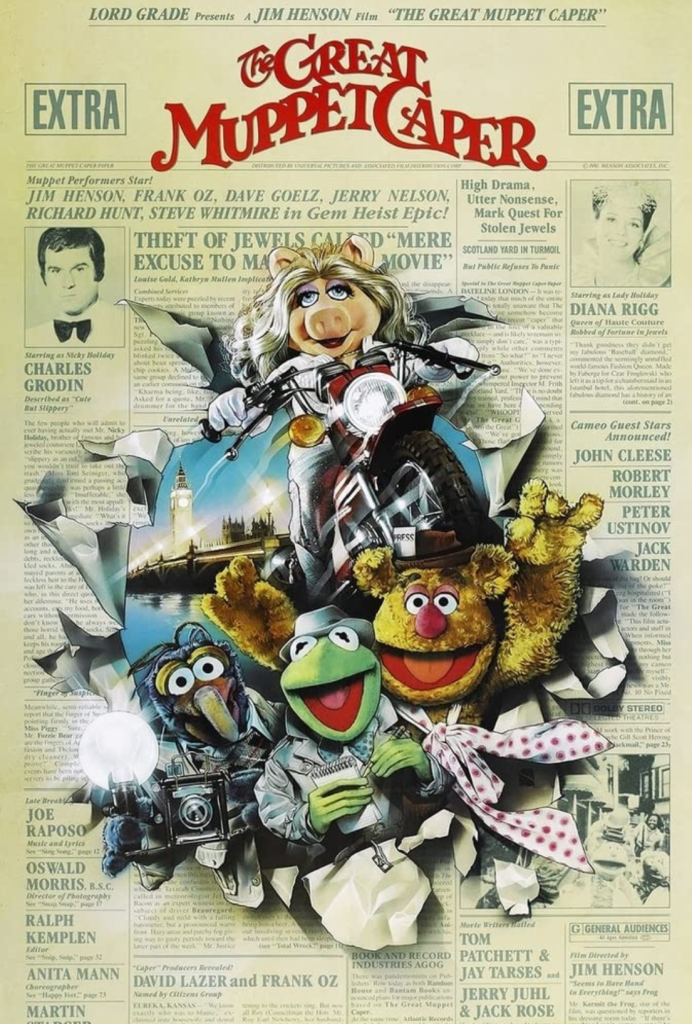
Welcome to part one of The Great Muppet Guest Star Caper Double Feature! Unlike past double feature reviews, my review of The Great Muppet Caper is spoiler-free. If you’re wondering why I chose this movie for the blogathon, you can check out this double feature’s introduction at the link below.
The Great Muppet Caperposter created by ITC Entertainment, Henson Associates, and Universal Pictures
1. Were you familiar with The Great Muppet Caper before The Great Muppet Guest Star Caper Blogathon?
I had heard of The Great Muppet Caper prior to being invited to the blogathon. One reason why I’m familiar with the 1981 film is Christine Elizabeth Nelson’s cameo. Christine is the daughter of Jerry Nelson, who was not only a member of The Muppets cast, he also worked on The Great Muppet Caper. Christine’s mother, Jacquie Gordon, wrote a book about her, titled Give Me One Wish: A True Story of Courage and Love, which chronicled Christine’s young life with a Cystic Fibrosis diagnosis. When I sought out her cameo, before seeing The Great Muppet Caper, I admit I was confused why Christine referred to Kermit as a bear. But as I watched the movie, I realized her line was part of a running joke where Kermit and Fozzie Bear are mistaken for twins, as they wear similar looking hats.
2. Who was the featured guest star in The Great Muppet Caper?
That would be John Cleese! He portrayed a character named Neville, a wealthy British resident. John and Joan Sanderson were featured in the scene where Miss Piggy breaks into a high-end home in an attempt to portray her boss, Lady Holiday.
3. If Neville was portrayed by a different actor, how would his role in The Great Muppet Caper change?
The Great Muppet Caper is similar to It’s a Mad, Mad, Mad, Mad, World in that the majority of the cast is given smaller roles, which results in a shorter amount of time on-screen. This surprised me, as I expected John to have more appearances in the movie. While John did a good job with the limited material given, I don’t think the role of Neville would change no matter who portrayed him. This is because The Muppets were the stars of the show, which is expected for this particular title.
4. Did you develop any thoughts and/or questions while watching this film?
In the film’s opening number, “Hey A Movie!”, a city landscape served as the number’s backdrop. From what I could tell, the city didn’t look like the background on Sesame Street. I was surprised by this creative decision, as both The Muppets and Sesame Street were created by Jim Henson. Because of this fact, I expected more cross-overs between the two intellectual properties (IPs). But the only Sesame Street reference I could find in The Great Muppet Caper was a cameo appearance from Oscar the Grouch. Personally, I think having Sesame Street serve as the backdrop for “Hey A Movie!” would have been a nice nod to that show. With both Sesame Street and The Muppets containing their own large cast of characters and their own specific stories, it makes sense why The Great Muppet Caper featured little acknowledgement of Sesame Street.
The inclusion and exclusion of certain Muppet characters also surprised me. Looking back on The Great Muppet Caper, I remember Pepe the King Prawn was nowhere to be found. In my recollections of The Muppets, Pepe and The Great Gonzo have been good friends. So, I was a bit confused why Pepe wasn’t featured in the story. After doing some research about the character, I learned he joined The Muppets family in 1996, a decade after The Great Muppet Caper premiered. Had Pepe starred in this movie, he likely would have worked with Lady Holiday’s fashion label.
5. The Great Muppet Caper was not only the second Muppet movie created, it was also released at the end of The Muppet Show’s run. Why do you think the creative team behind the Muppets chose to make and premiere this film toward the end of the show’s lifespan?
If you want to create a movie, especially a good one, there is a lot of time, dedication, creative energy, and resources needed to make that a reality. This can also be said for the creation of a television show. Many cast members from The Muppet Show also worked on The Great Muppet Caper. Had both of these programs been created around the same time, this creative team would have run the risk of their talent being spread too thin as well as creative burn-out.
6. Is there anything about The Great Muppet Caper you liked or didn’t like?
One of the overarching jokes in this story was the characters’ knowledge of being in a movie. The way this knowledge was written and delivered felt like the film’s creative team was winking at the audience. One example is when Lady Holiday, portrayed by Diana Rigg, tells Miss Piggy about her brother, Nicky, and why she doesn’t like him. After Miss Piggy asks Lady Holiday why she’s telling her this information, Lady Holiday responds, in a nonchalant and matter-of-fact way, that what she said is exposition and it needs to go somewhere. I liked this part of the story because of how it was cleverly incorporated into the script. The quality of the screen-writing made this overarching joke feel like it fit within the movie’s world.
The plot of The Great Muppet Caper revolves around Kermit, Fozzie Bear, and The Great Gonzo solving the mystery of stolen jewels. As someone who seeks out media from the mystery genre, I was intrigued by the idea of a mystery story starring The Muppets. But when I watched the movie, I quickly learned the musical numbers were given more emphasis than the mystery. Because I enjoyed watching and hearing these numbers, I didn’t mind this creative decision too much. However, I still wish the mystery itself was given a little more focus.
7. Could a new Muppets movie work in 2023?
In the short term, I believe a new Muppet movie could work, purely based on nostalgia. The Muppets is an IP (intellectual property) many people are fond of, so the movie itself might have a huge draw on opening weekend. But for long term success, meaning memorability, merchandising, and home entertainment sales, the story needs to be able to stand the test of time. To achieve that, the script has to be timeless and straight-forward.
8. What does The Muppet Show mean to you?
When I think of The Muppet Show, the word “tradition” comes to mind. It’s one of those shows the family can watch together, sitting around the television every weekend and enjoying the program, as well as each other’s company. With the large cast of characters, a variety of guest stars, and plenty of musical numbers, there seems to be something for everyone. Sadly, I can’t think of many shows today like The Muppet Show, a show that brings families together.
9. After watching The Great Muppet Caper, is there anything you can take away from your movie viewing experience?
When it comes to movies, especially musicals, sometimes the simplest, most straight-forward stories are the ones that work the best. As I reflect on The Great Muppet Caper, I am reminded of Singin in the Rain and Anchors Aweigh. These three films containstories that are easier to follow. But the strength of the talent, pleasant musical numbers, and execution of the final product worked in the story’s favor, making each title so enjoyable to watch! Seeing The Great Muppet Caper was such a fun experience! I found myself laughing and smiling during the film, as it exuded so much joy. That joy will carry in my heart long after the end credits roll. Then again, how can you not feel joy when The Muppets come around?
Last December, when I published my review of the 1981 made-for-TV movie, When the Circus Came to Town, it was my 700th post! For those who are not familiar with my annual double features, I commemorate the accomplishment of publishing 100 articles by hosting a special double feature, written in an interview style. In the past, my double features sought to answer a pre-selected question or see whether a prediction was correct. This time around, I will not include a pre-determined prediction or question. That’s because this double feature will correlate with The Great Muppet Guest Star Caper Blogathon! When I was invited by Gill (from Realweegiemidget Reviews) to join the event, I was told duplicates were not allowed. Keeping this in mind, I was surprised none of the Muppet movies had been chosen. I was also surprised to discover Big Bird (of Sesame Street fame) had been a guest star on The Muppet Show. With all of that said, I will be reviewing The Great Muppet Caper and Follow That Bird for the 700th double feature!