Take 3: Hallmark Hall of Fame’s The Corsican Brothers Review

When I reviewed the 1982 Hallmark Hall of Fame movie, Witness for the Prosecution, back in July, I stated how I didn’t think I’d ever see the film. This was due to the movie’s lack of DVD or VHS release. But this is not the only Hallmark Hall of Fame production I didn’t think I would ever receive the opportunity to watch. One of these titles is the 1985 film adaptation, The Corsican Brothers. Similar to Witness for the Prosecution, the 1985 title didn’t receive a VHS or DVD release, as far as I know. Also similar to Witness for the Prosecution, I was able to locate the full movie on Youtube! Besides these similarities, both films star Donald Pleasence. In fact, Donald’s involvement in The Corsican Brothers is one of the reasons why I chose to review this film, as I’m participating in The Devilishly Delightful Donald Pleasence Blogathon!

The Corsican Brothers poster created by Hallmark Hall of Fame Productions, Norman Rosemont Productions, and CBS

Things I liked about the film:

The scenery: Within the movie’s introduction, there is a shot of the ocean surrounding Corsica. As the introduction continues, rocky terrains, rolling hills, and a city on a mountain are also showcased. The natural beauty of this island was captured well on film, making outdoor scenes visually appealing. When scenes took place in the town, quaint looking buildings met cobble stoned streets. A fountain was located in the town’s square. From a visual perspective, the town looked peaceful. It resembled Wanda’s hometown in the Hallmark Hall of Fame movie, In Love and War!

The historical accuracy: According to the film’s introduction, the story begins in 1820. Though the majority of the story revolves around Louis and Lucien’s life as adults, the film still takes place in the 19th century. While watching The Corsican Brothers, I was impressed by the historical accuracy shown on screen! Furniture is one example of this. In a scene where the camera pans over a section of a study room, a green embroidered chair with bolted upholstery was featured. An oil lamp was also included in the room. The windows boasted a lattice design, which highlighted an old-world charm to the titular characters’ home. These details provided a nice blend of the characters’ past and present!

The Devilishly Delightful Donald Pleasence Blogathon banner created by Gill from Realweegiemidget Reviews and Barry from Cinematic Catharsis

What I didn’t like about the film:

The underutilization of Donald Pleasence: As I stated in the introduction, Donald Pleasence is one of the reasons why I chose to review this adaptation of The Corsican Brothers. As this is his second Hallmark Hall of Fame production I’ve seen and reviewed, I was eager to witness more of his acting talents. But, to my disappointment, Donald only appeared in about three and a half scenes. He did a good job with the acting material he was given. However, it made me wonder why he was cast in this movie in the first place, especially if the role didn’t allow his talents to be fully showcased?

Unexplained parts of the story:  I have never read this film’s source material. Despite this, I expected The Corsican Brothers to be like other adaptations of Alexandre Dumas’ stories; exciting tales full of adventure and intrigue. With the 1985 Hallmark Hall of Fame project, however, I was, more often than not, confused by what was happening on screen. At the beginning of the movie, a voice-over talks about how the region of Corsica is overruled by a multi-generational long vendetta. What this voice-over forgets to mention is how and why this vendetta started. From time to time, a mysterious woman appeared in Corsica, giving some of the characters fates. No explanations are provided for who this woman is or why she wants to get involved in the story’s events.

Little to no sense of urgency: In the adaptations of Alexandre Dumas’ stories I’ve seen, a common ingredient is a sense of urgency. Since there is a sense of adventure found in these stories, an added element of urgency gives the audience a reason to stay invested in the characters and their journey. With The Corsican Brothers, though, this sense of urgency was almost non-existent. I’d say about fifty percent of this movie showed Louis attending fancy events in Paris. Even when parts of the story were meant to be exciting, they either came across as anti-climactic or were not shown on screen. A good example is the trial in Paris that Louis is a part of.

Limited use of lighting: In a few scenes, events took place at night. But because of the limited use of lighting, it was difficult to see what was happening on screen. It got to the point where I couldn’t see characters’ faces. I am aware cinematic technology in the mid-80s was not as advanced as it is today, especially when it comes to made-for-tv films. Had the creative team of The Corsican Brothers incorporated a little more light to the nighttime scenes, it would have remedied the issue.

Hand-written letter image created by Veraholera at freepik.com. <a href=”https://www.freepik.com/free-photos-vectors/background”>Background vector created by Veraholera – Freepik.com</a>. <a href=’https://www.freepik.com/free-vector/love-letter-pattern_1292902.htm’>Designed by Freepik</a>. Image found at freepik.com.

My overall impression:

When creating a book-to-film adaption, you should strive to create a movie that satisfies both the casual viewer and readers of the source material. As I stated in this review, I have never read The Corsican Brothers. Instead of being invested in the characters and their stories, I was, more often than not, confused by the events on screen. It felt like the creative team behind the movie expected the audience to have read the book prior to watching their presentation. Story related flaws are not the only flaws that stood out to me. Limited use of lighting made nighttime scenes difficult to see. The underutilization of Donald Pleasence also didn’t help. Not all Hallmark Hall of Fame movies are created equal, as some are bound to be better than others. Sadly, The Corsican Brothers isn’t one of the better ones.

Overall score: 5.5 out of 10

Have you seen The Corsican Brothers? What’s your favorite adaptation of Alexandre Dumas’ literary work? Let me know in the comment section!

Have fun at the movies!

Sally Silverscreen

Take 3: The Legend of Billie Jean Review (80s-tastic Mall-tacular Double Feature Part 2)

Hello and welcome to the second part of the 80s-tastic Mall-tacular Double Feature! Before this review begins, I’d like to remind my readers there will be spoilers for The Legend of Billie Jean. If you’re interested, you can check out the double feature’s introduction and first part at these links:

The 80s-tastic Mall-tacular Double Feature Introduction!

Take 3: Night of the Comet Review (80s-tastic Mall-tacular Double Feature Part 1)

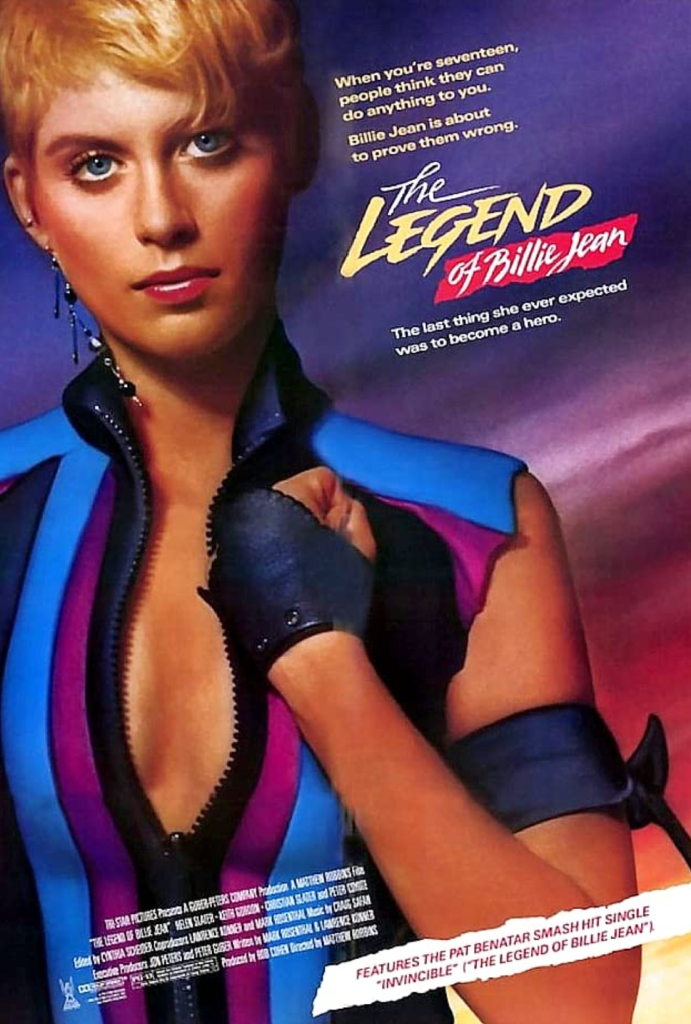
The Legend of Billie Jean poster created by Delphi III Productions, The Guber-Peters Company, and Tri-Star Pictures

1. How were you introduced to The Legend of Billie Jean?

Before I started watching Dan Bell’s Dead Mall series, I had heard of The Legend of Billie Jean. It wasn’t until I saw the video, ‘DEAD MALL SERIES : Tour of the SUNRISE MALL from THE LEGEND OF BILLIE JEAN (1985)’, that my interest in the film piqued. In this 2016 video, Dan uses clips from The Legend of Billie Jean to compare how Sunrise Mall looks in the 21st century. He even discusses the history of the mall itself.

2. As of 2022, what is the state of the Sunrise Mall?

The portions of the mall that were featured in Dan’s video permanently closed in 2019. Only three tenants are still standing, which are connected to the mall’s exterior.

3. What role did the Sunrise Mall play in The Legend of Billie Jean?

In The Legend of Billie Jean, the Sunrise Mall was called ‘Ocean Park Mall’. It was the place Billie Jean agreed to meet the police in order to accept the money. Prior to this arrangement, Billie Jean’s brother, Binx, had his scooter destroyed. Billie Jean and her friends turn to the police with little success. She even tries to acquire the money to repair Binx’s scooter. One thing leads to another, causing Billie Jean, Binx, and her friends to run from the law. When Billie Jean arrives at Ocean Park Mall, she thinks she’ll finally get the money. But those plans don’t work out, with a chase scene ensuing.

4. Why do you think the Sunrise Mall was in the film for a short amount of time?

The Legend of Billie Jean is an expansive narrative, similar to Night of the Comet. As I said in answer number three, Billie Jean, Binx, and her friends go on the run. Because of this, the characters are not going to stay in the same place for an extended period of time. Around the filming and release of The Legend of Billie Jean, the Sunrise Mall was a business that relied on daily revenue and foot traffic. Therefore, the mall could only allow filming to take place within a certain time period.

5. Besides including a mall and focusing on teenage characters, do The Legend of Billie Jean and Night of the Comet share a common theme, idea, or message?

Like I mentioned in answer number three, the film’s conflict started because Binx’s scooter was destroyed. After the scooter was stolen by a neighborhood bully named Hubie, Binx’s attempt to retrieve it resulted in him getting beaten up by Hubie and his friends. This is when Billie Jean decided more needed to be done to help her brother. Billie Jean and Binx reminded me of Regina and Samantha from Night of the Comet. Both pairs of siblings are prominently featured in their respective story, with each pair trying to make the best of a complicated situation. Throughout each film, both sibling pairs appear to get along well with each other, displaying a good sense of camaraderie.

Money image created by Freepik at freepik.com. <a href=’https://www.freepik.com/free-vector/bills-and-coins-in-isometric-design_1065328.htm’>Designed by Freepik</a>. <a href=”https://www.freepik.com/free-photos-vectors/business”>Business vector created by Freepik</a>. Image found at freepik.com.

6. Is there anything about The Legend of Billie Jean you liked or didn’t like?

A pleasant surprise while watching The Legend of Billie Jean was the discovery of mixed media! Throughout the film, voice-overs from a radio station were heard. A newspaper would appear in the story from time to time. Video footage of Billie Jean also made an appearance in the story. The inclusion of mixed media led to creative and interesting ways it was used in the movie. Radio station voice-overs featured calls from listeners, sharing their support for Billie Jean and her cause. Newspaper articles shared details to progress the story forward, from the health status of Hubie’s father to the identity of Lloyd. In an effort to clear her name, Billie Jean, Binx, and her friends create a video and give copies to the police and various tv stations. Mixed media allowed the movie to receive a unique and memorable identity!

The majority of this story focused on the conflict of how Billie Jean, Binx, and her friends would obtain the money to repair Binx’s scooter. Billie Jean received the most character development, as she is the titular character. While I thought the story was interesting and while I liked Billie Jean as a character, I wish some of the other characters had received more character development. Toward the beginning of the film, one of Billie Jean’s friends, Putter, is watching a female wrestling match on tv. When she learns of Billie Jean’s plan to report Binx’s stolen scooter, Putter eagerly looks forward to this excursion to the police station. As I was watching the movie, I was curious about Putter’s interest in going to the police station and watching wrestling on television.  Unfortunately, these parts of the story were not explained.

7. Did you develop any thoughts and/or questions while watching this film?

While I didn’t develop any questions, I did notice some interesting coincidences. During my viewing of The Legend of Billie Jean, I learned the movie was a “modern” Joan of Arc story. After Billie Jean, Binx, and her friends break into Lloyd’s house, Lloyd introduces them to the story of Joan of Arc. Billie Jean is so inspired by what Lloyd told her, she decides to cut her hair short to reflect Joan’s appearance. There’s even a parallel between Joan of Arc getting burned at the stake and a statue of Billie Jean getting burned in a fire toward the end of the movie. Now here’s where the interesting coincidences come in. Last year, I reviewed the Touched by an Angel episode, “The Spirit of Liberty Moon”. That episode was not only a “modern” Joan of Arc story, Bai Ling’s character was named Jean. Yes, I know the name, Jean, is Billie’s middle name. But according to Jean’s friend in “The Spirit of Liberty Moon”, Jean is the French version of Joan. Plus, I reviewed both the Touched by an Angel episode and The Legend of Billie Jean in October.

8. In your double feature for Rich Kids and Over the Edge, you discussed certain events from the ‘70s that likely influenced the creation of those films. Is there anything from the ‘80s that you think either affected The Legend of Billie Jean or teenagers from that time?

Imagine, once again, you’re a teenager in the 1980s. You have so much to be thankful for, from a family that loves and supports you to that new set of wheels you just got as a gift. But, sometimes, you think life can be a little unfair. On your way home from school, you see a homeless person on a street corner, asking for money or even a sandwich. A flyer appears in your family’s mailbox from time to time, asking for food bank donations. No matter how respectful you are to the homeless person on the street corner or how many donations you take to the food bank, you wonder if your efforts are enough to truly make a long-lasting impact. Then, you hear about an event called Hands Across America. Everyone is talking about it, from your next-door neighbor to the cashier at your local grocery store. There’s even an assembly at your school about the event. The more you think about Hands Across America, the more you realize there are other people that have the same thought as you do: try to make the world a better place than how you found it.

Hands Across America was not mentioned in The Legend of Billie Jean. In fact, the event took place a year after the film was released. But there was one scene that reminded me of this piece of ‘80s history. While Billie Jean, Binx, and her friends are on the run, a group of children ask for Billie Jean’s help. They lead her to a house where one of their friends is being physically abused by his father. The small group grows larger as Billie Jean makes her way to the house. Binx and Billie Jean’s friends eventually join the group, adding their support for Billie Jean’s mission. Now you’re probably wondering, “What does this scene have to do with Hands Across America”? Well, it’s the idea of people from all walks of life coming together to support a common goal. In the case of The Legend of Billie Jean, those children, plus Billie Jean, Binx, and her friends, shared the same idea: save the young boy from his abusive dad. Before Billie Jean succeeded in her rescue effort, the large group of children circled around the boy’s house, intimidating the boy’s father. The film itself, as well as Hands Across America, showed teenagers at that time there were other teens who shared their same goals and dreams.

9. A lot has changed since the release of The Legend of Billie Jean. Have you come across any recent pieces of media that prominently feature a mall?

After breaking into Lloyd’s house, Billie Jean discovers a room upstairs. In this room, there are Halloween masks, security monitors, even video equipment. The room itself could make any Halloween costume store jealous, with dim lighting, candles, and cobwebs adding to the room’s eerie atmosphere. Even the build-up to the room’s discovery was straight out of a horror movie, as a costumed Lloyd follows Billie Jean. Later in the film, it is discovered Lloyd is a member of his school’s drama club, explaining why the aforementioned room contained so many costumes.

The scene I just described reminded me of a Hallmark film titled hoops&yoyo’s Haunted Halloween. In this animated film, the protagonists, Hoops and Yoyo, along with their friend, Piddles, go Halloween costume shopping at their local mall. During their trip, they become locked inside the mall after hours. I’ve only seen pieces of this 2012 movie. But based on what I have seen, the film is more spooky than scary. However, I do think it’s an interesting coincidence how both hoops&yoyo’s Haunted Halloween and The Legend of Billie Jean feature a mall in their respective story.

10. After watching this movie, is there anything you can take away from your movie viewing experience?

Calling The Legend of Billie Jean a “mall movie” is, in my opinion, a bit of a stretch. Similar to Night of the Comet, the Sunrise Mall was featured in only a few scenes. If anything, The Legend of Billie Jean is a “coming of age” story, as Billie Jean, Binx, and her friends experience personal growth over the course of the film. I liked The Legend of Billie Jean more than Night of the Comet. The story in the 1985 movie was pretty straight forward, making the film easier to follow. It was also interesting how mixed media was incorporated into the story. The Legend of Billie Jean is a fine, competently made film, complete with its own merits and flaws. The film’s message of how “fair is fair” is just as relevant now as it was in 1985, allowing the movie to be a more timeless title.

Image by Freepik

Have fun at the mall!

Sally Silverscreen

Take 3: Night of the Comet Review (80s-tastic Mall-tacular Double Feature Part 1)

Hello and welcome to the first part of the 80s-tastic Mall-tacular Double Feature! Before this review begins, I’d like to remind my readers there will be spoilers for Night of the Comet. If you’re interested, you can check out the double feature’s introduction at this link:

The 80s-tastic Mall-tacular Double Feature Introduction!

Night of the Comet poster created by Thomas Coleman and Michael Rosenblatt Productions, Film Development Fund, and Atlantic Releasing Corporation

1. How were you introduced to Night of the Comet?

At the beginning of Dan’s video, ‘DEAD MALL SERIES : Back to the 80s : The Gallery in Philadelphia (Hologram Plaza – Disconscious)’, the scene where Regina and Samantha, the film’s protagonists, go to the mall is included in the introduction. That scene is spliced with Dan’s footage of The Gallery in Philadelphia, as the song, Enter Through the Lobby by Disconscious, plays over the images. In Dan’s video, ‘DEAD MALL SERIES : Best Fountain in the US : Burlington Center Mall NJ **CLOSED**’, he brings up several of his favorite “mall movies”. One of these movies is Night of the Comet.

2. Was Night of the Comet filmed in a mall? If so, which one?

According to a Youtube comment, Night of the Comet was filmed at Bullocks Wilshire. Upon further research, I learned it was a high-end, Los Angeles department store, complete with its own tea room. As of late 2022, the building is owned by Southwestern Law School.

3. What role did the mall play in Night of the Comet?

Before Regina suggests she and Samantha go to the mall, their world had been turned outside down. Most of the population had either been disintegrated into dust or turned into a zombie, due to the aftermath of the titular comet. The sisters are at their wits end, desperately trying to not only defend themselves, but also trying to find answers. After Samantha tearfully confesses how a guy from her class was going to ask her out on a date, Regina sees going to the mall as an opportunity to get their minds off the confusion surrounding them.

4. Why do you think the mall was in the film for a short amount of time?

When Dan Bell referred to Night of the Comet as a “mall movie”, I assumed the mall would play a significant role in the story. I even predicted the mall would play a bigger role in Night of the Comet than in The Legend of Billie Jean, as I thought the story would primarily take place in one location. But the 1984 title is a more expansive narrative. Not only is the aftermath of the comet more widespread, there are more locations for the characters to explore. While Regina and Samantha’s mall excursion was fun to watch, it was interesting to see the comet’s effects on other locales, like the local movie theater and a mysterious science headquarters.

5. Besides including a mall and focusing on teenage characters, do The Legend of Billie Jean and Night of the Comet share a common theme, idea, or message?

I haven’t seen The Legend of Billie Jean yet. But based on the introduction of Dan’s video, ‘DEAD MALL SERIES : Tour of the SUNRISE MALL from THE LEGEND OF BILLIE JEAN (1985)’, I can safely assume a shared idea between The Legend of Billie Jean and Night of the Comet is younger characters taking matters into their own hands. As I mentioned in answer number three, Regina and Samantha are at their wits end, as they desperately try to defend themselves and figure out what is truly going on. Since there are very few people to turn to, they rely on themselves and each other, proving they are capable of anything they set their mind on. Through strength, resilience, and adversity, Regina and Samantha become the embodiment of Christopher Robin’s quote:

“You’re braver than you believe, stronger than you seem, and smarter than you think.”

Colorful galaxy image created by Freepik at freepik.com. <a href=’https://www.freepik.com/free-vector/lovely-hand-drawn-galaxy-background_2943080.htm’>Designed by Freepik</a>. <a href=”https://www.freepik.com/free-photos-vectors/background”>Background vector created by Freepik</a>. Image found at freepik.com.

6. Is there anything about Night of the Comet you liked or didn’t like?

Based on the synopsis and Dan’s thoughts on Night of the Comet, I knew the protagonists were described as “valley girls”. But I didn’t know what to expect from Regina and Samantha. When I watched the movie, though, I adored these characters, as they were so endearing! In fact, they’ve become two of my favorite characters from film! Part of this is due to Catherine Mary Stewart’s and Kelli Maroney’s performance. Through their well-rounded portrayals, Catherine and Kelli carried this film, making it worth the price of admission. No matter what their characters experienced, their expressions and reactions felt realistic. Even the on-screen camaraderie was believable, successfully selling the idea Regina and Samantha were sisters. According to Wikipedia, Thom Eberhardt, Night of the Comet’s director, asked teenage girls how they’d respond to a large-scale catastrophe while working on PBS specials. The answers he received were used as inspiration for the film’s script, adding to Regina and Samantha’s believability.

When creating a science fiction story, you need to explain the science in a way that satisfies the audience. Even if the science was made specifically for the story, you still need to provide a logical explanation. With Night of the Comet, though, most of the science was left unexplained. There were also parts of the story that were under-utilized. At the beginning of the movie, Regina is playing an arcade game. She discovers a gamer named “DMK” has beaten her high score. Not only does Regina attempt to beat “DMK”’s high score, she wonders who “DMK” is. While the audience learns the identity of “DMK” (a random survivor named Danny, who used his initials to record his high score), this part of the story was forgotten about until the end of the movie. To me, this was a missed opportunity. Regina could have used her video game/arcade game skills to save the day. She and “DMK” could have met face-to-face earlier in the story, setting aside their differences to recruit more survivors to safety. But, alas, it just wasn’t meant to be.

7. Did you develop any thoughts and/or questions while watching this film?

As I said in answer number six, most of the science was left unexplained. While watching Night of the Comet, I found myself more confused than entertained. I’ll list some of the questions I had after I saw the movie, as I don’t want this review to become even longer than it already is:

  • Why did the effects of the comet cause some people to disintegrate into dust while causing others to become zombies?
  • Why exactly did steel protect Samantha, Regina, and the other survivors from the comet’s effects?
  • How did Brian and Sarah survive? Where did they come from?
  • Why did Willy and his gang of zombies possess more intelligence than other zombies the survivors encountered?
  •  What was the mission of the scientists? Were they trying to save or harm humanity?
  • Why did Audrey White go rogue? Was she a zombie?

8. In your double feature for Rich Kids and Over the Edge, you discussed certain events from the ‘70s that likely influenced the creation of those films. Is there anything from the ‘80s that you think either affected Night of the Comet or teenagers from that time?

Imagine you’re a teenager in the 1980s. You’ve got a lot of your plate as it is, from trying to pass your upcoming math test to figuring out how you’re going to get that latest album from the music store. But from time to time, you hear about this thing called The Cold War. That phrase puts a concerned look on your parent’s face as they drive you to school. You hear about it on the news, with the President pleading to “tear down that wall”. Even your favorite tv show is bringing it up. The Cold War seems to be everywhere. You wish there was something you could do to end this conflict. But because you’re just a teenager, you feel powerless, like there’s not much you can do. As you’re reading this, you’re probably wondering, “What does The Cold War have to do with Night of the Comet”? Even though The Cold War isn’t brought up in the story, it was present around the time of the film’s release. And yes, the film is meant to be a form of escapism. However, through Regina and Samantha’s adventures, teenagers at that time could see there were things within their control they could do.

9. A lot has changed since the release of Night of the Comet. Have you come across any recent pieces of media that prominently feature a mall?

For this answer, I’m not going to bring up a piece of media. Instead, I’ll talk about an experience, as it makes more sense with Night of the Comet. In the U.K., there is a company called Zombie Experiences, providing customers with the opportunity to explore abandoned locations and defeat zombies. One of those locations was a mall. But according to Zombie Experiences’ website, this experience ended in February 2018. They did re-locate this particular experience to a shopping complex. However, on Zombie Infection’s website, it will end this December. There are two other shopping mall experiences offered, but they seem inactive at the time of this review’s publication.

10. After watching this movie, is there anything you can take away from your movie viewing experience?

Calling Night of the Comet a “mall movie” is, in my opinion, a bit of a stretch. This is because the mall only appears in a few scenes. If I had to call Night of the Comet anything, I’d call it an “alternative Christmas film”. The story takes place around Christmastime, but doesn’t rely on the tropes and clichés typically found in Christmas movies. Like I said in answer number seven, I was more confused than entertained by Night of the Comet. After watching this film, I was left with more questions than I planned to have. But one of the reasons why I kept watching was Catherine’s and Kelli’s performance. I also think the story itself contained interesting ideas. Overall, I think Night of the Comet is an ok film with some bright spots.

Image by evening_tao on Freepik

Have fun at the mall!

Sally Silverscreen

The 80s-tastic Mall-tacular Double Feature Introduction!

Whenever I publish 100 posts, I coordinate a special double feature. Back in January, my 600th post was my Buzzwordathon review of How to Write Good by Ryan Higa. Since then, I’ve been waiting for the right time to talk about my next double feature. Now, I’m excited to finally publish these long over-due articles! With the changing of the seasons from summer to fall, there’s one place that has remained a constant staple: the mall. Back to school shopping may be in full swing, depending on when a given school distinct begins their year. Some people might consider starting their Christmas/holiday shopping, especially to avoid the crowds. Maybe a local mall has a reputation of gathering the community, from being a popular hangout spot to hosting community events. With that said, this double feature will revolve around the mall!

There are several movies from several decades where a mall is a story’s setting. For this double feature, though, both films were released in the ‘80s. Within that decade alone, there are several options I could have selected. But I ended up going with The Legend of Billie Jean and Night of the Comet! At first glance, pairing these films together seems like a no-brainer. However, I intentionally chose these titles because they were referenced on the Dead Mall Series, created by Youtuber, This is Dan Bell.

Image by Freepik

In my double features, I attempt to answer a question through both of my reviews. But this time, I will only make a prediction, as I haven’t made a prediction since my Halloween double feature back in 2018. For this double feature, my prediction is the mall in Night of the Comet will play a bigger role than the mall in The Legend of Billie Jean. I haven’t seen any of these films prior to these reviews. Based on the clips that were in the introduction of Dan’s video, ‘DEAD MALL SERIES : Tour of the SUNRISE MALL from THE LEGEND OF BILLIE JEAN (1985)’, my guess is the story of The Legend of Billie Jean will revolve around a conflict that is not confined to the mall. I once read a synopsis for Night of the Comet that stated the film contained a zombie apocalypse. If this is true, the script would present a logical explanation for the story remaining in one location.

Have fun at the mall!

Sally Silverscreen

Take 3: Hallmark Hall of Fame’s Witness for the Prosecution (1982) Review

In my list of the Top 10 Movies I’d Love to Review, I mentioned finding Oliver 2: Let’s Twist Again on Diana Rigg’s IMDB filmography. During that trip on IMDB, I found another film I could review for the Other Than A Bond Girl Blogathon. As the title of this review says, that movie is the 1982 Hallmark Hall of Fame presentation, Witness for the Prosecution! I’ve gone on record to state how I’d like to watch as many Hallmark Hall of Fame titles as realistically possible. If I’m going to be honest, I didn’t think I would ever see Witness for the Prosecution. That’s because the film not only didn’t receive a DVD release, but it doesn’t seem to have received a VHS release either. So, imagine my shock when I found the full movie on Youtube! Mysteries are, arguably, the most popular genre on my blog. This is also not the first time I’ve reviewed an Agatha Christie adaptation. Back in April, I wrote about the 2022 film, Death on the Nile. In that review, I said the movie had a weaker execution than its 2017 predecessor, Murder on the Orient Express. How will Witness for the Prosecution fare against these aforementioned adaptations? All rise, as this review is now in session!

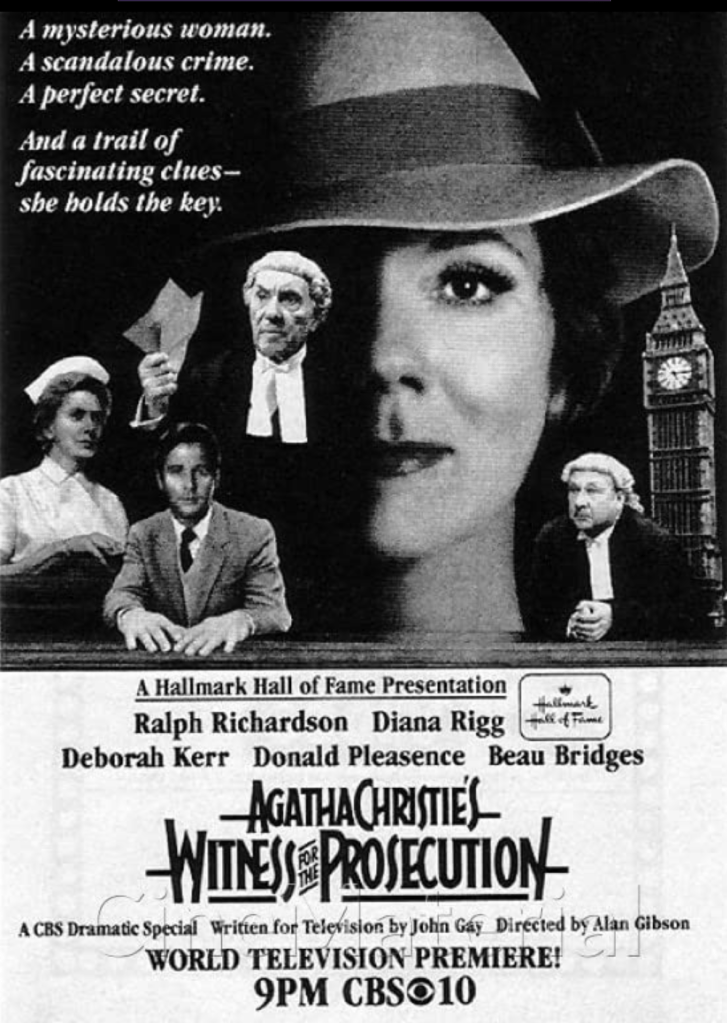
Hallmark Hall of Fame’s Witness for the Prosecution poster created by CBS Entertainment Production, Hallmark Hall of Fame Productions, Rosemont Productions, and United Artists Television

Things I liked about the film:

The acting: Diana Rigg is one of the eligible Bond Girls for the Other Than A Bond Girl Blogathon. Therefore, I will talk about her performance first. In Witness for the Prosecution, Diana portrayed Christine Vole, the wife of the accused party. Throughout the film, she carried her character as a woman from stories in the 1920s. What I mean by this is Christine held her own with confidence, never shaken by the probing of those involved in the legal side of the case. Even when she took the stand, Christine adopted a serious demeanor, as if putting on a “poker face” and refusing to show her deck of cards too early. These acting choices and the consistency of her performance allowed Diana to pull off a captivating and memorable portrayal!

Deborah Kerr is an actress I’ve talked about before on 18 Cinema Lane. While I have seen and reviewed five of her films, none of them were from the mystery genre. Despite this, Deborah held her own, acting wise, among the cast! She portrays Nurse Plimsoll in Witness for the Prosecution. While watching the 1982 production, her performance reminded me a bit of Donna Reed’s portrayal of Mary from It’s a Wonderful Life. Nurse Plimsoll cares about the health and well-being of the film’s protagonist, Sir Wilfred Robarts. Though Wilfred finds her overall nursing approach annoying, Nurse Plimsoll doesn’t give up on her mission. Even though she is stricter than other on-screen nurses, her heart is always in the right place. This can be seen through Deborah’s facial expressions, body language, and emotions.

Even though the cast as a whole was strong, there was one performance that stole the show. This came from Beau Bridges! Witness for the Prosecution shows Beau portraying an American named Leonard. Because his case is presented in a British/U.K. court system, he is a “fish out of water”. The situation itself provides an interesting dynamic for the cast, including Beau, to work with. It also gave Beau an opportunity to utilize a variety of emotions. During the case, one of the witnesses causes Leonard to have an emotional reaction. At the start of the witness’ questioning, Leonard presents a calm “resting face”. But as the questioning continues, he slowly becomes sadder, adopting a growing frown and his eyes filling with tears. This transformation was gradual, allowing Beau to adapt to the on-screen situation.

The set design: The majority of Witness for the Prosecution takes place within a British/U.K. court room. Despite the limited locations, there were some examples of set design that I liked! Inside the court room, the ceiling was domed, with clear glass exposing a view of the sky. Surrounding the dome are etched, white arches. With a green light shown on these arches, they gave the appearance of boasting an antique limestone material, which complimented the dark wood of the court room’s walls and furniture. In the lobby of the court room, painted murals are shown near the ceiling. The lobby’s walls appear to be covered in a two-tone marble material, with the floor revealing a black-and-white tile design. My favorite set in Witness for the Prosecution was Wilfred’s office! The room’s color scheme was brown, beige, and red. When this set was first introduced, a large, dark wood bookcase proudly stood. It was guarded by a dark wood table and two dark brown armchairs. While the walls were beige, the curtains on the window were red, giving the room a pop of color. The more time Wilfred spent in this space, the more the sophisticated, professional, and intelligent appearance of the office complimented his personality.

An in-depth look at the British/U.K. court system: As I mentioned in my point about the film’s set design, the majority of this story takes place in a British/U.K. court room. That part of the movie exposed the audience to the British/U.K. court system. Even though Witness for the Prosecution is not the “end all, be all” when it comes to this specific court system’s portrayal in entertainment media, it gives viewers a chance to compare and contrast it to other court systems in other productions. The layout of the court room itself provides one example. Toward the front of the court room, the witness stand is located at the judge’s right-hand side. This part of the court room is separate from the judge’s stand. Meanwhile, in court room productions taking place in the United States, the witness stand can either be located at the judge’s left or right-hand side. It is also connected to the judge’s stand.  

The Other Than A Bond Girl Blogathon banner created by Gabriela from Pale Writer and Gill from Realweegiemidget Reviews

What I didn’t like about the film:

The magical monocle: While working on the case, Wilfred wore a monocle when he was questioning the accused party and his wife. As he questioned them, a light shone through the monocle and directly landed on Leonard and Christine. But these were the only two times Wilfred used the magical monocle. The purpose of the monocle or Wilfred’s reason for using it was never explained. Was this monocle truly magical or was the monocle used as foreshadowing? I wish this part of Wilfred’s character was more consistent.

A dialogue heavy story: With any movie or tv show episode featuring a court case, there’s going to be a certain amount of dialogue within the story. But because Witness for the Prosecution mostly revolved around a court case, the 1982 production feels more dialogue heavy compared to Death on the Nile and Murder on the Orient Express. Before watching Witness for the Prosecution, I had expected more showing than telling when it came to the mystery. Instead of watching the characters making discoveries related to the mystery, I heard about it through the questioning in court. Because of this creative decision, I didn’t find the movie’s mystery as engaging as it could have been.

An inactive detective: In a story where a detective, amateur or professional, is the protagonist, the audience expects to see this character actively solve their respective film’s mystery. Sadly, the viewers won’t witness that in Witness for the Prosecution. Wilfred is a lawyer defending Leonard in his case. However, Wilfred places more emphasis in resolving the case than playing detective. Even though this movie’s mystery was solved, it felt like Wilfred was served the answer on a silver platter instead of discovering it himself. Similar to what I said about the dialogue-heavy story, I didn’t find the mystery engaging because of Wilfred’s inactive detective role.

Sketch of London image created by Archjoe at freepik.com. <a href=’https://www.freepik.com/free-vector/hand-drawn-houses-of-parliament_1133950.htm’>Designed by Archjoe</a>. <a href=”https://www.freepik.com/free-photos-vectors/background”>Background vector created by Archjoe – Freepik.com</a>. Image found at freepik.com.

My overall impression:

Hallmark Hall of Fame’s Witness for the Prosecution shares a similar plot with 1997’s Red Corner: an American man is accused of murder, with his case in a court system outside of the United States. But where Red Corner succeeded and Witness for the Prosecution didn’t is how Shen, Jack’s lawyer in Red Corner, not only played a role in the court case, but also went above and beyond in attempting to solve the mystery surrounding the case. This allowed Red Corner’s story to be intriguing and engaging for the audience. With the 1982 production, Wilfred spends more time on the court case than the mystery wrapped around it. This decreases the audience’s engagement. The dialogue heavy nature of Witness for the Prosecution’s story also affected the mystery’s intrigue. Hallmark Hall of Fame’s presentation is the third Agatha Christie adaptation I’ve seen, which I wasn’t overly thrilled with. I still want to, one day, read her literary work. But based on my reactions to the three adaptations I have watched so far, I’m starting to wonder if I’ll find an Agatha Christie story I like?

Overall score: 6.1-6.2 out of 10

Have you seen any of Agatha Christie’s adaptations? Do you have a favorite Agatha Christie story? Let me know in the comment section!

Have fun at the movies!

Sally Silverscreen

Take 3: Children of a Lesser God Review

May’s theme for Genre Grandeur is ‘Best Picture Nominated Movies that didn’t win’. As the Oscars have been around for more than fifty years, there were plenty of titles for me to choose from. But I knew the main-stream, bigger name films were going to get selected by other participants of Genre Grandeur. So, I decided to choose a movie that was not only off the beaten path, but also less talked about than other films. This is one of the reasons why I’m reviewing Children of a Lesser God. Eric Binford, from Diary of A Movie Maniac, is another reason why I chose to write about the 1986 project. While talking about non-preachy movies containing messages, I brought up the Hallmark Hall of Fame production, Sweet Nothing in My Ear. After Eric mentioned how he loves Marlee Matlin, I realized I have never reviewed any project from Marlee’s filmography. I have seen Sweet Nothing in My Ear, as well as a handful of Switched at Birth episodes. But I’ve never discussed the ABC Family show on 18 Cinema Lane and I didn’t review the 2008 Hallmark Hall of Fame film. It should also be noted how the last time I wrote about an ’80s movie was last September.

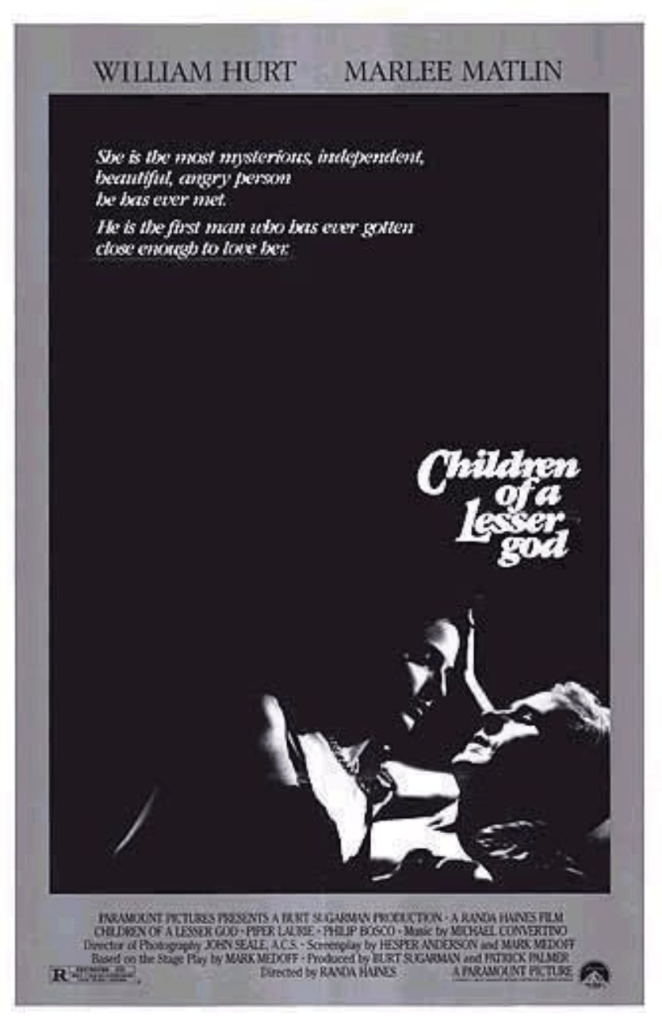
Children of a Lesser God poster created by Paramount Pictures

Things I liked about the film:

The acting: Since Marlee Matlin is one of the reasons why I chose to review Children of a Lesser God, I will talk about her performance first. While portraying Sarah, Marlee’s facial expressions and body language were expressive. They were also as fluid as her sign language. During an assembly, Sarah witnesses a performance from James’ students. At first, she appears content, not seeing any issue with the performance. But as the performance goes on, Sarah’s face progressively changes, appearing angry for reasons not yet revealed. In fact, Sarah becomes so upset by this performance, she ends up breaking a mirror. The strength of Marlee’s acting abilities not only allowed her to stand on her own, talent-wise, but also go toe-to-toe with William Hurt!

In Children of a Lesser God, William Hurt portrays James. The first thing I noticed about his acting performance was how he was able to balance the light-hearted and serious moments of the story! Toward the beginning of the film, James is explaining to his students why they should learn to speak. To demonstrate a likely scenario, James does a hand-stand, in an attempt to make his point. Later in the film, James learns more about Sarah. She explains how, in high school, her male peers would desire an intimate relationship with her, yet refuse to take the time to get to know her. During this conversation, James becomes frustrated over things he can’t change, such as Sarah’s past. Similar to what I said about Marlee’s performance, William was also expressive in his role. The expressive nature of his performance is what helped him maintain a consistent portrayal!

Several scenes show James interacting with the students in his speech class. These scenes are meant to serve as the more light-hearted moments of the film. One of the students in this class is Lydia. Portrayed by Allison Gompf, Lydia was not afraid to try new things. In fact, she was one of the first students to try speaking. What helped Allison and her character be memorable was her on-screen personality. It was so bubbly and up-beat, you can’t help but smile every time she appears on screen!

The on-screen chemistry: As I just mentioned, both Marlee and William gave solid performances individually. However, they also performed well together! The strength and expressiveness of their acting abilities worked in their favor and complimented one another. These aspects of their combined performance allowed them to showcase a relationship that felt realistic. One of my favorite scenes in Children of a Lesser God takes place when James wants to listen to one of his records. But shortly after he puts on a Bach record, he is overcome with guilt. James turns off the record, telling Sarah he can’t enjoy the music because she can’t hear it. A few moments later, Sarah puts the record back on, as she knows how much James enjoys the music. Through the acting, as well as the screenwriting, this scene is a great example of the sacrifices and compromises that can take place within a romantic relationship.

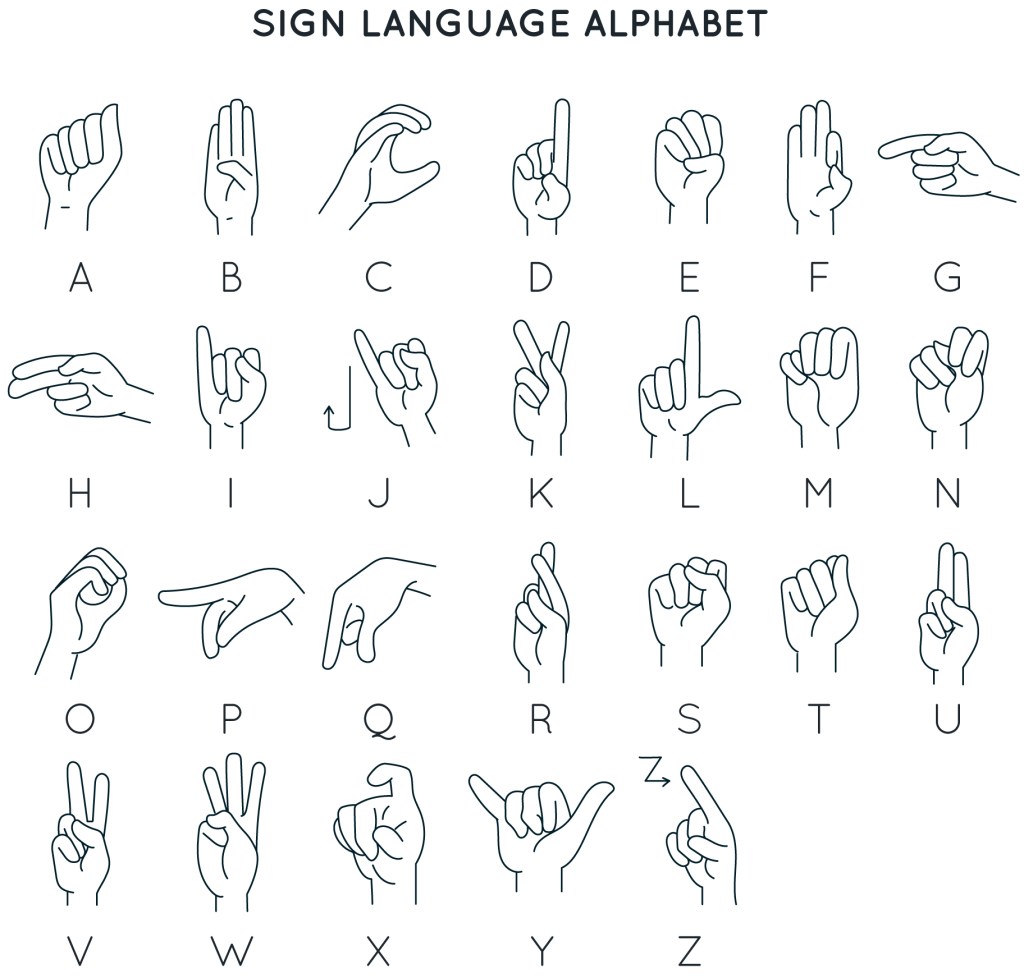
 An introduction to deaf culture: Whenever I talk about a movie highlighting a specific culture/community, I try to remind my readers that the film in question is not the “end all, be all” when it comes to discussing that culture/community. This is the case when talking about Children of a Lesser God. The students in James’ speech class are their own individuals, displaying distinct styles and expressing unique perspectives. These students, including Sarah, have their reasons why they either want or don’t want to speak. At one point in the film, James’ students perform in their school’s assembly. Throughout this performance, they sing, dance, and sign while on stage. The joy expressed by these characters can be seen and felt. This scene shows one can experience joy when they’ve found a place to belong.

Sign language alphabet image created by Freepik at freepik.com. Hand sign vector created by freepik – www.freepik.com

What I didn’t like about the film:

A confusing title: With a title like Children of a Lesser God, I’m going to safely assume “children” is referencing deaf people, with the title itself emphasizing how deaf people are just as important to society as hearing people. But in the movie, Sarah is the only deaf character the story revolves around. Yes, there are deaf characters featured throughout the film. However, these characters are shown as well-adjusted individuals who aren’t prejudiced or mistreated. As I mentioned before, Sarah recounts a situation that happened to her in high school. Sarah’s mother, portrayed by Piper Laurie, shares traumatic events Sarah experienced in her life. But all of these events happened prior to the film. With all this said, the title, Children of a Lesser God, seems confusing.

A limited presence of James’ students: As I said earlier in this review, the moments where James interacts with his students were meant to be the more light-hearted moments of the film. But throughout the movie, the presence of the students themselves were limited. I really liked the camaraderie between these characters, as it made their connection seem believable. Because of the student’s limited presence, it left few opportunities to get to know them. Sure, we learn about them through their experiences in James’ speech class. But compared to James and Sarah, I felt like I, as an audience member, only became familiar with James’ students. I kind of wish they had received their own subplot.

No appearances from Ruth: When Sarah’s mom is talking to James about Sarah’s past, she mentions her other daughter, Ruth. She also mentions how, in high school, Ruth’s male peers were more interested in Sarah. Despite Ruth getting brought up in the story, Sarah’s sister never appears in the film. Personally, I think this was a missed opportunity. It would have been interesting to hear the perspective of a sibling of someone with a disability. I also wanted to know how Ruth felt about what Sarah went through in high school. In the movie’s opening credits, I learned Children of a Lesser God was based on a Broadway play. I haven’t seen this play, so I don’t know if Ruth is a character that is meant to be in the story. But, like I said, it still feels like a missed opportunity.

Orange cat image created by Freestockcenter at freepik.com. <a href=’https://www.freepik.com/free-photo/ginger-cat_883376.htm’>Designed by Freestockcenter</a>. <a href=”https://www.freepik.com/free-photos-vectors/gold”>Gold image created by Freestockcenter – Freepik.com</a>. Image found at freepik.com.

My overall impression:

Children of a Lesser God is a character-driven movie. With these types of films, you need a cast that is so strong, it gives the audience a reason to stay invested in the overall story. That is exactly what this 1986 production achieved! Even though Children of a Lesser God primarily revolves around Sarah and James, the supporting cast was great to watch. Presenting an introduction to the deaf culture also helps. Though I liked this movie, there were some aspects of this project that could have been stronger. I wish James’ students had received their own subplot and Ruth had appeared in the story. But as I said in this review, Children of a Lesser God is based on a Broadway play. Therefore, I don’t know what was in the original source material. As I close this review, I’d like to say I can’t speak for whether Children of a Lesser God should have received the Best Picture award. That’s because I haven’t seen Platoon or the other films nominated in 1987.

Overall score: 7.7-7.8 out of 10

Have you seen Children of a Lesser God? Which movie do you think should have won Best Picture in 1987? Please let me know in the comment section below!

Have fun at the movies!

Sally Silverscreen

Travel Lessons I Learned from Movies and TV

Movies and television not only provide entertainment, they also tell a story through a visual medium. Something else movies and television do is teach lessons through those stories. Throughout my life, I have learned so many lessons from various movies and television shows. How to travel smart has been one of them. As my blogathon’s theme this year is ‘Travel Gone Wrong’, I have decided to share a list of six travel related lessons I’ve learned over the years! This is especially exciting, as it’s the first list I’ve created for one of my blogathons! The list is based off of movies and shows I have personally watched. I also tried to present a combination of programs where the mishaps were met with either hilarious or horrifying results. Now, have your boarding ticket ready, as we’re about to start this list!

Created by Sally Silverscreen at Adobe Creative Cloud Express

Never Tell Strangers Where You Will be Staying (Especially if You’re Traveling Alone)

When I reviewed the 1962 film, Cape Fear, I said the most effective “scary movies” are the ones that involve real-life situations. A movie that definitely belongs in that discussion is the classic, Taken. The 2008 title showcases the dangers that can sometimes present themselves in international travel, without coming across as a PSA/cautionary tale/“after school special” type story. This is because the film places more emphasis on the action within the project. Every time I think of this movie, I always speculate how Kim and Amanda might have avoided their plight had they not told a group of strangers, who ended up being human traffickers, which hotel they were staying at. It also didn’t help how they revealed they were both traveling alone. There’s a saying that goes “Strangers are friends you haven’t met yet”. Well, as Kim and Amanda’s situation shows, that isn’t always the case, especially since some people’s intentions are not great. Watching Taken reminded me how you should only share your hotel and travel status with people you know and trust.

Pink travel backpack image created by Pikisuperstar at freepik.com. <a href=”https://www.freepik.com/free-photos-vectors/watercolor”>Watercolor vector created by Pikisuperstar – Freepik.com</a>. <a href=’https://www.freepik.com/free-vector/travel-lettering-with-watercolor-pink-backpack_2686676.htm’>Designed by Freepik</a>. Image found at freepik.com.

If You Want to Start any Relationships with the “Locals”, Take the Time to Know Them First

When I refer to “locals”, I’m referring to anyone who is from a particular travel destination, whether it’s “across the pond” or across town. For this point, I have two examples to share. The first is from a movie I reviewed back in January, Red Corner. While in China for business related reasons, Jack becomes attracted to a woman he briefly met at a nightclub. Attraction gets the better of them, as they end up sharing intimate relations with one another. The woman is discovered dead the following morning, with Jack declared a suspect in her murder. The second example, which also involves a man named Jack, is the Lost episode “Stranger in a Strange Land”. Within the flashbacks from that episode, Jack forms a month-long, intimate relationship with Achara, a character I mentioned in my latest Sunset Over Hope Valley re-cap. During their relationship, Jack becomes frustrated that Achara won’t share what her “gift” is with him. Taking matters into his own hands, he barges into her place of employment and demands an explanation. When Achara’s revelation isn’t enough, Jack forces her to give him a tattoo, even though she initially refuses his request. Their relationship ends disastrously, with Achara in tears and Jack unofficially banned from Thailand.

Screenshot taken by me, Sally Silverscreen. Photo originally found at https://www.thehollywoodroosevelt.com/pool/tropicana-pool-cafe.

I’ve said before that, in my opinion, starting or ending a relationship shouldn’t be taken lightly. I’ve also said that both members of a relationship should be equal to one another. Taking that into account, it’s important to remember when two people come together to form a relationship, they bring with them elements of their lives, which includes their respective cultures. This is where my two examples come in. Despite Jack from Red Corner spending such a short amount of time with the aforementioned woman, he had to deal with her government, a government he was not familiar with. He was also not familiar with the Chinese language and cultural beliefs. This, to an extent, left Jack at a disadvantage. Meanwhile, in Thailand, Jack from Lost didn’t respect Achara’s cultural boundaries. As I mentioned earlier, she initially refused his tattoo request. During their confrontation, Achara told Jack her tattoos are “not decoration, it is definition”. Achara also said Jack couldn’t receive a tattoo because he was “an outsider”. Though she doesn’t provide details to her comments, Achara implies her tattoos have a strong connection to her culture. But whenever Jack and Achara are shown having a conversation, they seem to purposefully avoid talking about anything personal. When I first reflected on “Stranger in a Strange Land”, I knew Achara and Jack’s relationship didn’t last for a reason. Rewatching it years later reminded me why. Honestly, both parties from both relationships could have avoided so much heartache if they had taken the time to learn about and from one another. Sometimes, the best way to know more about a specific culture is to interact with those who are a part of it. Seems to me both aforementioned relationships missed a great opportunity.

Illustrated African landscape image created by Macrovector at freepik.com. Background vector created by macrovector – www.freepik.com

Be Mindful Who You Place Your Valuable Belongings With

Traveling with valuable belongings is inevitable. This has been the case since the concept of traveling was born. A valuable belonging can be almost anything, especially according to the decade. In the 1980s, one of these valuable belongings was camcorders/video cameras. Priceless, irreplaceable family memories were captured on these devices. At the time, they also carried an expensive price tag. I’ve only seen about half of National Lampoon’s European Vacation. The one scene I vividly remember is when the Griswald family have their video camera stolen. Clark asks a passerby to take his family’s picture with the camera. During this photo session, the passerby suggests the family stand in a nearby fountain. After the Griswalds take this suggestion, the passerby runs away with their video camera. While this scene is meant to be played for laughs, a serious point is to be made. There’s nothing wrong with asking someone to take a picture of you with your chosen electronic device. However, if you are in possession of a valuable item, being mindful is key. If something doesn’t add up, don’t hesitate to say or do something about the situation. Similar to what I said about Taken, place your belongings with those you trust.

Travel suitcase image created by Freepik at freepik.com. <a href=’https://www.freepik.com/free-vector/water-color-travel-bag-background_1177013.htm’>Designed by Freepik</a>. <a href=”https://www.freepik.com/free-photos-vectors/background”>Background vector created by Freepik</a>. Image found at freepik.com.

On Your Trip, Know Where Every Member of Your Party Is

A movie I have never talked about on my blog before is the live-action adaptation, Madeline. I’ll admit it has been years since I’ve seen this film. But from what I remember, there is one scene that perfectly fits this discussion. The titular character and her classmates are at a local carnival on a field trip. Toward the end of this trip, Madeline is late for their bus ride home. To avoid getting in trouble, one of Madeline’s classmates holds up a hat to look like Madeline was sitting in her seat. This leads Miss Clavel to assume Madeline was with the rest of the class. But, in reality, she was somewhere else. During any trip, there is so much to think about. Keeping your party together is one of them. If Madeline had told one of her classmates or even Miss Clavel where she was going or how long she would be gone for, the school community would have one less thing to worry about. There’s no “modern” technology present in this film. But if Madeline had access to a cell phone, she should have kept it on and with her at all times. Miss Clavel is known for saying “Something is not right”. Had Madeline been in worse danger than was depicted in the movie, something would have been very wrong.

Snowy mountain image created by Freepik at freepik.com. <a href=’https://www.freepik.com/free-vector/landscape-background-of-snow-track-and-mountains_968656.htm’>Designed by Freepik</a>. <a href=”https://www.freepik.com/free-photos-vectors/background”>Background vector created by Freepik</a>. Image found at freepik.com.

Leave Enough Time to Gather All Your Belongings

A running joke on The Middle is “the blue bag”. This blue bag contains important items, such as snacks, and is meant to travel with the Heck family whenever they go on a trip. Unfortunately, this bag is, more often than not, forgotten. When this realization occurs, the family typically asks in unison, “You forgot the blue bag”? A reason why this bag gets left behind is because the Heck family usually rushes to get to their destination. In my years of travelling and watching The Middle, I know how essential it is to be prepared. This is why I always pack the day before I leave for a trip. The day before I plan to leave, I also gather what I know I will pack and put those items in one place. This has saved me so much headache and stress.

Colorful travel suitcase image created by Pikisuperstar at freepik.com. <a href=’https://www.freepik.com/free-vector/beautiful-illustration-of-travel_2686674.htm’>Designed by Freepik</a>. <a href=”https://www.freepik.com/free-photos-vectors/watercolor”>Watercolor vector created by Pikisuperstar – Freepik.com</a>. Image found at freepik.com.

Take Advantage of the Opportunities Around You

Ok, so I know I’ve been sharing lessons I’ve learned relating to more serious, travel related situations. Well, this lesson is serious, but not in the same way. Travelling, whether near or far, can give you opportunities to explore new places, meet new people, and grow as an individual. Two characters who take advantage of this are Brooklyn and Joe from Anchors Aweigh! For the majority of this story, Joe and Brooklyn travel to Los Angeles/Hollywood after receiving permission to leave their Navy base. During their travels, they make new friends, fall in love, even helping make a dream come true. Brooklyn and Joe also visit places not highlighted in a travel guide. But none of that would have been possible if they hadn’t been open to the possibilities of their surroundings. So many discoveries are waiting to be found when you travel. They can come in all different shapes and sizes. How do you find them, you ask? Just be aware of what your surroundings have to offer.

Have fun on your travels!

Sally Silverscreen

The Travel Gone Wrong Blogathon is Ready to Set Sail!

All aboard the blogathon train! Spring is a time when vacations are either in the planning stage or just beginning. This is one of the inspirations for my Travel Gone Wrong Blogathon! As was mentioned in the official announcement post, plans can either go hilariously or horrifyingly wrong. So, for this year’s event, entries are classified accordingly. All the participant’s posts will be found on this one communal post, in order to locate them easier. With that said, grab your suitcase and fasten your seatbelts! We’re off on a blogathon adventure!

Created by Sally Silverscreen at Adobe Creative Cloud Express

Sally from 18 Cinema Lane — Travel Lessons I Learned from Movies and TV

Hilariously Wrong

Gill from Realweegiemidget Reviews — FILMS… Our Ladies (2019)

Ruth from Silver Screenings — How to Have a Miserable Vacation

Rebecca from Taking Up Room — The Hardys Take Manhattan

J-Dub from Dubsism — Sports Analogies Hidden In Classic Movies – Volume 131: “Planes, Trains, and Automobiles”

Hamlette from Hamlette’s Soliloquy — “French Kiss” (1995)

Classic Movie Muse from The Classic Movie Muse — 5 Reasons Why You Should Watch The Great Race (1965)

Horrifyingly Wrong

Debbie from Moon In Gemini — The Travel Gone Wrong Blogathon: Train to Busan (2016)

geelw from “DESTROY ALL FANBOYS”! — The Passenger, Or: Boarding? Pass!, The Gift Or: “Where’s Waldo?” Or: “Really Dead Letter Office”

J-Dub from Dubsism — Sports Analogies Hidden In Classic Movies – Volume 130: “Airport”

Eric from Diary of A Movie Maniac — THE LOST WEEKEND (1945)

Evaschon98 from Classics and Craziness — movie review: flightplan (2005).

The 4th Annual Gold Sally Awards Has Arrived!

18 Cinema Lane recently celebrated its fourth anniversary! To commemorate such an important milestone, I am, once again, hosting the Gold Sally Awards! As I said last month, each award post will feature two polls at a time. This decision was made to help the voting process move at a faster pace. With that said, this year’s Gold Sally Awards will begin with the Best Movie and Story polls! Because I didn’t post any announcements for the Gold Sally Awards, the first two polls will be available for two weeks; from February 16th to March 2nd. Like years past, you are allowed to vote for more than one nominee. But you can only vote once per person. The link to the polls will be located under each poll. Just click on the word ‘PollMaker’.

Similar to last year, I thought featuring this anniversary image was appropriate for the start of the Gold Sally Awards! Anniversary image created by WordPress.
What was the Best Movie of 2021?
1. The Karate Kid (1984)
2. The Three Musketeers (1948)
3. The Love Letter
4. Perry Mason: The Case of the Telltale Talk Show Host
5. Sincerely, Yours, Truly
6. Rigoletto
7. Holly and Ivy
8. The King and I (1956)
9. A Star Is Born (1937)
10. Poisoned in Paradise: A Martha’s Vineyard Mystery
 
Created with PollMaker
What was the Best Story of 2021?
1. The Karate Kid (1984)
2. The Three Musketeers (1948)
3. The Love Letter
4. Perry Mason: The Case of the Telltale Talk Show Host
5. Sincerely, Yours, Truly
6. Rigoletto
7. Holly and Ivy
8. The King and I (1956)
9. A Star Is Born (1937)
10. Poisoned in Paradise: A Martha’s Vineyard Mystery
 
Created with PollMaker

Have fun voting!

Sally Silverscreen

The Top 10 Best Movies I Saw in 2021

Like I said in my list of the worst movies I saw in 2021, this year is a little different. Since 2018, most of the movies on my best list have been those I have reviewed. But a few titles on those lists weren’t covered on my blog. 2021 is the first year where every film on my best list has been reviewed on 18 Cinema Lane! It should also be noted how each of these titles were either blogathon entries or Blog Follower Dedication Reviews. Therefore, I will include a link to each of these reviews on my list! As I said in my worst movies of 2021 list, I saw several films this year that I liked. This article is reflective of those feelings. But unlike my aforementioned list, there will be Honorable Mentions. So, with that said, let’s end 2021 on a high note with the top ten best movies I saw in 2021!

Honorable Mentions

Cape Fear (1962), Bathing Beauty, Aurora Teagarden Mysteries: Til Death Do Us Part, Elizabeth Is Missing, and The Girl Who Spelled Freedom

<a href=”http://<a href=”https://www.freepik.com/vectors/christmas”>Christmas vector created by BiZkettE1 – http://www.freepik.com</a>&quot; data-type=”URL” data-id=”<a href=”https://www.freepik.com/vectors/christmas”>Christmas vector created by BiZkettE1 – http://www.freepik.com2021 New Year image created by BiZkettE1 at freepik.com.

10. Poisoned in Paradise: A Martha’s Vineyard Mystery

Hallmark Movies & Mysteries’ Martha’s Vineyard Mystery series is a newer story that began last year. Despite how young this series is, it has grown over the course of four movies! This chapter not only recognizes its strengths, but also improves on some of the previous movies’ mistakes. Giving equal focus to the main and side mysteries is one example. Speaking of the mysteries, the overarching story was intriguing and engaging. There were even new characters added to this film I wanted to know more about. In Poisoned in Paradise: A Martha’s Vineyard Mystery, Jeff’s story didn’t receive a lot of development. With this and everything else said, I hope this series continues in 2022!

Take 3: Poisoned in Paradise: A Martha’s Vineyard Mystery Review + 360, 365, 370, and 375 Follower Thank You

9. A Star Is Born (1937)

In my three (soon to be four) years of movie blogging, I never thought I’d ever see any version of A Star Is Born. But now that I have seen the original from the ‘30s, I can honestly say it was better than I expected! The story’s honesty about the entertainment industry and maturity toward heavier subjects was such a surprise. What was also a surprise was the use of mixed-media throughout the film, as it was ahead of its time. Even though A Star Is Born was released toward the beginning of the Breen Code era, it highlights the quality storytelling that came from this period in time. With the constant changes in the entertainment landscape, as well as technology, I can kind of see why this story has been remade on more than one occasion.

Take 3: A Star Is Born (1937) Review

8. The King and I (1956)

In 2021, there is at least one movie from the ‘50s on my best and worst movies list. But since I already talked about I Dream of Jeanie and The Trap, it’s time for The King and I to shine! This was the first time I had seen this version of the story in its entirety. Despite that, I found the film to be quite enjoyable! It is a good looking and sounding film, with the costume design, musical numbers, and set design building an aesthetically pleasing picture. The most memorable part of the movie was Tuptim’s interpretation of Uncle Tom’s Cabin! As I said in my review, it served as a good example of how everyone can view a text differently. The scene itself was more interesting than I expected.

Take 3: The King and I (1956) Review

7. Holly and Ivy

Because Hallmark creates so many Christmas movies, it can sometimes feel like they blend together. However, that is not the case for Holly and Ivy! What helps this title stand out is showing realistic characters dealing with realistic situations. This is quite different from those Hallmark pictures where the conflict either revolves around returning to a small town, saving a beloved establishment, or planning a major event. The emotional balance within this story added to my enjoyment of the picture. It never felt like the creative team was trying to emotionally manipulate me or force a reaction out of me. Looking back on the few Christmas films I reviewed this year, I can say with all honesty that Holly and Ivy was the best one!

Take 3: Holly and Ivy Review

6. Rigoletto

In my opinion, Rigoletto is to Beauty and the Beast what Ever After: A Cinderella Story was for Cinderella. What I mean by this is Rigoletto does an effective job at executing a non-magical version of Beauty and the Beast! Even though there have been musical versions of this particular story, such as the 1991 animated production from Disney, the 1993 film chose music as one of the story’s themes. This was an interesting choice, as it showed the audience the talent and skill it takes to be a good singer. Another interesting choice was the story taking place during The Great Depression. As I said in my review, this creative decision helped the film achieve its own identity.

Take 3: Rigoletto Review + 350 and 355 Follower Thank You

A Star Is Born (1937) poster created by Selznick International Pictures and United Artists

5. Sincerely, Yours, Truly

This is the first year an UP Network movie has appeared on any of my best lists! While Sincerely, Yours, Truly does contain a similar story to those found on Hallmark Channel, it makes up of that in genuineness and sincerity. The movie also presented interesting ideas, such as a grant proposal process and avoiding the “it’s not what you think” cliché. The on-screen chemistry and witty banter between the lead actor and actress definitely added to my enjoyment of this film! I don’t know what’s in store for UP Network in 2022. But I hope they continue to release quality productions like Sincerely, Yours, Truly!

Take 3: Sincerely, Yours, Truly Review + 295, 300, 305, 310, and 315 Follower Thank You

4. Perry Mason: The Case of the Telltale Talk Show Host

This entry in the Perry Mason movie series is one of the most memorable titles! One of the reasons why was the titular talk show host. Featuring real life talk show hosts in this story was a good idea. Having them portray talk show hosts on the radio was an even better idea, especially since some of those hosts had their own television show. That creative decision gave them new material to work with. The engaging nature of the mystery, where the outcome unfolds as the story goes on, maintained a steady amount of intrigue. This served as another way Perry Mason: The Case of the Telltale Talk Show Host stood out in the mystery genre!

Take 3: Perry Mason: The Case of the Telltale Talk Show Host Review + 290 Follower Thank You

3.  The Love Letter

Over the years, I have enjoyed finding and watching Hallmark Hall of Fame movies from years, even decades past. Sometimes, there are hidden gems that can be discovered. 1998’s The Love Letter is one of those gems! Unlike Chasing Leprechauns, the creative team behind the Hallmark Hall of Fame title found a way to allow the realistic and whimsical aspects of the story to co-exist. In fact, the whimsical part of the movie is what made the project one of the most unique in Hallmark Hall of Fame history! The film does contain the elements you’d usually find in a production of this nature, such as historical accuracy. But that just adds to the strength of The Love Letter!

Take 3: Hallmark Hall of Fame’s The Love Letter Review

2. The Three Musketeers (1948)

Isn’t it interesting how another Gene Kelly movie made it to my best list’s top three? Despite the weird coincidence, I did enjoy this version of The Three Musketeers! There was so much about this project I liked, from the strength of the ensemble cast to the stellar fight choreography. However, the best part of the film was how much detail went into it. This can be seen in the set design and costumes, where research and care are also reflected. While I still haven’t gotten around to reading the novel this movie is based on, The Three Musketeers was definitely an entertaining story!

Take 3: The Three Musketeers (1948) Review

1. The Karate Kid (1984)

When it comes to the world of cinema, nothing beats the classics! The timelessness of 1984’s The Karate Kid allows the film to have a strong rate of re-watchability. The film’s story also contained ideas and messages that caused me to think, which is not something I’d expect from a sports movie. As I write this list, Mr. Miyagi’s words immediately come to mind. Whether it’s the famous “Wax on, Wax off” quote or his wisdom about karate, these words not only help The Karate Kid remain a memorable picture, but also give the audience something to apply to their lives. Add some exciting karate sequences and you have a solid film that has stood the test of time!

Take 3: The Karate Kid (1984) Review (Olympic Dreams Double Feature Part 1)

The Karate Kid (1984) poster created by Delphi II Productions, Jerry Weintraub Productions, and Columbia Pictures

Have fun in 2022!

Sally Silverscreen