
This review is from my series, Comparing with the Critics. If you’d like to learn more about the series, click on the link below.
Introducing my new series, Comparing with the Critics!
In the ‘Best Films of 1976’ episode of Opening Soon…at a Theater Near You, Gene Siskel stated “1976 was a pretty lousy year for movies”. He emphasized that statement by saying “the year was littered with dogs”. Since I haven’t seen a lot of movies from 1976, I can’t agree or disagree with Siskel’s claim. But what I can do is talk about one of Siskel’s choices for worst movies of 1976. As I said in my 1976 introduction of Comparing with the Critics, one episode was primarily focused on discussing the best movies from a given year. This left Siskel and Ebert with only a few minutes to talk about some of the year’s worst films. Despite the 1976 episode’s limited selection of “bad” movies, I chose Gable and Lombard for this edition of Comparing with the Critics Worst of review. What made Gable and Lombard the most interesting title from the episode’s collection of “bad” movies was the story’s emphasis on Clark Gable and Carole Lombard’s relationship. I am somewhat familiar with Clark and Carole, as I have reviewed at least one of their movies on 18 Cinema Lane. Because I hadn’t heard of Gable and Lombard until I saw the ‘Best Films of 1976’ episode of Opening Soon…at a Theater Near You, I viewed the film as a way to expand my cinematic horizons and learn more about Carole and Clark. Now that I have seen the movie for myself, I believe Siskel’s, and even Roger Ebert’s, thoughts on the film were a tad harsh.
Before revealing his choices for the worst movies of 1976, Siskel says the year featured “two kinds of cinematic canines: cheap, lousy pictures and expensive, lousy pictures”. Based on what films he chose, Gable and Lombard was placed in the latter category. According to Wikipedia, the film’s budget was $4.5 million. It appears most of the budget was spent on Gable and Lombard’s set design. One scene took place outside, with the guests at a ball wearing white. Small candles surrounded the pool’s perimeter. In the pool were small islands of white flowers and candles, along with swans peacefully gliding through the water. Overall, this part of the set was absolutely gorgeous! Throughout Gable and Lombard, some scenes took place in Clark or Carole’s dressing room. These dressing rooms looked more like condominiums; distinct spaces that appear livable. Carole’s dressing room boasted a color combination of yellow and white. Featuring design choices like a white dining room set gave the dressing room a feminine style. Meanwhile, dark wood surrounded the fireplace in Clark’s dressing room. There was even a pool table located near the fireplace. These design choices created a more masculine space. Carole and Clark’s dressing rooms provided a good visual representation of how different they were despite having a similar career path.
While Roger Ebert never shared his thoughts on Gable and Lombard in the ‘Best Films of 1976’ episode, he did write a review for the movie, which can be found on rogerebert.com. In his review, Ebert states “Brolin does, indeed, look a lot like Gable – but imitation here has nothing to do with flattery”. While I agree with Ebert’s opinion on James Brolin’s appearance in the movie, I disagree with the rest of Ebert’s statement. Not only did James look like Clark, he even sounded like him too! It almost felt like James transformed into another person. During Gable and Lombard, James consistently carried an easy-going attitude. This choice in acting and directing showcased Clark’s down-to-earth personality. Meanwhile, Carole was a comedic, life of the party. Portrayed by Jill Clayburgh, Carole’s up-beat personality made her one of the most popular actresses of her time. But behind closed doors, Carole had her doubts and insecurities. In one scene, Carole is sharing with Clark how she feels undeserving of a recent achievement. Her eyes reveal a sense of worry. Concern, even sadness, can be heard in her voice. During her conversation with Clark, Carole looks and sounds truly discouraged. Clark, with a warm smile and calming tone of voice, reassures Carole what’s most important is surrounding herself with people who support her. Jill’s and James’ performance is one of the reasons why this scene is one of my favorites in Gable and Lombard!
Sidney J. Furie, the director of Gable and Lombard, chose to make “a movie about just folks”, primarily focusing on the personal lives of Clark Gable and Carole Lombard. While Ebert says this decision gave “the movie a certain originality”, he also criticizes Sidney’s choice, claiming that “by limiting itself to this aspect of their lives the movie never deals with the reasons we find them interesting in the first place”. As I said in this review’s introduction, I am somewhat familiar with Clark and Carole. Because I don’t know which parts of Gable and Lombard are factual or creative liberty, I took the story of Carole and Clark’s relationship with a grain of salt. From the way Louis B. Mayer (portrayed by Allen Garfield) talked to Clark about groups of people demanding certain elements of films be changed due to “indecency”, I knew he was talking about the Breen Code, a series of morality related guidelines enforced in Hollywood from 1934 to 1954. Therefore, I saw Gable and Lombard as a character study of how a portion of the Breen Code era affected the professional and personal lives of the Hollywood landscape, with Carole and Clark serving as just two examples. When Clark is accused of having an affair with a waitress, Carole volunteers to testify in court. Everyone from her inner circle knows if she testifies, she will expose her and Clark’s relationship as well as end her career. While explaining why he doesn’t want Carole to testify, Louis B. Mayer shares with Clark the ugly truth about what happened to some actresses after their careers ended. This scene is honest about the consequences if the Breen Code was broken. By viewing the film from the lens of the Breen Code, Gable and Lombard’s narrative is not only compelling, it is given higher stakes.
I said earlier in this review how Ebert and Siskel were only given a few minutes to talk about the year’s worst films. This made Siskel’s discussion of Gable and Lombard sound vague, as he states “in real life, you can get arrested for playing around with dead bodies. The same should be true for movie-makers who desecrate the memory of great, dead actors”. Because this review affords me more time to elaborate on my opinion, I will now discuss what I didn’t like about Gable and Lombard. At the beginning of the movie, Clark is told Carole was in a plane crash, but her whereabouts are unknown. The very next scene shows Carole riding in an ambulance, alive and appearing uninjured. That scene took place years before the plane crash happened. With no on-screen text acknowledging the story’s time and place, it was sometimes difficult to figure out the story’s timeline. I liked James’ and Jill’s portrayal of Clark and Carole. However, I found their on-screen chemistry inconsistent. When their story began, Carole and Clark went from enemies to lovers. For the rest of the story, they continuously broke up then got back together. I recognize Gable and Lombard is based on a real-life relationship. But because of the back-and-forth nature of that relationship, I couldn’t stay fully invested in the relationship of Clark and Carole.

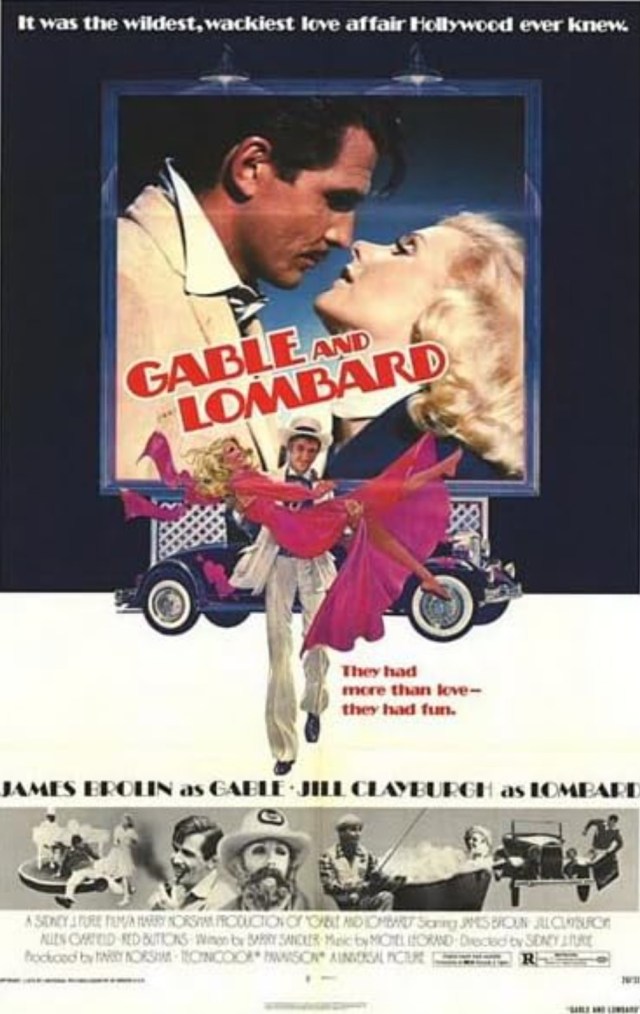
Looking back on Gable and Lombard, I believe Siskel’s, and even Roger Ebert’s, thoughts on the film were a tad harsh. I wouldn’t call it a “dog” or “lousy”, as the movie does have its merits. But I do believe the marketing is a bit misleading. The quotes on Gable and Lombard’s poster are “It was the wildest, wackiest love affair Hollywood ever knew” and “They had more than love – they had fun”. In the ‘Best Films of 1976’ episode of Opening Soon…at a Theater Near You, Carole dumped salad on Clark’s head, one of the more humorous scenes from the film. While there were comedic moments sprinkled throughout the story, the movie’s marketing presents the false idea it is solely a comedy. Seen from the lens of the Breen Code, Gable and Lombard presents a character study of how a portion of the Breen Code era affected the professional and personal lives of the Hollywood landscape. With the story emphasizing Carole and Clark’s relationship, they navigate complicated decisions, as well as honesty about feelings and emotions. The balance of comedy and tragedy adds a sense of maturity to the overall story. At worst, the movie prioritizes style over substance. as most of the budget seems to be put toward the set design. But, at best, Gable and Lombard is just ok.
This review was brought to you by
Sally Silverscreen
 18 Cinema Lane
.jpg)