Take 3: The Man with the Golden Arm Review

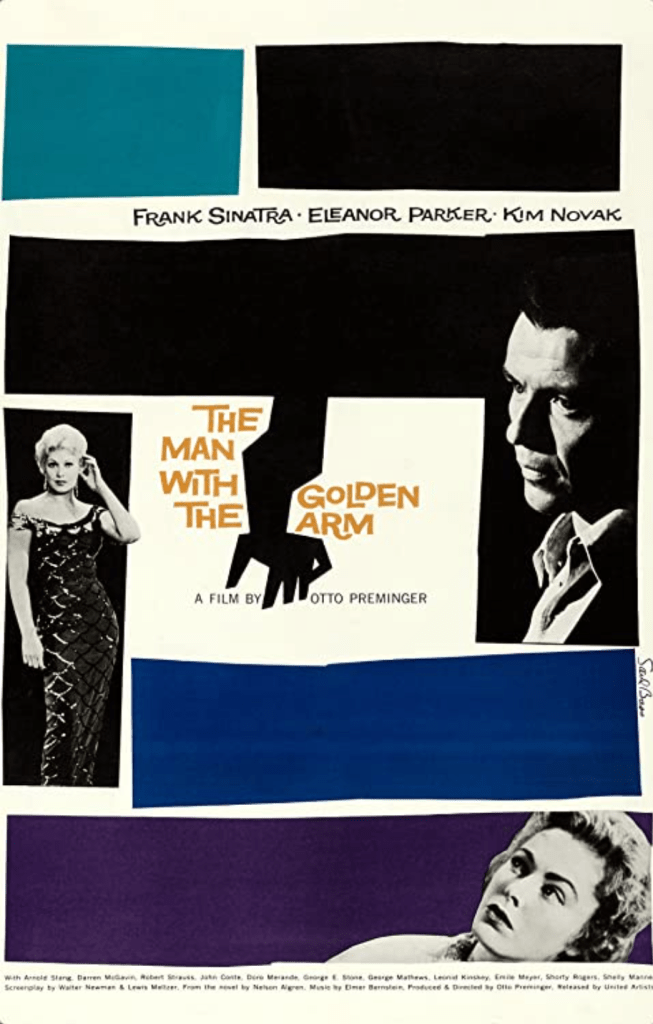
On my Movie Recommendations board on Pinterest, I have 107 films listed. The Man with the Golden Arm is one of those films. Maddy, from Maddy Loves Her Classic Films, recommended the 1955 movie to me years ago. With all my movie recommendations, I try to find the perfect opportunity to review them, as a way to show respect to the people who suggested those movies. When the Kim Novak Blogathon was announced, I immediately went to my aforementioned Pinterest board, to see if any of Kim’s films were on there. Sure enough, I came across the poster for The Man with the Golden Arm! This is not the first time I’ve reviewed one of Kim’s films. Back in 2019, I wrote about the 1954 title, Phffft, a movie I thought was just ok. How will the 1955 film compare to Phffft? The only way to find out to keep reading my review!

The Man with the Golden Arm poster created by Carlyle Productions and United Artists

Things I liked about the film:

The acting: Because Kim Novak is one of the reasons why I’m reviewing this movie, I’ll talk about her performance first. Portraying Frankie’s lover, Molly, Kim adopted a different persona from her role in Phffft. In The Man with the Golden Arm, she traded flirty for headstrong! Molly is a woman who knows what she wants and finds a way to get it. One of these things is for Frankie to get clean. She says it likes it is by telling Frankie what he needs to hear instead of what he wants to hear. Whenever this happens, Kim uses a tone of voice that is stern enough to be taken seriously. Her approach to emotions in The Man with the Golden Arm is more subtle. However, Kim’s facial expressions and body language perfectly showed the audience what was on her character’s mind. While working at a nightclub, Molly is disappointed by Frankie’s lateness. Her eyes are more downcast, like she doesn’t want Frankie to see her disappointment. Also, her face carries a serious expression, as if she’s tired of being let down.

Most of Kim’s scenes show Molly interacting with Frankie. These scenes presented an on-screen chemistry between Kim Novak and Frank Sinatra I liked seeing! This on-screen chemistry was a strong friendship where both parties seemed to have a deep understanding for one another. It kind of reminded me of the on-screen chemistry between Mercedes Ruehl and Jamey Sheridan in the Hallmark Hall of Fame movie, The Lost Child. While we’re on the subject of Frank Sinatra, let me talk about his performance next! The Man with the Golden Arm is the seventh movie of Frank’s I’m reviewing. In the previous six, he carries this suave charisma that presents an illusion of his character having an effortless existence. While his character, Frankie, does have charisma, it is toned down. What overshadows it is a persona that is more downtrodden and beaten. This makes sense for this particular story, as Frankie is attempting to overcome a drug addiction. Despite the change in acting material, Frank effortlessly pulls it off! His performance was versatile, allowing Frank to adapt to whatever his character faced. His performance was also consistent.

Another consistent performance came from Eleanor Parker! Prior to watching this movie, I had seen and reviewed Interrupted Melody. In that review, I said Eleanor’s portrayal of Marjorie Lawrence was emotional. I can also say that about her portrayal of Zosh, but for different reasons. Zosh is a woman who became paralyzed due to a car accident. While she also wants to see Frankie get clean, she has her own reasons why. Because of the emotionality Eleanor possesses, her portrayal of Zosh caused a ripple affect among the characters. The best example of Eleanor’s emotionality can be seen when Frankie returns from rehab. As their interaction carries on, Eleanor’s demeanor changes over time. It starts with Zosh being excited about Frankie’s return, then leads to concern and frustration over his and her future. Zosh’s reactions ripple through Frankie, presenting some obstacles on his journey to recovery.

Showing the negative effects of drug use: The subject of drug use/drug addictions is one that requires a certain amount of seriousness. Not only is that seriousness found within the story of The Man with the Golden Arm, but it can also be seen in Frank’s performance. When Frankie experiences a relapse, his right hand shakes. Shortly before he relapses, his pupils change in size. Frankie’s attitude changes to agitation, as he attempts to get the “monkey” of his back. He even becomes desperate to appease this “monkey”, putting himself, Zosh, and Molly in danger. Besides being referred to as a “monkey”, Frankie’s addiction is also compared to sugar by a member of the card dealing world. He tells Frankie giving up the addiction is like giving up sugar for the rest of his life, giving Frankie the illusion he can quit whenever he wants. However, these words cause more harm than good. It was interesting to hear the characters in this film talk about drug addictions in a more open sense. The Man with the Golden Arm was released in 1955, a time when drug addictions/drug use wasn’t talked about as openly as today. Therefore, this subject’s inclusion in the script felt ahead of its time.

The use of music: Throughout The Man with the Golden Arm, I noticed how music was used to elaborate on a scene’s particular tone. The music also built up to a tense filled moment. A great example is when Frankie relapses. While on his way to consume drugs, an orchestral tune can be quietly heard in the background. When he gets closer to his destination, the background music gets louder, stopping once Frankie gets what he wants. This specific tune plays every time Frankie relapses, serving as an indicator to the audience what’s to come. A big band tune could be heard when Frankie is looking for Molly later in the film. This tune highlighted Frankie’s urgency to find Molly. It also reflected Frankie’s musical desires and Molly’s place of employment. The use of music I described in this paragraph shows the cleverness incorporated into the movie!

The Kim Novak Blogathon banner created by Classic Movie Muse from The Classic Movie Muse

What I didn’t like about the film:

The underutilization of Kim Novak: Earlier in this review, I talked about how I enjoyed watching Kim’s performance. While I still stand by this statement, I feel her talents were underutilized. Kim appeared in a handful of scenes. Even though she was cast as a main supporting actress and she was one of the few actresses in the film, I was disappointed by how limited Kim’s on-screen appearances were. The Man with the Golden Arm is Frankie’s story, as he is the titular character. Therefore, I knew Frank Sinatra’s character would be focused on the most in this movie. But Eleanor Parker had much more screen time than Kim did. If you’re planning on watching this film specifically for Kim’s performance, like I did, you may be a bit let down.

Too many plots: The Man with the Golden Arm contained five plots, each having something important to say. Because there was no distinction of focus between these plots, they ended up spending the movie’s run-time competing against one another. The competition among the five plots caused them to be resolved in an unsatisfactory way or too conveniently. One example involves a secret Zosh carries throughout the story. This secret will not be shared in this review, in an effort to prevent the film from being spoiled. But when the secret is revealed to the rest of the characters, the timing of this reveal feels presented simply to tie up loose ends. Had some of these plots either been written out or relegated to subplot status, maybe Zosh’s secret would have been revealed sooner.

Limited inclusion of musical talents: I don’t believe there is an unspoken rule that Frank Sinatra has to sing and/or have a musical number whenever he stars in a film. But I do feel there was a missed musical opportunity in The Man with the Golden Arm. At the beginning of the movie, Frankie shares how, while in rehab, he learned how to play the drums. He even plans on joining a band. After these words were spoken, I was so excited to see Frank step out of his comfort zone and try his hand at playing an instrument that may have been new to him. But as the story progressed, Frank was shown playing the drums for a handful of seconds. In one of these scenes, it seemed like Frank was playing the drums alongside the radio, which made it difficult to discern what sounds truly came from the radio. The other two scenes presented a force that prevented me from seeing Frank perform a full drum solo.  That excitement I felt toward the beginning of the movie slowing but surely fizzled.

Poker neon sign image created by Freepik at freepik.com. <a href=’https://www.freepik.com/free-vector/poker-neon-lights-background_1137542.htm’>Designed by Freepik</a>. <a href=”https://www.freepik.com/free-photos-vectors/background”>Background vector created by Freepik</a>. Image found at freepik.com.

My overall impression:

Throughout my years of movie blogging, I have seen films that tried to say so much, but ended up saying so little. The Man with the Golden Arm is one of those films. I recognize the important messages the creative team wanted to share with the audience. But because the movie had five plots, these messages did not have a strong delivery. I can, however, commend the production for addressing a serious issue in a time when that issue was not openly talked about. The strong acting performances and use of music can be acknowledged as well. Kim Novak’s performance was one of the strongest in this film. So, it was disappointing to see Kim receive a limited amount of screen-time, especially since she was one of the reasons why I chose to watch this movie. In the future, I want to seek out Kim’s other film work. I’d also like to watch Frank’s and Eleanor’s other work too.

Overall score: 6.1 out of 10

Have you seen any of Kim Novak’s films? If so, which one would you recommend I review next? Tell me in the comment section below!

Have fun at the movies!

Sally Silverscreen
The 4th Annual Gold Sally Awards Has Arrived!

18 Cinema Lane recently celebrated its fourth anniversary! To commemorate such an important milestone, I am, once again, hosting the Gold Sally Awards! As I said last month, each award post will feature two polls at a time. This decision was made to help the voting process move at a faster pace. With that said, this year’s Gold Sally Awards will begin with the Best Movie and Story polls! Because I didn’t post any announcements for the Gold Sally Awards, the first two polls will be available for two weeks; from February 16th to March 2nd. Like years past, you are allowed to vote for more than one nominee. But you can only vote once per person. The link to the polls will be located under each poll. Just click on the word ‘PollMaker’.

Similar to last year, I thought featuring this anniversary image was appropriate for the start of the Gold Sally Awards! Anniversary image created by WordPress.
What was the Best Movie of 2021?
1. The Karate Kid (1984)
2. The Three Musketeers (1948)
3. The Love Letter
4. Perry Mason: The Case of the Telltale Talk Show Host
5. Sincerely, Yours, Truly
6. Rigoletto
7. Holly and Ivy
8. The King and I (1956)
9. A Star Is Born (1937)
10. Poisoned in Paradise: A Martha’s Vineyard Mystery
 
Created with PollMaker
What was the Best Story of 2021?
1. The Karate Kid (1984)
2. The Three Musketeers (1948)
3. The Love Letter
4. Perry Mason: The Case of the Telltale Talk Show Host
5. Sincerely, Yours, Truly
6. Rigoletto
7. Holly and Ivy
8. The King and I (1956)
9. A Star Is Born (1937)
10. Poisoned in Paradise: A Martha’s Vineyard Mystery
 
Created with PollMaker

Have fun voting!

Sally Silverscreen

Take 3: Harvey (1950) Review

This month’s Genre Grandeur is one I have been anticipating! That’s because of the film I selected for the event! January’s theme is ‘Comedies that feature characters who are either Stoners or Drunk’. After doing some research on the internet, I discovered the 1950 movie, Harvey, would be eligible! Harvey is a film I have been wanting to see for several years. Led by the beloved James “Jimmy” Stewart, so many good things have been said about this film. I was also interested in seeing Harvey because of its release date. Recently, I read an editorial by Jillian Atchley titled ‘It’s A Wonderful Life, James Stewart, and George Bailey’. In the article, Jillian explains there are two kinds of James Stewart films; pre-war and post-war. The post-war films, such as It’s A Wonderful Life, contain depth. I’d also add the post-war films feature higher stakes. Since Harvey was released four years after It’s A Wonderful Life, I was curious to see how deep this story would go. I also wanted to see how James would approach a character who is friends with an imaginary rabbit.

Harvey (1950) poster created by Universal Pictures

Things I liked about the film:

The acting: I have seen some of James Stewart’s movies prior to watching Harvey. What I’ve noticed about his roles in films like The Philadelphia Story, Mr. Smith Goes to Washington, It’s A Wonderful Life, and Rear Window is how there is a certain amount of charm included in his character’s personality. While portraying Elwood P. Dowd, James’ on-screen personality was different from what I’d seen before. In Harvey, Elwood is more laid-back. He also has a gentler persona, not having a care in the world. But there was one point in the movie where Elwood became somewhat philosophical. When asked by Dr. Lyman Sanderson and Miss Kelly how he first met Harvey, Elwood gives a thorough answer that is thoughtful and reminiscent. His answers to Lyman’s and Kelly’s questions not only captivate them, but the audience as well. This conversation shows there is more to Elwood when you look past the drinking and fascination with Harvey.

There were other performances in Harvey I enjoyed seeing. One of them came from Josephine Hull. Portraying Elwood’s sister, Veta, Josephine’s performance reminded me, to an extent, of Frances Bavier’s portrayal of Aunt Bee Taylor from The Andy Griffith Show. Let me explain myself; like Aunt Bee, Veta has her concerns and worries. You can hear the tension in her voice and see the fear in her eyes, illustrating how much Veta had on her plate. But, like Aunt Bee, Veta had her heart in the right place. All she wanted was for her brother to be a functioning and contributing member of society. Even if her actions weren’t always agreeable, Veta put her brother’s needs before her own. Because of her performance’s consistency, Josephine became an actress I looked forward to seeing on screen!

The set design: When I thought of Harvey, impressive set design was not what came to mind. So, when I first saw the set design in this movie, I was pleasantly surprised! A great location is the Dowd family home, which I wish was given more screen-time. While the house boasts a classic Victorian exterior, its interior was shown the most. In the house’s foyer, the stone staircase immediately caught my eye. Bearing a carved design, this staircase felt like it belonged in a castle! Another part of the home that features carved designs are the door frames. Marble fireplaces and stained-glass windows added exquisite details that highlighted the elegance and charm of the house! Another location I loved was Charlie’s! From some character’s descriptions, the bar sounded like a cheap or sleazy place. But when its interior was shown, it actually looked kind of cozy! The wood paneled walls were covered in framed photos. As a viewer, this gave me the impression the establishment is proud of their history. The booth Elwood sits at also gives off a cozy feel! The dark wood, tall backed seats surround a smaller, dark wood table. Above this seating arrangement was a small Tiffany style ceiling light.

Collection of white rabbit images created by freepik at freepik.com Hand drawn vector created by freepik – www.freepik.com

What I didn’t like about the film:

Lack of comedy: According to IMDB, Harvey is partially classified as a comedy. As I’ve said before, comedy is a subjective genre. But personally, I didn’t find this movie very funny. In fact, I only chuckled once during this hour and forty-four-minute film. I could see the jokes the screenwriters were trying to deliver. Unfortunately, none of these jokes stuck the landing. On IMDB, Harvey is also partially classified as a drama. While watching this movie, it felt like the creative team involved leaned too much into the drama genre. There’s typically nothing wrong with having comedic and dramatic elements in a singular story. In the case of Harvey, the balance between these two elements was not there.

Medical negligence: In real life or fiction, members of the medical profession are human. They are not only capable of helping others, but also capable of making mistakes. However, there is a very fine line between making mistakes and committing medical negligence. In an effort to help Elwood, Veta takes him to a mental hospital called Chumley’s Rest. But due to a registration mix-up, Veta gets admitted into the hospital instead. The idea of mistaken identity and being forced to do something against your will sounds terrifying. Paired with the fact this situation is supposed to be played for laughs makes it worse. Because of this and because of how avoidable the situation was, it didn’t sit well with me.

No explanations for Harvey: As the title suggests, a portion of this story revolves around Elwood’s friendship with Harvey, a 6 foot 3 ½ inch, invisible white rabbit. Throughout the movie, I was waiting for an explanation of what Harvey was. I even waited to see if Harvey would show up on screen. Sadly, none of these things happened. Even though suggestions about Harvey’s purpose were given, no definitive answers were presented. Was Harvey truly an imaginary friend? Was he a mythical creature only Elwood could see? Was Harvey used as a tactic by Elwood to test people’s trust? As I continue to write this review, I still don’t know what Harvey is.

Decisions being flip-flopped: There’s nothing wrong with showing a character changing their mind about something. After all, that prevents them from being static. If a character is going to change their mind on something, you need to show the process of that viewpoint being changed. In the case of Harvey, that process was, sometimes, omitted. When visiting the Dowd family home in search of Elwood, Marvin Wilson, an employee from Chumley’s Rest, takes a romantic fancy to Myrtle Mae, Elwood’s niece. During Marvin’s visit, Myrtle expresses no interest in his romantic advances. But when they meet up again, later in the film, Myrtle suddenly wants to pursue a relationship with Marvin. Her change of opinion feels abrupt, with no lead-up to that decision. The omission of decision transitions sometimes left me frustrated.

Heartbeat image created by Freepik at freepik.com. <a href=’https://www.freepik.com/free-vector/medical-logo_763775.htm’>Designed by Freepik</a>. <a href=”https://www.freepik.com/free-photos-vectors/logo”>Logo vector created by Freepik</a>. Image found at freepik.com.

My overall impression:

“What is the point of this movie”? I’m not asking this to be disrespectful or mean-spirited. I’m asking this because I’m genuinely curious to figure out what that point is. Sometimes, a film’s purpose or intended message is either obvious or easier to figure out. But with Harvey, I don’t know what the creative team was trying to say. Was this movie meant to be a cinematic PSA about how those with mental health related issues should be treated with dignity and respect? Is the film supposed to be an exploration of how some adults lose their sense of imagination the older they become? How am I expected to care about the filmmakers’ message when I don’t have a clear idea what it is? Besides being confusing, Harvey was, for me, disappointing. Because of James Stewart’s involvement in this project and because of the inclusion of a 6 foot 3 ½ inch, invisible white rabbit, I thought the movie was going to be whimsical and charming, with a sense of ‘magical realism’. Unfortunately, the 1950 film was none of those things. The lack of comedy and medical negligence did not help either. In all my years of watching movies, I never thought I’d see a James Stewart film I didn’t like. But, as of January 23rd, 2022, here I am.

Overall score: 5 out of 10

Have you seen Harvey? Which film from James Stewart’s filmography would you recommend I review next? Let me know in the comment section!

Have fun at the movies!

Sally Silverscreen
If you’re interested in reading Jillian’s editorial, here is the link:

The Top 10 Best Movies I Saw in 2021

Like I said in my list of the worst movies I saw in 2021, this year is a little different. Since 2018, most of the movies on my best list have been those I have reviewed. But a few titles on those lists weren’t covered on my blog. 2021 is the first year where every film on my best list has been reviewed on 18 Cinema Lane! It should also be noted how each of these titles were either blogathon entries or Blog Follower Dedication Reviews. Therefore, I will include a link to each of these reviews on my list! As I said in my worst movies of 2021 list, I saw several films this year that I liked. This article is reflective of those feelings. But unlike my aforementioned list, there will be Honorable Mentions. So, with that said, let’s end 2021 on a high note with the top ten best movies I saw in 2021!

Honorable Mentions

Cape Fear (1962), Bathing Beauty, Aurora Teagarden Mysteries: Til Death Do Us Part, Elizabeth Is Missing, and The Girl Who Spelled Freedom

<a href=”http://<a href=”https://www.freepik.com/vectors/christmas”>Christmas vector created by BiZkettE1 – http://www.freepik.com</a>&quot; data-type=”URL” data-id=”<a href=”https://www.freepik.com/vectors/christmas”>Christmas vector created by BiZkettE1 – http://www.freepik.com2021 New Year image created by BiZkettE1 at freepik.com.

10. Poisoned in Paradise: A Martha’s Vineyard Mystery

Hallmark Movies & Mysteries’ Martha’s Vineyard Mystery series is a newer story that began last year. Despite how young this series is, it has grown over the course of four movies! This chapter not only recognizes its strengths, but also improves on some of the previous movies’ mistakes. Giving equal focus to the main and side mysteries is one example. Speaking of the mysteries, the overarching story was intriguing and engaging. There were even new characters added to this film I wanted to know more about. In Poisoned in Paradise: A Martha’s Vineyard Mystery, Jeff’s story didn’t receive a lot of development. With this and everything else said, I hope this series continues in 2022!

Take 3: Poisoned in Paradise: A Martha’s Vineyard Mystery Review + 360, 365, 370, and 375 Follower Thank You

9. A Star Is Born (1937)

In my three (soon to be four) years of movie blogging, I never thought I’d ever see any version of A Star Is Born. But now that I have seen the original from the ‘30s, I can honestly say it was better than I expected! The story’s honesty about the entertainment industry and maturity toward heavier subjects was such a surprise. What was also a surprise was the use of mixed-media throughout the film, as it was ahead of its time. Even though A Star Is Born was released toward the beginning of the Breen Code era, it highlights the quality storytelling that came from this period in time. With the constant changes in the entertainment landscape, as well as technology, I can kind of see why this story has been remade on more than one occasion.

Take 3: A Star Is Born (1937) Review

8. The King and I (1956)

In 2021, there is at least one movie from the ‘50s on my best and worst movies list. But since I already talked about I Dream of Jeanie and The Trap, it’s time for The King and I to shine! This was the first time I had seen this version of the story in its entirety. Despite that, I found the film to be quite enjoyable! It is a good looking and sounding film, with the costume design, musical numbers, and set design building an aesthetically pleasing picture. The most memorable part of the movie was Tuptim’s interpretation of Uncle Tom’s Cabin! As I said in my review, it served as a good example of how everyone can view a text differently. The scene itself was more interesting than I expected.

Take 3: The King and I (1956) Review

7. Holly and Ivy

Because Hallmark creates so many Christmas movies, it can sometimes feel like they blend together. However, that is not the case for Holly and Ivy! What helps this title stand out is showing realistic characters dealing with realistic situations. This is quite different from those Hallmark pictures where the conflict either revolves around returning to a small town, saving a beloved establishment, or planning a major event. The emotional balance within this story added to my enjoyment of the picture. It never felt like the creative team was trying to emotionally manipulate me or force a reaction out of me. Looking back on the few Christmas films I reviewed this year, I can say with all honesty that Holly and Ivy was the best one!

Take 3: Holly and Ivy Review

6. Rigoletto

In my opinion, Rigoletto is to Beauty and the Beast what Ever After: A Cinderella Story was for Cinderella. What I mean by this is Rigoletto does an effective job at executing a non-magical version of Beauty and the Beast! Even though there have been musical versions of this particular story, such as the 1991 animated production from Disney, the 1993 film chose music as one of the story’s themes. This was an interesting choice, as it showed the audience the talent and skill it takes to be a good singer. Another interesting choice was the story taking place during The Great Depression. As I said in my review, this creative decision helped the film achieve its own identity.

Take 3: Rigoletto Review + 350 and 355 Follower Thank You

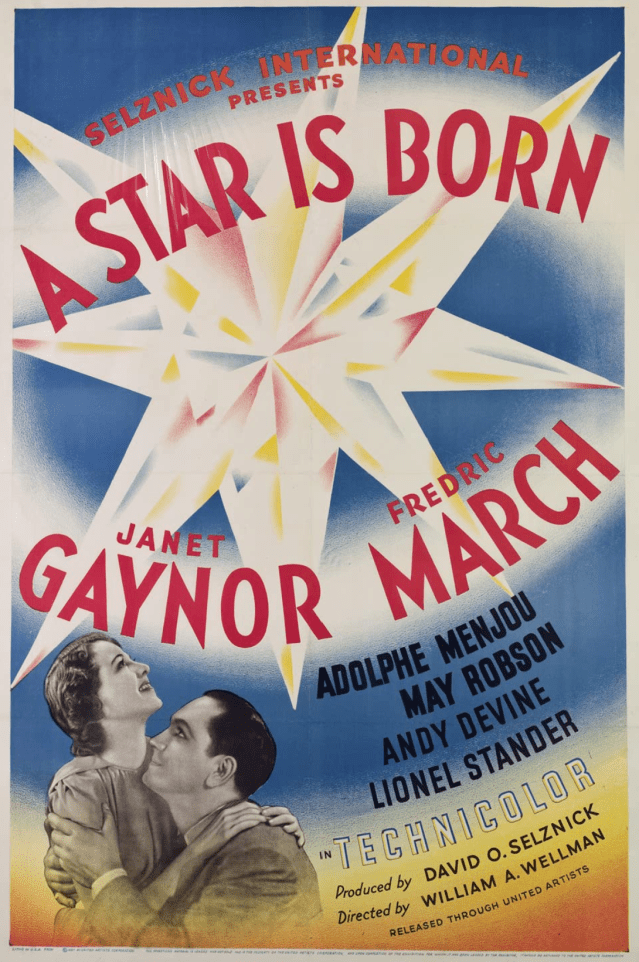
A Star Is Born (1937) poster created by Selznick International Pictures and United Artists

5. Sincerely, Yours, Truly

This is the first year an UP Network movie has appeared on any of my best lists! While Sincerely, Yours, Truly does contain a similar story to those found on Hallmark Channel, it makes up of that in genuineness and sincerity. The movie also presented interesting ideas, such as a grant proposal process and avoiding the “it’s not what you think” cliché. The on-screen chemistry and witty banter between the lead actor and actress definitely added to my enjoyment of this film! I don’t know what’s in store for UP Network in 2022. But I hope they continue to release quality productions like Sincerely, Yours, Truly!

Take 3: Sincerely, Yours, Truly Review + 295, 300, 305, 310, and 315 Follower Thank You

4. Perry Mason: The Case of the Telltale Talk Show Host

This entry in the Perry Mason movie series is one of the most memorable titles! One of the reasons why was the titular talk show host. Featuring real life talk show hosts in this story was a good idea. Having them portray talk show hosts on the radio was an even better idea, especially since some of those hosts had their own television show. That creative decision gave them new material to work with. The engaging nature of the mystery, where the outcome unfolds as the story goes on, maintained a steady amount of intrigue. This served as another way Perry Mason: The Case of the Telltale Talk Show Host stood out in the mystery genre!

Take 3: Perry Mason: The Case of the Telltale Talk Show Host Review + 290 Follower Thank You

3.  The Love Letter

Over the years, I have enjoyed finding and watching Hallmark Hall of Fame movies from years, even decades past. Sometimes, there are hidden gems that can be discovered. 1998’s The Love Letter is one of those gems! Unlike Chasing Leprechauns, the creative team behind the Hallmark Hall of Fame title found a way to allow the realistic and whimsical aspects of the story to co-exist. In fact, the whimsical part of the movie is what made the project one of the most unique in Hallmark Hall of Fame history! The film does contain the elements you’d usually find in a production of this nature, such as historical accuracy. But that just adds to the strength of The Love Letter!

Take 3: Hallmark Hall of Fame’s The Love Letter Review

2. The Three Musketeers (1948)

Isn’t it interesting how another Gene Kelly movie made it to my best list’s top three? Despite the weird coincidence, I did enjoy this version of The Three Musketeers! There was so much about this project I liked, from the strength of the ensemble cast to the stellar fight choreography. However, the best part of the film was how much detail went into it. This can be seen in the set design and costumes, where research and care are also reflected. While I still haven’t gotten around to reading the novel this movie is based on, The Three Musketeers was definitely an entertaining story!

Take 3: The Three Musketeers (1948) Review

1. The Karate Kid (1984)

When it comes to the world of cinema, nothing beats the classics! The timelessness of 1984’s The Karate Kid allows the film to have a strong rate of re-watchability. The film’s story also contained ideas and messages that caused me to think, which is not something I’d expect from a sports movie. As I write this list, Mr. Miyagi’s words immediately come to mind. Whether it’s the famous “Wax on, Wax off” quote or his wisdom about karate, these words not only help The Karate Kid remain a memorable picture, but also give the audience something to apply to their lives. Add some exciting karate sequences and you have a solid film that has stood the test of time!

Take 3: The Karate Kid (1984) Review (Olympic Dreams Double Feature Part 1)

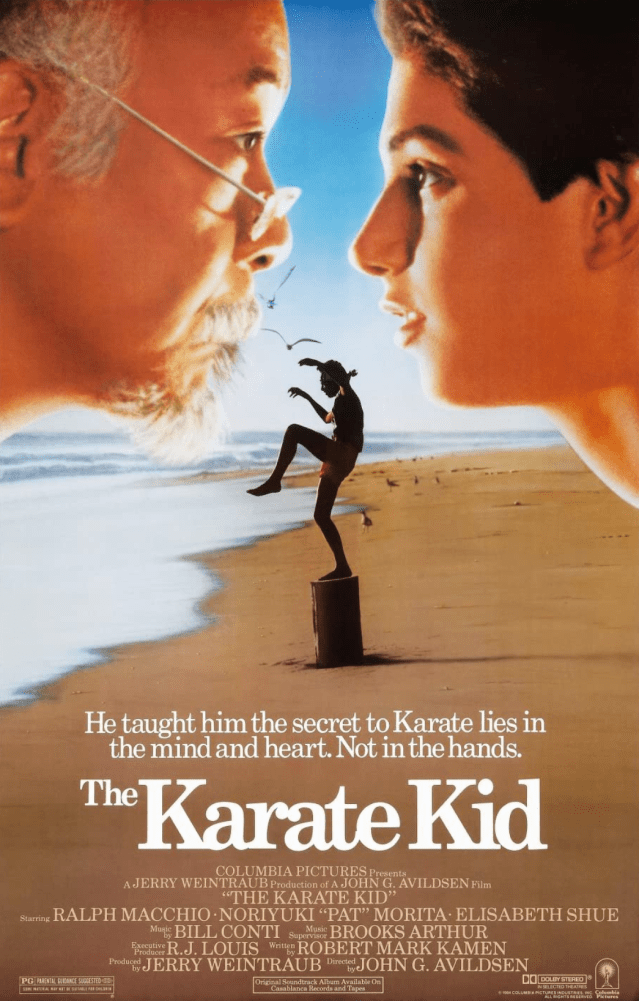
The Karate Kid (1984) poster created by Delphi II Productions, Jerry Weintraub Productions, and Columbia Pictures

Have fun in 2022!

Sally Silverscreen

The Top 10 Worst Movies I Saw in 2021

When it comes to my best and worst of the year lists, 2021 is a little different. For one, this is the first year where I don’t have any Dishonorable Mentions. This is because I didn’t see enough movies to justify having this portion on the list. For another, my list has the least number of movies that were “so bad they were bad”. The reason is most of the films on this year’s list were disappointments. When I look back on my movie viewing in 2021, I feel most of the titles I saw and/or reviewed were either ok or fine/decent. Sure, I did see several films I liked. But some of those will be discussed on my best of the year list. Speaking of lists, let’s start counting down the top ten worst movies I saw in 2021!

Two disclaimers:

  1. As I’ve said in past lists, I did not write this list to be mean-spirited or negative. It’s simply a way to expressive my own, honest opinion.
  2. Some of the movies on this list have been reviewed on my blog. I will include a link to my reviews of these films.
<a href=”http://<a href=’https://www.freepik.com/vectors/background’>Background vector created by pikisuperstar – http://www.freepik.com</a>&quot; data-type=”URL” data-id=”<a href=’https://www.freepik.com/vectors/background’>Background vector created by pikisuperstar – http://www.freepik.comColorful 2021 image created by Pikisuperstar at freepik.com.

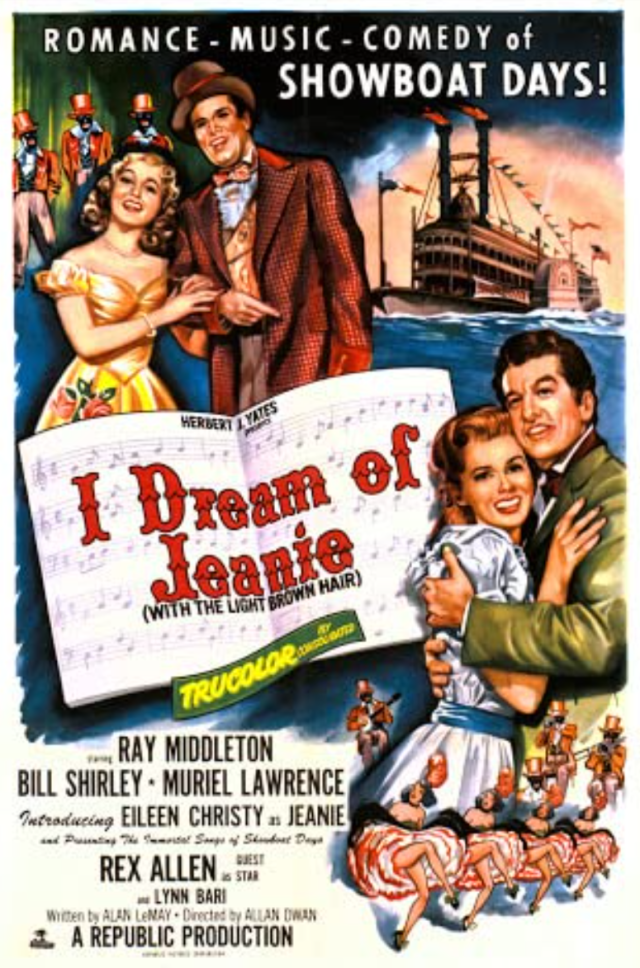
10. I Dream of Jeanie (1952)

This movie made me wish I had saved an hour and twenty-nine-minutes by reading Stephen Foster’s Wikipedia page. For a “biopic”, I Dream of Jeanie wasn’t very informative. While I did learn a few things, the story didn’t capture an almost complete picture of the famous composer. It also showcased him in a not-so-favorable light. Because he was portrayed as a desperate push-over, Stephen was a character that exuded sympathy to the audience. What did not help was how the film placed more focus on other characters and events as well, such as the oh so annoying Edwin P. Christy. Speaking of Edwin, this movie would be called “The Edwin P. Christy Show” if given an honest title.

Take 3: I Dream of Jeanie (1952) Review

9. Country at Heart

This movie is notorious among the Hallmark fans for having more than one release date between 2019 to 2020. Too bad it wasn’t worth the wait. What could have been an interesting story turned out to be another tale of a woman from the city coming back to her small hometown. This is also one of those films where the protagonist says they are going to do something, but ends up spending most of the movie not doing the aforementioned thing. Country at Heart’s biggest flaw, though, lay in the singing abilities of the main character, Shayna. Throughout the story, Shayna’s talents were treated as if she were the next great undiscovered talent. But, in reality, her talents were, at best, fine. I don’t know if Jessy Schram sang in the movie or if there was a singing double. However, this part of the film dissuaded me from buying what the movie was selling.

8. The Trap (1959)

What a weird coincidence for another movie from the ‘50s to end up on my worst list. Even though The Trap is classified as a drama, the creative team placed more emphasis on the drama within the story. When you have gangsters in your film, this is not the genre you want to place your movie in. Since my warning came way too late, the 1959 title was a boring combination of a Suddenly rip-off and a road trip picture. Adding insult to injury, the excitement and action you’d expect from a gangster film was so far and few between. I’m honestly surprised I didn’t fall asleep during this movie, as I wanted to on more than one occasion.

Take 3: The Trap (1959) Review

7. Jane Doe: Ties That Bind

It is possible to make a good movie revolving around a debate. The Hallmark Hall of Fame film, Sweet Nothing in My Ear, is a beautiful example of this. With Jane Doe: Ties That Bind, however, adding a debate to a mystery story doesn’t work. This is because it goes against the very nature of the mystery genre, which emphasizes finding a concrete resolution to the story’s conflict. Unfortunately for the 2007 movie, a debate was the most focused part of the script. Because of that decision, the debate overshadowed the mystery itself. When everything was said and done, the debate wasn’t resolved. If I could summarize this film in one meme, it would be the one where the woman asks “You did this for what”?

6. Hometown Hero

It’s a shame that not one, but two PixL movies ended up on my list, especially since I rarely talk about their films on my blog. The reason why Hometown Hero is considered one of the worst movies I saw this year is because of how bland it was. This caused me not to care about any of the characters or their stories. It also doesn’t help that the main actor and actress had such weak on-screen chemistry, it felt like their characters were becoming good friends instead of romantic significant others. Similar to what I said about choice number seven, I would choose the meme of the woman asking “Where’s the flavor”? if I needed to summarize Hometown Hero in one meme.

I Dream of Jeanie (1952) poster created by Republic Pictures

5. The Price of Fitting In

Lifetime has an infamous history of creating PSA/“after school special”/cautionary tale movies, which cover a variety of serious, real world subjects. When I came across this 2021 title, I was curious to see what new topics and issues would be discussed in this film, especially considering it’s been a long while since Lifetime created a movie of this nature. But unlike the network’s other PSA/“after school special”/cautionary tale productions from decades past, The Price of Fitting In suffers from an identity crisis. The script spends the entire movie trying to figure out what type of story it wants to adopt. This led several parts of the narrative to either be underdeveloped or unresolved. The Price of Fitting In does recognize how a robotics team can experience similar peer-related situations like other extracurriculars, so I’ll give the movie credit where it’s due. I just wish that idea had belonged in a better film.

4. Raising Arizona

The best way to describe how I feel about this movie is by using an analogy: You’re listening to someone tell a joke. But when it’s time to deliver the punchline, that person forgets what it is. So instead, they either try to come up with a new punchline on the spot or they attempt to figure out what the original punchline was.  In Raising Arizona, the comedic moments lasted so long, the punchline got lost in translation. Some of the jokes didn’t make sense because of this. The characters were not charming or likable enough to make their dysfunctionality tolerable for the audience. If anything, they were one-dimensional and uninteresting. The only part of the movie that prevented me from DNFing (did not finish) it was Leonard Smalls. He was such a mysterious and intriguing character, that I wish I watched a movie about a character like Leonard.

3. Durango

As I said in my review from July, Hallmark Hall of Fame’s Durango is “the first western set in Ireland”, according to IMDB. For the first of its kind, it was a step in the wrong direction. Stories in the western genre are known for having higher stakes, giving the audience an excuse to stay invested in the characters’ well-being. Durango didn’t get that memo because most of the stakes were so low, the characters’ plans worked out too perfectly. Despite never reading the book this Hallmark Hall of Fame title is based on, I can tell how weak this script was. What was also weak was Matt Keeslar’s performance and his on-screen chemistry with Nancy St. Alban. Watching this movie on Hallmark Drama was a blessing in disguise. I may not have saved some time, but at least I saved some money.

Take 3: Hallmark Hall of Fame’s Durango Review

2. Chasing Leprechauns

Yet another Hallmark movie set in Ireland joins the list. Since the network doesn’t create many St. Patrick’s Day themed movies, it is frustrating when a story relating to this particular holiday doesn’t stick the landing. With Chasing Leprechauns, the creative team wanted to include a whimsical element without making the movie too whimsical. Like I said in my review of the 2012 film, those involved with the project wanted to have their cake and eat it too. When I look at the movie’s poster, it feels like false advertising. For one, Chasing Leprechauns is a drab looking picture, not the lush, green paradise the poster wants you to believe. For another, there are no leprechauns in the story, despite the word ‘leprechauns’ being in the title. Hallmark is known for releasing some of their movies on DVD. As far as I know, Chasing Leprechauns was never made available for purchase. Maybe its poor quality is the reason why?

Take 3: Chasing Leprechauns Review

Remember when I said there were two PixL movies on my worst list? Well, The Cookie Mobster is the second film. For those who are not familiar with PixL, this is an entertainment company that typically creates “rom-coms” similar to those on Hallmark Channel. Because of that, this 2014 film was way too ambitious for the company’s own good. The light-hearted tone of the scouting troop’s story and the darker tone of the former gangster’s story ended up clashing with each other. Adding to that, the screenwriters didn’t display an understanding for several of the movie’s subjects. The weak script caused me to question the story’s validity, which took away any opportunity for me to stay invested in the story. The more I think about The Cookie Mobster, the more I wish it had been created by INSP or Hallmark Movies & Mysteries.

Since I’m talking about Durango again, I’m re-posting my screenshot of the film’s poster. Screenshot taken by me, Sally Silverscreen.

Have fun in 2022!

Sally Silverscreen

Take 3: The Trap (1959) Review

Back in August, The Classic Movie Muse invited me to join the Bernard Herrmann Blogathon! I immediately became interested, but wasn’t sure which film I would choose. While I am familiar with the movies Bernard’s music can be heard in, I’m not that familiar with Bernard as a composer. But with the blogathon taking place on Halloween weekend, I wanted to watch a film that fit the occasion. Originally, I was going to review 1962’s Cape Fear, the movie I wrote about for the 2nd Annual Spooky Classic Movie Blogathon. But, long story short, that didn’t work out. So instead, I chose to review The Trap from 1959! Based on the synopsis, it sounded like an exciting story involving gangsters, the law, and a whole lot of conflict. But did I find the movie enjoyable? If you want to know that answer, you’ll just have to keep reading my review!

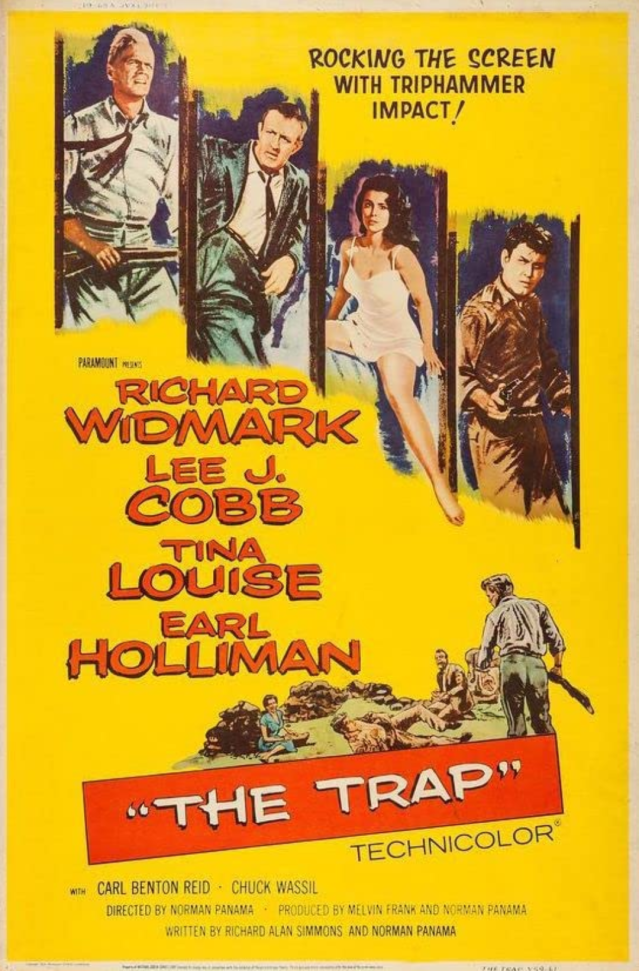
The Trap (1959) poster created by Paramount Pictures

Things I liked about the film:

The acting: I’m not familiar with Richard Widmark as an actor. However, I did like his performance in The Trap! The easy-going and suave persona Richard brought to his character, Ralph, reminded me of Frank Sinatra. His facial expressions and use of emotions were believable as well. When a tragic situation happens in his family, genuine fear was shown on Ralph’s face. Because he was in a dangerous circumstance in the story, Ralph became vulnerable both literally and emotionally. Another character that was vulnerable was Ralph’s brother, Tippy. At the beginning of the movie, Tippy’s alcohol dependency is apparent. With a relaxed body position, a pained look on his face, and a tired tone of voice, Earl Holliman effectively portrayed how this problem can take over someone’s personality. Starring alongside Earl and Richard was Tina Louise as Linda Anderson. This particular character was desperately trying to get by and hold on for dear life. But Linda never came across as desperate or frazzled. Instead, Tina brought a sense of charm and a likable personality to her role. Through the script and Tina’s performance, it highlights how Linda cared about how she presented herself.

The music: Despite being an uncredited composer on this project, I did like hearing Bernard Herrmann’s musical scores! Similar to Cape Fear, the music helped elevate a scene’s suspense. It also fit the emotion depicted in a specific scene. Anytime Ralph and Linda interacted with one another is a perfect example of this. A pleasant, dramatic tune could be heard in the background, the kind you’d hear in a romance movie. Because these characters have a history together, this type of music seemed fitting. It added memorability to those scenes as well.

The Bernard Herrmann Blogathon banner created by The Classic Movie Muse from The Classic Movie Muse

What I didn’t like about the film:

Very little excitement: With a movie involving gangsters, the law, and conflict, you’d think it would be exciting. But unfortunately, this story was lacking in the excitement department. Sure, there was a gun fight and a car chase. But these moments were far and few between. The first half of the movie focused on the gangsters’ preparations, emphasizing telling over showing. A road trip that was mostly bland took over the film’s second half. While I continued to watch this movie in the hope some excitement would arrive, it sadly never came.

Emphasis on drama: On IMDB, The Trap is classified as a drama, as well as an action and crime movie. But the script placed more emphasis on the story’s drama. Most of this film focused on the strained relationships among the Anderson family. Even as Victor Massonetti (the leader of the movie’s gangster group) was attempting to escape the country, there was still time to feature Ralph having a conflict with one of his family members. While there’s nothing wrong with featuring drama in a story, it overshadowed the more exciting parts of The Trap. This certainly felt like the screenwriters had difficulty balancing these three genres.

The run-time: This movie has a run-time of an hour and twenty-four minutes. With the way the story focused on drama over action, I honestly think the run-time was too long. Some scenes were drawn out longer than necessary. For example, when Ralph was traveling in a car with Victor, those scenes felt like they were longer just for the sake of satisfying the run-time. The beginning of the movie also satisfied this run-time by maintaining a slower pace. With a shorter run-time, the story could have gotten straight to the point a lot sooner. It also would have prevented some scenes from feeling like they dragged on.

Antique car image created by Freepik at freepik.com. <a href=’https://www.freepik.com/free-vector/red-classic-car_803652.htm’>Designed by Freepik</a>. <a href=”https://www.freepik.com/free-photos-vectors/vintage”>Vintage vector created by Freepik</a>. Image found at freepik.com.

My overall impression:

On the movie poster for The Trap, it says “Rocking the screen with triphammer impact!”. The only impact this movie had on me was making me want to fall asleep on more than one occasion. Within the first half, the story was reminiscent of 1954’s Suddenly, a movie I thought was just ok. But when the second half rolled around, it felt like a boring road trip film. As I said in my review, there was a gun fight and car chase in The Trap. But these exciting moments had such a limited presence in the overall story. One of the flaws of this film was relying too much on the drama genre. When a movie features gangsters, you expect action and excitement. Tensions over which man Linda truly loved were certainly not as riveting as the screenwriters thought. The Trap was, for me, a disappointment. While I liked the acting and music, it wasn’t enough to present a recommendation.

Overall score: 5.1 out of 10

Have you seen The Trap? If so, what are your thoughts on the film? Please share how you feel in the comment section below!

Have fun at the movies!

Sally Silverscreen

Take 3: I Dream of Jeanie (1952) Review

I’m participating in two blogathons; the Musicals: With A Song And A Dance In My Heart Blogathon and The Biopic Blogathon. Because of this choice, I wanted to review a movie that was “the best of both worlds”. One day, while on Youtube, I came across the 1952 film, I Dream of Jeanie. After learning it was a musical biopic about the composer, Stephen Foster, I knew I had found the perfect entry! Prior to these events, I had never heard of I Dream of Jeanie. In fact, I was not familiar with Stephen Foster either. But I wanted to use my participation as an opportunity to learn more about him. I also wanted to be introduced to films that were newer to me. Did my plan work? Continue reading if you want to find out!

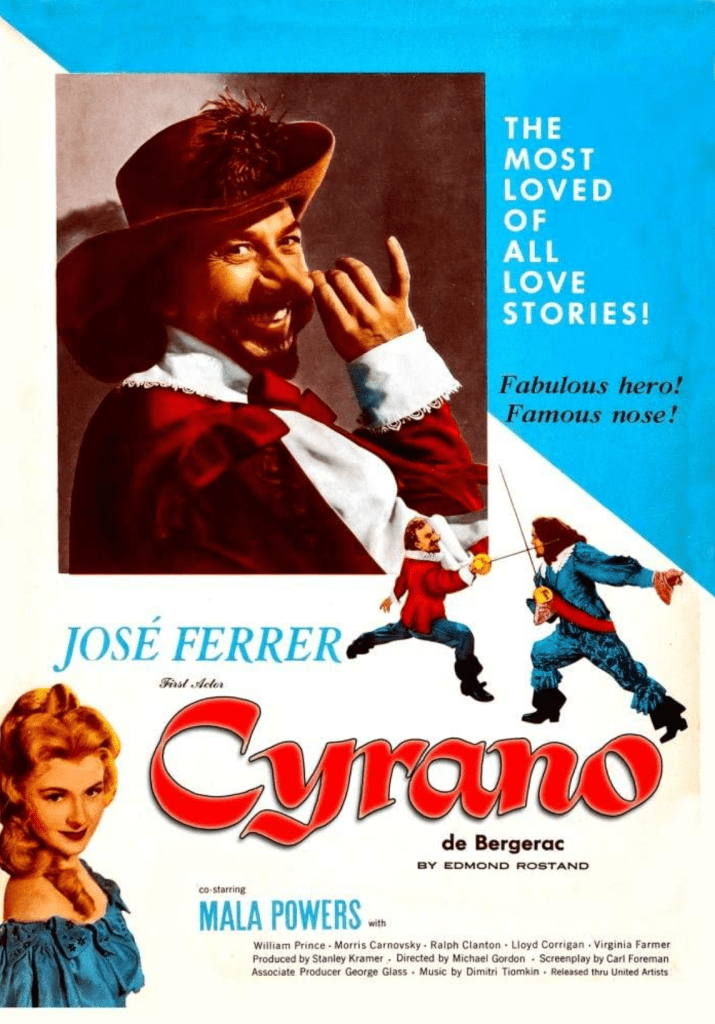
I Dream of Jeanie (1952) poster created by Republic Pictures

Things I liked about the film:

The acting: Bill Shirley is an actor I’m not familiar with. While I have seen Disney’s Sleeping Beauty, I have never seen any of his live-action films. Despite this, I did enjoy watching his acting performance! His mannerisms and line delivery reminded me of Jimmy Stewart. This is because of the tender-hearted nature Bill presented. His singing talents were amazing in this movie! One of his best performances was his solo, “Beautiful Dreamer”. With his deeper vocals and the heart-felt lyrics, there was emotion found in the song. He also sang beautifully with Eileen Christy, who portrayed Jeanie. Toward the beginning of the film, they sang a duet of “Oh! Susanna”. Bill and Eileen displayed good harmony during their performance. Having nice on-screen chemistry also worked in their favor.

While we’re on the subject of Jeanie, let’s talk about Eileen Christy’s performance. Throughout the film, she presented her character with a likable persona. Jeanie was sometimes the film’s “comic relief” as well. When a script adopts a “comic relief” character, that individual can either be goofy or be seen as dumber than the protagonist. With Jeanie, that was never the case. Even though she was silly, her intelligence never faltered. Another actress who gave a good performance is Muriel Lawrence. Portraying Jeanie’s sister, Inez, she provided an embodiment of a “diva”. Her strong will and determination to get her way made Inez one of the film’s more unlikable characters. But as an actress, Muriel had star qualities!  Whenever she appeared on screen, Muriel was able to garner the camera’s attention, even when her character wasn’t the focus of a scene. It also helps that she sang beautifully in this movie.

The musical numbers’ inclusion in the story: In some musicals, a musical number can make the story feel paused. With I Dream of Jeanie, the musical numbers pushed the story forward and made sense within the context of the story. A perfect example is Muriel’s solo, “Lo, Hear the Gentle Lark”. Toward the beginning of the movie, Inez and Stephen talk about an upcoming recital, where Stephen hopes Inez will agree to an engagement. When the event arrives, the performance is used to make Inez shine, showing how she craves attention. During the recital, unpublished songs by Stephen are introduced. The secret of Stephen’s involvement with “Oh! Susanna” is revealed at this event as well. Similar to “Lo, Hear the Gentle Lark”, the inclusion of these aforementioned songs also fit within the story.

A glimpse into the legal side of the music industry: One of the conflicts Stephen experiences is his lack of royalties from “Oh! Susanna’s” success. Whenever the song is performed, Stephen’s name is never mentioned. This surprises everyone in his life, including his brother. Stephen also faces legal threats due to the song’s copyright. This is because he presented the song to multiple publishers. Since I’m not well versed in the legalities of the music world, I found this brief exploration fascinating! That part of the story allowed me to learn something new. It also showed how different copyright laws and royalty agreements were in the 1840s.

The Musicals: With A Song And A Dance In My Heart Blogathon banner created by Neil from Thoughts From The Music(al) Man

What I didn’t like about the film:

Not really biographical: The purpose of a “biopic” is to provide some education to an audience about a particular individual. In the case of I Dream of Jeanie, this movie is meant to tell the story of Stephen Foster. But I ended up not learning much about the composer. While I discovered he wrote ‘Oh! Susanna’, I was expecting to learn more about Stephen. How did he become interested in music? Did he receive any professional training? This film doesn’t answer these questions. Instead, the script focuses more on other characters and events.

The characterization of Stephen Foster: No main individual in any “biopic” is meant to be seen as “perfect”. However, one of the staples of a “biopic” is to present the admirable aspects of a given individual. With I Dream of Jeanie, Stephen Foster, more often than not, came across as a desperate push-over. I don’t blame Bill Shirley for this, as he did a good job with the acting material he received. But I will put blame on the film’s screenwriter, Alan Le May. For the majority of the movie, Stephen loves a woman named Inez. She not only doesn’t like the type of music he makes, she also hates “Oh! Susanna”. In an attempt to win her love, Stephen announces how he’s trying to achieve a “redemption” by only playing classical music. He does this instead of standing up for himself or trying to compromise with Inez. This is, sadly, just one example of Stephen’s characterization.

The character of Edwin P. Christy: Not every character is meant to be likable. Sometimes, a character’s likability is based on personal preference. In my opinion, Edwin P. Christy was annoying. Once again, blame is given to Alan Le May. Edwin was a flamboyant and over-the-top showman. But what made him unlikable for me was how he used every opportunity to put the spotlight on himself. During Inez’s recital, Edwin disrupts the event by loudly playing one of Stephen’s songs at Stephen’s nearby stable. Edwin then crashes the recital and performs some of Stephen’s unpublished music, with no granted permission from Stephen. After some time, Edwin’s antics became unpleasant. It almost felt like Edwin tried to make the story about himself as well.

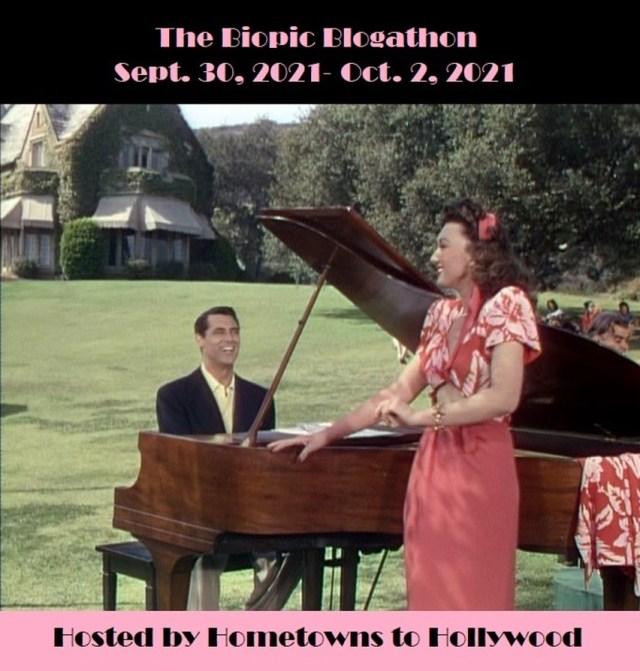
The Biopic Blogathon banner created by Annette from Hometowns to Hollywood

My overall impression:

In my introduction, I said I wanted to use my participation in these blogathons to learn more about Stephen Foster. Unfortunately, that’s not what happened. Don’t get me wrong, I did learn a few things about him and about some of the legalities of the music world’s early years. But it wasn’t enough to justify an hour and twenty-nine-minute movie. If anything, it almost seems like this film was about anything but Stephen. When characters like Edwin P. Christy try to take the spotlight for themselves, it makes the project look less biographical. As I mentioned in this review, some of the blame falls on the screenwriting. The quality of a project’s script is what makes or breaks it. If the script is weak, there’s only so much the other members of the creative team can do to salvage it. Now, as I wrap up this review, I must take a detour to Wikipedia.

Overall score: 5.6 out of 10

Have you seen any biopics? If so, which one is your favorite? Let me know in the comment section below!

Have fun at the movies!

Sally Silverscreen
Take 3: Plymouth Adventure Review

When I participated in the Fourth Van Johnson Blogathon last year, I reviewed the three episodes of Murder, She Wrote Van appeared in. For this year’s blogathon, I wanted to do something different by writing about one of his films. While looking through my Pinterest board of movie recommendations, I was reminded of the 1952 movie, Plymouth Adventure. This film was introduced to me by the Brannan sisters from Pure Entertainment Preservation Society, when they reviewed the movie during my blogathon, ‘A Blogathon to be Thankful For’. The Mayflower journey is one of the most important events in U.S. history. However, it is rarely covered in cinema. This is one of the reasons why I wanted to check this film out! I also liked reading what the Brannan sisters had to say about Plymouth Adventure. Therefore, I was curious to see if my opinion was similar to theirs.

Plymouth Adventure poster created by Metro-Goldwyn-Mayer

Things I liked about the film:

The acting: The blogathon I am participating in celebrates the filmography of Van Johnson. So, talking about his performance first makes sense. What I liked about Van’s portrayal of a carpenter named John Alden was how his emotions represented the audience, expressing the thoughts and feelings we might experience if we were in his shoes. The moment John boards the Mayflower provides a perfect example. As he is walking around the deck, he is in awe of the ship’s magnitude. When he crosses paths with Spencer Tracy’s character, Captain Christopher Jones, John distinguishes himself from the other passengers as a carpenter, wanting to stand out for his skills and talents. Van’s on-screen personality highlights this distinction among the film’s ensemble!

My favorite character in Plymouth Adventure is Gilbert Winslow, portrayed by John Dehner. John carried his character with class and wisdom, like a true sophisticated gentleman. These characteristics are highlighted well in a scene between Gilbert and Christopher. In this scene, they are discussing the settlers’ reasons for partaking in the journey. Christopher feels they are foolish for throwing their lives away for the unknown. But Gilbert respectfully rebuts that argument by saying the settlers are brave because they sacrificed so much in order to achieve a better, more free life. Dawn Addams portrayed one of these settlers, a woman named Priscilla Mullins. While she was only in the movie for a limited amount of time, Priscilla brought a kind gentleness to the story. This presented a good counterpart to the harshness of the journey itself. I also liked seeing Dawn and Van perform together! They had nice on-screen chemistry and I was interested in seeing where Priscilla and John’s relationship would go. I was not expecting a romance in this film, so that was a pleasant surprise!

The use of color in the costumes: When I think about the 1600s, I think of articles of clothing that look plain and unimpressive. Outfits made for royal family members are an exception, as they were meant to stand-out among a sea of commoners. In Plymouth Adventure, I was happy to see pops of color in the film’s costumes! It was also interesting to see which colors were used. As I mentioned before, Gilbert Winslow is my favorite character in this movie. Throughout the story, he wore an outfit that was covered in an emerald green material. That creative decision not only helped John stand out among the ensemble cast, but the costume itself also complimented his dark hair. Noel Drayton’s costume also complimented his hair! Because his hair is a lighter hue, his costume was a nice burnt orange. Because of this creative choice, I can remember who Miles Standish, Noel Drayton’s character, was, as I am able to pick him out from the crowd. During the Mayflower journey, Priscilla can be seen wearing a simple, yet modest dress. This dress was pink and light yellow, a color combination I liked seeing. Dawn’s costume contrasted nicely against the dark waters from the ocean. It also highlights the character’s kind gentleness.

Showing the journey’s reality: When a movie portrays a historical event or period in time, the serious parts of that story can sometimes get glossed over or even omitted. With Plymouth Adventure, the creative team didn’t shy away from bringing up the harsher, sadder realities of that titular trip. During the journey, the Mayflower is caught in the middle of a storm. One of the settlers fears her son might have gone onto the deck. In an attempt to rescue him, William Bradford makes the selfless choice to find the settler’s son. I won’t spoil the movie, but I will say, at one point, I didn’t think William was going to survive his mission. That scene did a good job highlighting the fear that was constantly present on the Mayflower. History will tell you that the Mayflower journey was a harsh one, with sickness, hunger, and even death boarding the famous ship. So, I appreciate the creative team’s attempts at making the story feel as accurate as possible.

The Fifth Annual Van Johnson Blogathon banner created by Michaela from Love Letters to Old Hollywood

What I didn’t like about the film:

Not enough character development: When a movie’s creative team contains an ensemble cast, it can be a challenge to give each actor or actress involved the recognition they deserve. But with Plymouth Adventure, the screen time each actor received felt inconsistent. This caused the story’s character development to be limited. When Gilbert was first introduced, I was excited to see what his role on the Mayflower would be. Even during his conversation with Christopher about the settlers, I knew Gilbert was important in some way. But as the film went on, he was reduced to being the story’s narrator. These narrations were presented as journal entries, as if he were recording the journey’s history. I’m not denying the importance of keeping historical records. However, I was expecting more for Gilbert Winslow.

How the settlers were referenced: At the beginning of the film, there was an on-screen message which stated Plymouth Adventure was dedicated to the adventurous settlers. As I was watching the movie, I questioned how honest that message was. The settlers in the story were referenced as “fools”. Their motives for taking the trip were constantly in question, even by the ship’s captain. Despite having supporters on their side, like Gilbert Winslow and William Brewster, the settlers faced more disrespect than I expected. Even Christopher Jones accused the settlers of running away in fear from their government, when, from what I remember, they were running to a place where they felt they could create a better government. I’m aware that the settlers probably did face criticism back when the Mayflower journey actually took place. But in the context of the movie and how the Mayflower journey actually played out, that aforementioned message kind of feels disingenuous.

Christopher and Dorothy’s relationship: Because the Mayflower journey was long and grueling, it makes sense for the film’s creative team to create subplots within the script. But out of everything that happened in this movie, Christopher and Dorothy’s relationship is my least favorite. There was one scene where, after a drunken escapade, Christopher approaches Dorothy in the middle of the night. I’m not going to lie, this exchange made me feel uncomfortable. As the story progresses, we learn that Christopher has fallen in love with Dorothy. However, Dorothy is married to William Bradford. Once again, I won’t spoil the movie for anyone who hasn’t seen it yet. But, honestly, that subplot was scandalous for a Breen Code era film. I also wish some of that story time had been given to Priscilla and John, a couple who actually had potential to form a lasting, romantic relationship.

Paper Boats in the Sea image created by Freepik at freepik.com. <a href=’https://www.freepik.com/free-vector/background-of-paper-boats-with-hand-drawn-waves_1189898.htm’>Designed by Freepik</a>. <a href=”https://www.freepik.com/free-photos-vectors/background”>Background vector created by Freepik</a>. Image found at freepik.com.

My overall impression:

Blogathons can be a great way to discover new films and share the ones you love. From my event, ‘A Blogathon to be Thankful For’, I discovered a movie that I had, honestly, never heard of before. With that same title being chosen for the Fifth Annual Van Johnshon Blogathon, it seems like things are coming full circle. When it comes to that title, Plymouth Adventure, I thought it was just ok. For the most part, it appears the movie’s creative team had good intentions for the project. However, I can think of period/historical films that are stronger than this one. I appreciate the creative team’s decision to show the harsher parts of this story, as it illustrates just how difficult the journey was. But there are areas of the script that could have been improved, such as giving Christopher and Dorothy a different subplot. As I finish writing this review, I now realize I need to search for another film to write about for Thanksgiving.

Overall score: 6.1 out of 10

Take 3: Suddenly (1954) Review

Movies that take place over a 24 Hour time frame (not including time loop movies) are the chosen subject for August’s Genre Grandeur. Since this theme is so broad, I needed to do some research before choosing my contribution. While reading through a list on Wikipedia, I came across the 1954 title, Suddenly. I have heard of this movie because it was recommended by Maddy from Maddy Loves Her Classic Films. Last year, I reviewed five of Frank Sinatra’s movies. While most of the movies I’ve seen were either a comedy or musical, Ocean’s Eleven was the only one that was dramatic in tone. This makes Suddenly a unique project in Frank Sinatra’s filmography. Movies from the Film-Noir genre have also been far and few between on my blog. So, I’m hoping this review makes up for that!

Suddenly (1954) poster created by Libra Productions and United Artists

Things I liked about the film:

The acting: In Frank Sinatra’s movies I’ve seen so far, he was given roles that allow him to achieve likability. This is made possible through a charismatic personality. While Frank’s character in Suddenly, John Baron, carries himself with suave charisma, he is not someone the audience wants to root for. In fact, this part of John’s personality can make viewers uncomfortable. That’s because, as the movie poster says, he is “a savage, sensation-hungry killer”. The darker material is different from what I’ve seen from Frank’s filmography, so far. However, Frank gave a strong performance that really showcased his range as an actor! While he carried his character with the charisma he has portrayed in other films, he was quick to adopt anger. Whenever someone gave him an insult, John immediately grew intense with rage. It not only showed how John had an underlying instability, but also showed how Frank was like a chameleon with expressions and emotions. These elements help create a character that puts the audience on edge.

Despite being the only actress in Suddenly, Nancy Gates’ did a good job portraying her character, Ellen Benson! While watching this film, I couldn’t help but be reminded of Judy Garland’s acting abilities. This is because, like Judy, Nancy brought a gentleness to her role. Throughout the movie, Ellen always put others before herself. She tries to protect her son, Pidge, from a world she feels is too dangerous. That part of Ellen’s story gives Nancy an opportunity to bring genuine emotion to her role. Toward the beginning of the film, Ellen and Sheriff Tod Shaw, portrayed by Sterling Hayden, debate over her overprotective nature. When Tod brings up her deceased husband, Ellen is immediately moved to tears. James Gleason provides a good counterpart to Ellen Benson with his portrayal of her father, Peter Benson. In the film, he has a more easy-going, light-hearted personality. While I wouldn’t say he was the movie’s comic-relief, Peter did prevent the story from being too dark. Peter’s ability to adapt to any situation and his quick thinking give the audience peace of mind, as it shows he has a good head on his shoulders and will know what to do. It also helps that Peter was the glue that kept his family together.

The subject matter: I was not expecting Suddenly to contain the real-life subjects it did. But they provided a good insight into the views, beliefs, and issues within the time period of the movie’s release. Because the movie takes place in and premiered a decade after World War II, the characters discussed the negative impacts of war. John Baron’s part of the story kind of serves as a cautionary tale when it comes to a war’s psychological aftermath. As John’s plan starts to unravel, the Benson family and Tod accuse John of being “un-American”. This reflects the McCarthyism that primarily took place in the ‘50s.  United States history is also included in the story, with presidential assassination attempts brought up within the script. Tod argues these attempts were failures, because the perpetrators were not only caught, but also frowned upon in history. His insight into this particular subject is interesting, especially remembering what would happen a decade after the film’s release.

Film-Noir’s new setting: Whenever I think of the Film-Noir genre, I think of stories that take place either in big cities or shady places with a dark, ominous tone. With Suddenly, the story takes place in a small, suburban town. This type of location usually hosts stories that are light-hearted and matched with a happy ending. Suddenly’s pairing provided a good contradiction. It also expanded Film-Noir’s horizons, showing that movies from this genre can take place anywhere. It was a creative decision that was definitely thought outside the box!

Children holding American flags during a sunset image created by rawpixel.com at freepik.com. <a href=”https://www.freepik.com/free-photos-vectors/people”>People photo created by rawpixel.com – http://www.freepik.com</a>. Image found at freepik.com.

What I didn’t like about the film:

Some weak performances: While I liked the majority of the acting performances in Suddenly, there were a few that were weak. One of those performances came from Sterling Hayden. When his character was involved in police/serious matters, Sterling successfully carried his character with stoic confidence. But when it came to tender-hearted moments, like when Tod is asking Ellen on a date, Sterling appeared stiff and wooden. Another performance that was weak was Kim Charney’s. I know Kim was a young actor when portraying Pidge. However, Kim carried one expression and emotion throughout the movie, causing Pidge to appear one-dimensional. I am aware that performances from young actors or actresses can be hit or miss. But, for me, Kim’s performance was a miss.

Unclear story details: Suddenly is the type of story where the audience figures out what’s going on as the film progresses. However, there are some parts of the story that don’t receive clarification. When John reveals his plan, he says he is being paid to carry it out. But the audience never learns who this anonymous benefactor is or why John is being paid in the first place. When telling Ellen about his past, John says the “experts” removed the feeling out of him. The identities of these “experts” and the reason for removing John’s feelings are never revealed. The omission of these answers feels like the film’s creative team is intentionally withholding information from the audience.

A self-contained story: The film-noir genre typically shows characters doing what they want and going where they please. This reminds me of Cady’s quote from Mean Girls: “The limit does not exist”. But in Suddenly, the majority of the story takes place in the Benson family home, as John is holding the family hostage. That part causes the movie to feel stagnant and limited, which is the opposite of film-noir’s nature. It also doesn’t help when the movie’s conflict is drawn out for most of the story.

Diner image created by Freepik at freepik.com. <a href=’https://www.freepik.com/free-vector/american-vintage-restaurant-hand-drawn_902205.htm’>Designed by Freepik</a>. <a href=”https://www.freepik.com/free-photos-vectors/food”>Food vector created by Freepik</a>. Image found at freepik.com.

My overall impression:

When I think about Tod’s view on presidential assassination attempts, I am reminded of the Touched by An Angel episode, “Beautiful Dreamer”. The majority of the episode’s story revolves around the assassination of President Abraham Lincoln, with John Wilkes Booth believing the act will make people see him as a hero. Instead, he is seen as not only a coward, but also one of the most hated people in history. I find it interesting that two different pieces of media from two different time periods share a similar belief. Suddenly also makes me think of the Hallmark Hall of Fame movie, Foxfire. That’s because the 1954 film felt more like a play than a movie. During my viewing experience, I found myself picturing the Benson family home as a stage, with any event outside of the home taking place off-stage. With the story being self-contained, I honestly feel this production works better in that format. Suddenly provides good insight into parts of the 1950s, with the characters’ dialogue sounding authentic. I also liked seeing Frank Sinatra’s performance, as it shows just how far he can stretch his acting abilities.

Overall score: 6.3 out of 10

Have you seen any of Frank Sinatra’s film? If so, which one is your favorite? Tell me in the comment section!

Have fun at the movies!

Sally Silverscreen

Take 3: The King and I (1956) Review

For the Fourth Broadway Bound Blogathon, I chose to review the 1956 version of The King and I! Years ago, I had seen the 1999 animated adaptation of the musical. Since I vaguely remember it, I can’t provide an honest opinion of that movie. Because I had only seen pieces of the 1956 film and because it was recommended to me by Maddy from Maddy Loves Her Classic Films, I now found a good excuse to finally check the film out! While I knew the play itself was successful, I was surprised to discover it had won a Tony award. As this year’s blogathon focuses on Tony winners, it gave me an opportunity to learn something new. This is one of the reasons why I love participating in blogathons! Now, let’s start this review of 1956’s The King and I!

The King and I (1956) poster created by 20th Century-Fox.

Things I liked about the film:

The acting: Deborah Kerr is a dramatic actress, as her strengths can be seen in drama films. Because there were plenty of dramatic moments in The King and I, this allowed the best of Deborah’s acting abilities to be placed on display! In scenes that allowed Anna to stand up to King Mongkut, Deborah adopts a serious persona without any sarcasm. Her tone of voice is stern, while also standing up straight and looking directly at King Mongkut. Because there were light-hearted moments as well, it gave Deborah an opportunity to incorporate humor into her performance. This balance made the role suit Deborah well! This is the first time I had ever seen any of Yul Brynner’s performances. However, I was quite impressed by his portrayal of King Mongkut of Siam! Similar to Deborah Kerr’s role, there was a good balance of drama and comedy. In a scene where King Mongkut is talking to his son about what he learned in school, Yul speaks with a serious tone of voice. He also moved around the set with a posture that reflects his character’s royal power. However, when he introduced Anna to his children, King Mongkut would make silly faces in order to get them to smile. Before watching The King and I, the only film of Rita Moreno’s I had seen is West Side Story. Because of this, it was interesting to see Rita work with different material. While Anita, Rita’s character in West Side Story, is sassy and confident, Tuptim is more reserved and sensitive. When Rita didn’t have speaking lines, facial expressions and body language helped convey what Tuptim was thinking. As I liked her portrayal of Tuptim, it makes me wish Rita had appeared in more scenes.

The musical numbers: A musical is only as good as its musical numbers. With The King and I, I found the musical numbers to be entertaining! The most interesting one is the Siamese interpretation of Uncle Tom’s Cabin. Because Tuptim is reading a copy Anna gave her, she decides to write a play based on her own version of the novel. This particular number features traditional dancing, stylized face masks, and practical effects, such as a white sheet representing ice. It served as a good example of how everyone can view a text differently. The rest of the musical numbers in The King and I ranged from dramatic to comedic. One of them is ‘Getting to Know You’. In this scene, Anna dances with one of King Mongkut’s wives. Some of the children circled around their mother in order to mimic Anna’s skirt. This was a simple way humor was incorporated into some of the musical numbers.

The costume design: The King and I is known for being an elaborate musical, with elegance being found within the costume design. Bright colors were worn by almost all the characters. In a scene where Anna is introduced to King Mongkut’s children, the children’s outfits featured hues of pink, red, and green. The members of the royal family sometimes wore plaid, which complimented the rich color palette of the movie. Metals like gold could also be seen in the royal family’s attire. Some of King Mongkut’s jackets featured gold embroidery, a reminder of his wealth and affluence. Bronze coated the children’s headpieces as well. With the costume design being so exquisite, I wonder how much of this movie’s budget was devoted to it?

The Fourth Broadway Bound Blogathon banner created by Rebecca from Taking Up Room.

What I didn’t like about the film:

The under-utilization of Rita Moreno: As I mentioned earlier, the only film of Rita’s I had seen is West Side Story. Therefore, I was looking forward to seeing her performance in The King and I. I was disappointed to see Rita’s talents under-utilized. In this two hour and thirteen-minute movie, Rita appeared in a handful of scenes. While she did participate in the story’s musical components, she was only given one duet and the narration during the Uncle Tom’s Cabin play. I understand The King and I was released five years before West Side Story. But if the 1961 film has taught me anything, it’s how Rita is, talent wise, capable of so much more.

Drawn out storylines: The storylines in The King and I were drawn out because of the film’s two hour and thirteen-minute run-time. King Mongkut’s story, where he attempts to save his reputation, is one example. For about half the movie, King Mongkut wants to prevent other world leaders from thinking he is “barbaric”. Since this particular storyline lasted for so long, the resolution/payoff was fine, but somewhat anti-climactic. Lun Tha and Tuptim’s storyline took place throughout the whole movie. However, by the end of the film, it was left unresolved. It makes me wonder if it would have been resolved if The King and I’s run-time had been shorter?

Songs interrupting the story: In a typical musical, the musical numbers help progress the story forward. But in The King and I, the musical numbers interrupt the over-arching story, causing the transition between story and song to feel less seamless. After an elegant party at the palace, King Mongkut discovers Tuptim is missing. King Mongkut’s search is disrupted by Anna singing ‘Shall We Dance?’. This then turns into a private dance between Anna and King Mongkut, which is interrupted by a guard. The guard informs King Mongkut that Tuptim has been found. Moments like this one cause the story to pause for the sake of a musical number.

String of musical notes image created by Freepik at freepik.com. <a href=’https://www.freepik.com/free-vector/pentagram-vector_710290.htm’>Designed by Freepik</a> <a href=”https://www.freepik.com/free-photos-vectors/background”>Backgroundvector created by Freepik</a>. Image found at freepik.com.

My overall impression:

So far, I have seen four of Deborah Kerr’s movies. Out of those titles, I’d say The King and I is her best one! As I said in my review, the material complimented her acting abilities. There was enough drama to show off her strengths, while also having enough comedy to let Deborah have fun with the role. The film gave me a chance to see interesting performances and musical numbers, from Rita’s portrayal of Tuptim to a Siamese interpretation of Uncle Tom’s Cabin. The exquisite costume design and sets are definitely photogenic, highlighting the wealth and power within the royal family. Even though the movie as a whole is good, there are musicals I would choose over it. The songs interrupting the story instead of progressing it forward is one reason why I feel this way. I’ve heard Anna and the King is a non-musical version of this particular story, so I’d be interested in seeing how lack of musical numbers affects the overall story-telling. I’d also be interested in watching Deborah Kerr and Yul Brynner’s other film, The Journey.

Overall score: 7.7 out of 10

What are your thoughts on The King and I? Which version is your favorite? Let me know in the comment section!

Have fun on Broadway!

Sally Silverscreen