
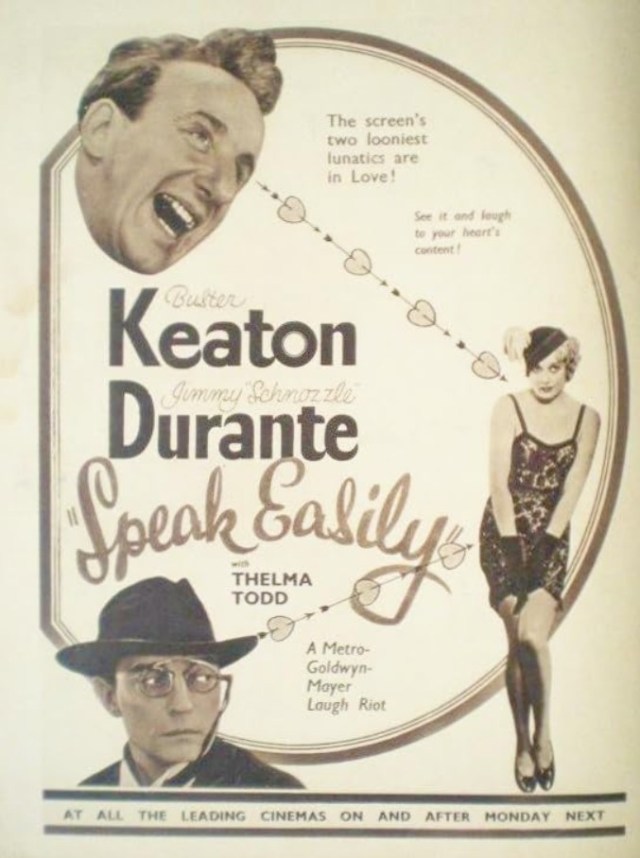
When I participated in the 10th Annual Buster Keaton Blogathon last year, I reviewed Buster’s episode of The Twilight Zone; “Once Upon a Time”. In that review, I stated how his episode would be a good place to start if one were introduced to the show, partly due to the story’s light-hearted nature. For this year’s event, hosted by Lea from Silent-ology, I wanted to check out one of Buster’s films. After taking a trip to his IMDB filmography, I selected the 1932 picture, Speak Easily! One of the reasons why I chose this movie for the blogathon was the story itself. According to the Internet Movie Data Base, “a timid professor inherits a large sum of money and decides to fund a terrible musical”. Another reason for choosing Speak Easily is how Buster starred in a “talking picture” (movies with sound). Because he’s known as a silent screen legend, I was curious to see how he’d perform in a film with audible dialogue. So, with all that said, let’s begin this review of the 1932 presentation!
Things I liked about the film:
The acting: As I mentioned in the introduction, Buster Keaton is known as a silent screen legend. His forte was “slapstick” comedy, which worked in the format of silent films. With Speak Easily, Buster had to incorporate both physical movement and dialogue in order to help tell the story. Honestly, I think he did a good job with the provided material! In the 1932 production, Buster portrays Professor Post, an intelligent yet isolated man. This allowed Buster to adopt eloquent words, a sense of awkwardness, and responses that are too literal. Add his signature “slapstick” comedy for good measure and you have a character that was charming in his own right! Along the way, Professor Post becomes friends with a theater performer named James Dodge. Portrayed by Jimmy Durante, James had a big personality, brighter than all the lights of Broadway. This vibrancy was consistent throughout the movie, a strength of Jimmy’s performance! Ruth Selwyn and Thelma Todd join the cast as Pansy Peets and Eleanor Espere. Both actresses did a good job making their characters feel distinct from each other. During Speak Easily, Ruth displayed a gentle persona and was more soft spoken. Meanwhile, Eleanor adopted a flirtatious personality.
The dialogue: Prior to reviewing Speak Easily, I have seen a few of Buster’s “talking pictures”. However, his roles in these movies were smaller, meaning he was given fewer lines to work with. Though Buster received more opportunities to incorporate dialogue in Speak Easily, I was more impressed with the dialogue itself. Throughout the film, I caught on to how well-written the dialogue was. One good example can be heard toward the beginning of the film. Professor Post doesn’t go to a local event at his college because he claims he wasn’t invited. His colleague, Jenkins, thinks this is an excuse for Professor Post to stay in his comfort zone. During a visit to Professor Post’s office, Jenkins tells Professor Post, “if you only go out and find life, you’ll enjoy living it”. This line serves as a friendly yet firm reminder how life is too short to miss out on.
The messages and themes: Like I said earlier in this review, Professor Post is an intelligent yet isolated man. After he receives a large sum of money, Professor Post chooses to travel to New York and, eventually, funds a musical. As the story progresses, he tries to form connections with his peers. Eventually, Professor Post successfully finds friends by staying true to himself. The trials and triumphs of forming relationships, whether romantic or platonic, is a relatable subject. What’s also relatable is having a genuine persona/personality and doing the right thing. The incorporation of these messages and themes was one of the things I liked about Speak Easily!
What I didn’t like about the film:
A drawn-out film: Speak Easily has a run-time of an hour and twenty-one minutes. However, the movie’s run-time felt longer. This is because parts of the story were drawn-out. As Professor Post boards a train, there’s a running joke about how he forgot his trunk. The joke then transforms into a couple forgetting their baby. That entire joke lasts for about four minutes. Had the joke just focused on Professor Post forgetting his trunk, maybe some of Speak Easily’s run-time could have trimmed.
An overshadowed musical: I’ve mentioned twice in this review how Professor Post funds a musical after receiving a large sum of money. This concept made me curious how Professor Post’s involvement would influence the musical. While the musical was featured in the movie, you have to wait over fifty minutes into an hour and twenty-one minute story just to see the musical come to life. Preparations for the musical were shown, but only in two scenes. The majority of the story focuses on Professor Post’s relationships with the other characters. That focus causes the musical to be over-shadowed.
Limited amount of “slapstick” comedy: I said earlier in my review how “slapstick” comedy was Buster’s forte. This part of his career has been incorporated into his “talking picture” projects, such as The Twilight Zone episode; “Once Upon a Time” and Speak Easily. But in the 1932 production, Buster’s “slapstick” comedy was used sparingly. That creative decision was the result of the film’s run-time, as Buster’s silent films were, more often than not, shorter. The limited amount of “slapstick” comedy felt like the movie was missing something. I wish Speak Easily’s creative team had capitalized on Buster’s forte a bit more.

My overall impression:
In Speak Easily, Professor Post sees working on a musical as trying something new. By moving out of his comfort zone, he was able to make new friends, find success, and travel beyond the walls of his office. By starring in this film, Buster Keaton was, in a way, trying new things. This time, he had to rely on more than just physical movement and “slapstick” comedy to carry the story. Even though I liked Buster’s performance in the 1932 presentation, the project itself was, in my opinion, just ok. I was pleasantly surprised by how well-written the dialogue was! The acting, as well as the messages and themes, were Speak Easily’s other strengths. But there were aspects of the movie I didn’t like, from the drawn-out nature of the film to the musical becoming overshadowed. By reviewing this project, I found an excuse to write about a pre-Breen Code era title. Since the only pre-Breen Code era movies I’ve reviewed this year, so far, were The Garage and 1925’s Phantom of the Opera, Speak Easily will easily fill that void!
Overall score: 6-6.1 out of 10
Have you seen Speak Easily? Which “talking picture” from Buster Keaton’s filmography would you like to see me review? Let me know in the comment section!
Have fun at the movies!
Sally Silverscreen












 18 Cinema Lane

