Take 3: I Heard the Bells Review + 500 Follower Thank You

Six years ago, when 18 Cinema Lane was born, I never imagined my blog would receive five hundred followers. But because of these followers, the people who took the time to read what I had to say, this milestone became a reality! To express my gratitude, I’m, once again, thanking my blog’s followers by writing this Blog Follower Dedication Review. This time, however, I’m presenting this review in the style of an open letter to the chosen film. While visiting the blog, It’s a Wonderful Movie, I came across a post about the 2022 Christmas movie, I Heard the Bells. At first, I believed it was a new production from Great American Family. This belief piqued my interest, as I wanted to review one of the network’s Christmas films. Then, I discovered I Heard the Bells was, simply, airing on Great American Family. Instead of being deterred by this misunderstanding, I still selected the 2022 picture for my Blog Follower Dedication Review, as I never heard of this presentation before 2024. With the Christmas season in full swing, writing about I Heard the Bells felt like an appropriate choice. So, without further ado, let’s begin this open letter!
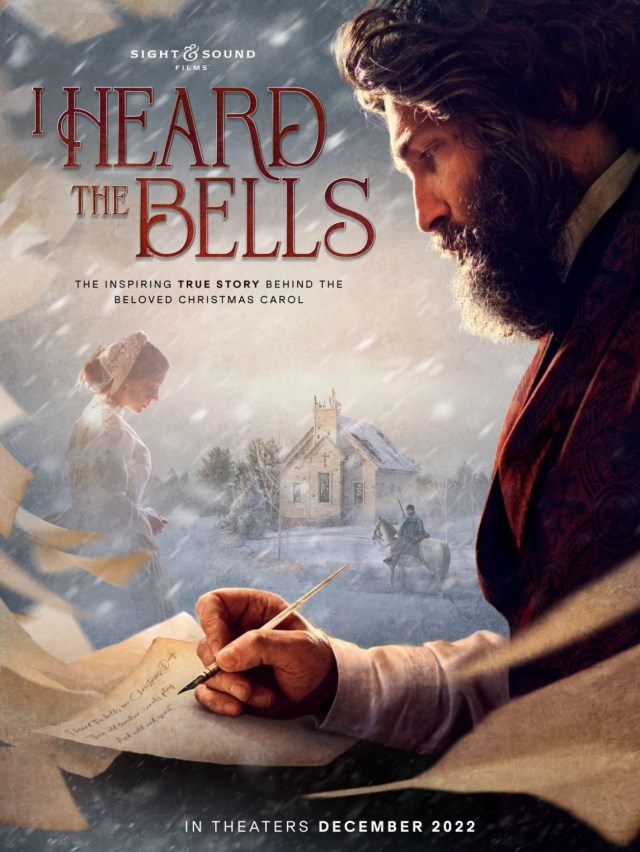
I Heard the Bells poster created by Sight & Sound Films

An open letter to I Heard the Bells:

As I write this letter, you remind me of another Christmas movie I know; Christmas on Division Street. That’s because you and the 1991 television film share one thing in common; meeting me by chance. If you hadn’t been featured on It’s a Wonderful Movie, I would never had heard about you. Then again, if I had paid closer attention, I would have known sooner you weren’t a Great American Family production. Despite that misunderstanding on my part, I still wanted to give you a fair chance. When it comes to writing about Christmas pictures, I root for every movie, including you, to be good. And that’s exactly what you are; good! With the seasonal entertainment landscape saturated with the same cliches, aesthetics, and story ideas, a Christmas movie needs to find a way to stand out from the competition. You, I Heard the Bells, succeeded in doing that!

Christmas Tree with boxes image created by Freepik at freepik.com. <a href=’https://www.freepik.com/free-vector/christmas-tree-out-of-gift-boxes_1448089.htm’>Designed by Freepik</a>. <a href=”https://www.freepik.com/free-photos-vectors/background”>Background vector created by Freepik</a>. Image found at freepik.com

In RKO 281 and Amadeus, Liev Schreiber and Tom Hulce brought humanity back to the names of Orson Welles and Amadeus. They also found the heart of the “genius” and put some genuine emotion behind it. Through his portrayal of Henry Wadsworth Longfellow, Stephen Atherholt followed in Liev and Tom’s footsteps. When it came to Stephen’s performance, however, he brought an emotional fire that helped make Henry a lively, well-rounded individual! Toward the beginning of the story, just hours before Christmas, Henry recites a poem. Combining facial expressions, vocal inflections, and body language, Henry was animated and captivating. He also spoke in a very poetic way, fitting for a man who had a way with words. Later in the story, after Henry experiences a tragedy, he gets into an argument with his son, Charley. At first, his eyes are downcast and he speaks in a softer tone, trying to avoid a conflict. But as Charley’s side of the argument becomes heated, Henry suddenly bursts with emotion. He quickly bolts from his seat and yells at his son, his anger spilling over. This reaction is so unexpected, Henry’s other children appear frightened.
Hand-written letter image created by Veraholera at freepik.com. <a href=”https://www.freepik.com/free-photos-vectors/background”>Background vector created by Veraholera – Freepik.com</a>. <a href=’https://www.freepik.com/free-vector/love-letter-pattern_1292902.htm’>Designed by Freepik</a>. Image found at freepik.com.

Through on-screen text, you made it known you were based on a true story. However, I still wish Stephen Atherholt and Rachel Day Hughes shared more scenes together. I already talked about Stephen’s portrayal of Henry Wadsworth Longfellow, explaining why it was good. Acting alongside Rachel, who portrayed Fanny Longfellow, Stephen shared strong on-screen chemistry with her! One of my favorite scenes is when Fanny and Henry dance together on Christmas. Their gentle waltz perfectly captures their romantic tenderness. Even in scenes taking place outside of Christmastime, this romantic tenderness was present between Henry and Fanny. At a dinner party, Henry is nervous about having his poetry recited in front of the party guests. During the poem’s introduction, Henry’s hand twitches. Fanny quickly puts her hand over his and even encourages him to lift up his eyes. Throughout this scene, Fanny’s encouragement is gentle, with her patience and kindness making Henry feel more comfortable in his situation. Though Rachel and Stephen shared only a few scenes together, they effectively showed how Fanny and Henry brought out the best in each other!

Envelope with hearts image created by Freepik at freepik.com. <a href=’https://www.freepik.com/free-photo/hearts-and-pink-envelope-for-mothers-day_1950691.htm’>Designed by Freepik</a>. <a href=”https://www.freepik.com/free-photos-vectors/love”>Love image created by Freepik</a>. Image found at freepik.com.

Bringing up RKO 281 and Amadeus again, these movies are historical pictures where attention to detail made their respective worlds feel visually immersive. It seems like you took another page out of Amadeus and RKO 281’s playbook by applying that attention to detail to Henry’s world! Watching this story unfold felt like traveling in time to the early 1860s. Whether it was the Civil War uniforms, the set design, or even a kite, every piece of this production appeared to be well-researched by your creative team. Remember when I brought up Henry reciting a poem hours before Christmas and the waltz between Henry and Fanny on Christmas? Those moments took place in the Longfellow home’s main sitting room, where era appropriate Christmas decorations can be seen. I noticed orange slices entwined on the garland above the fireplace, as well as candles illuminating the room. I even saw a Nativity set on a nearby table.

Adorable Christmas card image created by Rawpixel.com at freepik.com. <a href=’https://www.freepik.com/free-vector/christmas-greeting-card-vector_2824854.htm’>Designed by Rawpixel.com</a>. <a href=”https://www.freepik.com/free-photos-vectors/christmas”>Christmas vector created by Rawpixel.com – Freepik.com</a>. Image found at freepik.com.

While there was a lot to like about you, there were some things I didn’t like about you. One of them was how you were almost two hours long. I know you’re a fan of establishing shots, but did you really need that many? Personally, I think you could have either cut some of these shots or trimmed the establishing shots’ length. As I mentioned earlier in this letter, Henry experiences a tragedy. This event causes his appearance to change as time goes on. Even Charley’s hair looks different over time. Yet Henry’s daughters, Anne, Alice, and Edith, always looked the same despite the progression of years. For this flaw, I fault the director and casting director, as they should have been more mindful about how those in the story were presented. Speaking of those involved in the story, there are some people I wish were more involved in what was happening on-screen. Senator Charles Sumner, portrayed by Daniel Stargel, is one of Henry’s supporters. He even helps Charley find a respectable position in the military. But out of your almost two-hour story, Charles appears in only a handful of scenes. I remember how you’re based on a true story. However, that’s not going to change my mind on how Charles should have been given more appearances.

Do you remember at the beginning of this letter, when I said you reminded me of Christmas on Division Street? Well, there’s another Christmas movie you remind me of. That would be the classic It’s a Wonderful Life! For starters, you and the 1946 film are Christmas productions that are about more than just the Christmas holiday. Both of you focus on a man and his story, also exploring how that man’s relationships affect his existence. There’re also elements of faith in both stories. However, these elements are incorporated in different ways. Your delivery, as well as that of It’s a Wonderful Life, shows how much you cared about the overall presentation. In your case, your emphasis on attention to detail made the story look and feel so historically accurate, Henry’s world became immersive! Every acting performance was strong, especially Stephen’s and Rachel’s. Yes, you do have flaws. But I don’t think they will hold you back from, one day, becoming a classic! When I wrote about RKO 281 last year, I claimed good films leave a lasting impression. As I close this letter and move along on my blogging journey, I can honestly say you’ve done just that!

Sincerely,

Sally Silverscreen

P.S. I’ll give you a score of 7.6 out of 10.

Take 3: Hallmark Hall of Fame’s The Love Letter Review

I’m not going to lie; I love a good blog party! So, when I discovered Heidi, from Along the Brandywine, was hosting the Valentine’s Day Period Drama Blog Party, I couldn’t wait to sign up! Period dramas are not regularly covered on 18 Cinema Lane. While I do have a re-cap series for When Calls the Heart, I choose what films to watch based on how interesting their stories sound. There have been period dramas I loved, such as Swept from the Sea. But, for this blogathon, I wanted to review a film I hadn’t seen before. For about a year, I’ve had the Hallmark Hall of Fame movie, The Love Letter, on my DVR. Because parts of the movie take place in the 19th century, I felt it fit Heidi’s time period requirement of the 1600’s to World War II. I try to watch as many Hallmark Hall of Fame titles as I realistically can. Prior to reviewing The Love Letter, the only Hallmark Hall of Fame movie from 1998 I’ve seen is Grace & Glorie, which was one of the best movies I saw last year! While not all movies from this collection are created equally, I do watch these movies with an open mind.

Since an image of The Love Letter‘s poster was featured on my television, I took a screenshot of it with my phone. Screenshot taken by me, Sally Silverscreen.

Things I liked about the film:

The acting: Because The Love Letter heavily relies on the performances of its lead actor and actress, this part of the review will focus on Campbell Scott’s and Jennifer Jason Leigh’s portrayal of Scott Corrigan and Elizabeth Whitcomb. With Campbell’s performance, there was always a sense of focus in his character. This focus could be seen in Scott’s eyes. When he was inspecting the desk at the antique store or restoring that same desk, Scott’s focus showed how much he cared. This was a consistent part of the character and helped whenever he wrote to Elizabeth. In historical fiction/period films, it would be easy for the screenwriter to give their lead female character one distinct type of personality. Elizabeth Whitcomb, on the other hand, held a balance of two that brought something unique to the character. She had a youthful radiance about her, being a “romantic dreamer” at heart. However, Elizabeth carried herself with a graceful maturity that prevented her from becoming childish or immature. Jennifer brought both aspects to Elizabeth equally and beautifully, allowing her character to be multi-dimensional.

The historical accuracy: I am not an expert on the 1860s and its historical significance. But based on what I do know about this particular period in time, Elizabeth’s part of the story looked and felt historically accurate! The Whitcomb family home was furnished with pieces that appeared antique, from the couch in the sitting room to the desk Elizabeth and Scott share. Dark wood held these structures together, with green cushions and intricate carvings finishing the couch and desk. The costumes were very detailed and also reflective of the 1860s. Embroidery on Elizabeth’s jacket and the overall design of her lacy parasol serve as two examples. Even the dialogue spoken by the characters sounded like it came directly from an era gone by. Pieces of the story like the ones I mentioned tell me, as an audience member, the creative team behind this film cared about the presentation of this part of their project!

A fantastical element: Most of the stories from the Hallmark Hall of Fame collection are grounded in reality, which means that fantastical elements are rarely found in these scripts. With The Love Letter, the story revolves around two people from different time periods who communicate to each other through letter writing. The idea of time manipulation is a concept that would likely be found in either a fantasy or science fiction film. While stories like Somewhere in Time and Portrait of Jennie have been dramas paired with this specific concept, I don’t recall Hallmark Hall of Fame creating their own film like that before or after 1998. Because The Love Letter’s creative team chose to include a fantastical element into their overall project, it gave the movie an opportunity to stand out from other titles. This was a creative risk that worked in the film’s favor!

The Valentine’s Day Period Drama Blog Party banner created by Heidi from Along the Brandywine.

What I didn’t like about the film:

Scott being engaged: A trope that has appeared in several Hallmark films is the male or female protagonist being engaged at the beginning of the story, only to fall in love with someone else by the end of that story. This trope has found its way into The Love Letter. For most of the movie, Scott is engaged to a woman named Debra. As he finds himself falling in love with Elizabeth, he strings Debra along and keeps the letter writing a secret. Scott does tell Debra the truth about his feelings, but this doesn’t happen until the movie is almost over. Personally, I think this trope is pointless, as the audience is spending time with a relationship that will end up leading nowhere. Scott should have remained single so the script could give its undivided attention to his and Elizabeth’s exchanges.

A rushed explanation: When fantastical or science fiction elements are included in a script, it helps to provide clear explanations to the audience so they can understand what is happening on screen. In The Love Letter, Scott’s mother tells Scott that an imbalance in the time-space continuum is the reason why he and Elizabeth are able to write to one another. However, this explanation was rushed, with Scott’s mother briefly bringing it up on only two occasions throughout the whole movie. She gives Scott stamps from the 1860s and had a special kind of writing ink made for him. Scott’s mother even found a post office that has existed since the Civil War era. These objects and the post office felt more like they conveniently benefited the plot instead of serving as ‘macguffins’ to move the story forward. As I already mentioned, this kind of story is rarely found in the Hallmark Hall of Fame collection. Despite this, a little more time should have been devoted to providing a clearer explanation.

Lack of physical interactions between Scott and Elizabeth: Because Scott and Elizabeth are from different time periods, it is not possible for them to physically interact with one another. Even though this is the nature of the story, it prevented the audience from seeing the on-screen chemistry between Campbell Scott and Jennifer Jason Leigh. One of the staples of a romance film is the on-screen chemistry between the lead actor and actress. Since that element was missing from The Love Letter, I was only invested in Scott and Elizabeth’s relationship to a certain extent. While their words were romantic, verbal communication only plays a part among any given couple.

Hand-written letter image created by Veraholera at freepik.com. <a href=”https://www.freepik.com/free-photos-vectors/background”>Background vector created by Veraholera – Freepik.com</a>. <a href=’https://www.freepik.com/free-vector/love-letter-pattern_1292902.htm’>Designed by Freepik</a>. Image found at freepik.com.

My overall impression:

As I said in my review, most Hallmark Hall of Fame stories are grounded in reality. These stories are also on the simple side, with messages and themes that audience members can relate to. Even though The Love Letter has a fantastical element that is rarely found in films from this collection, it has a simpler story that works! Romance through words and thoughts is what carries the overall story, with important advice woven into the script. Forming a relationship with someone you truly love and never giving up on yourself are nice sentiments that can make audience members feel good about what they are watching. The movie also has the ingredients of a good Hallmark Hall of Fame title, like the level of detail when it comes to the film’s historical accuracy. It is true the movie has its flaws. However, the execution of a creative risk like this makes up for The Love Letter’s weaknesses. Films such as this one make me wish Hallmark would be more creative with their stories and think outside the box more. With the ball in their court, I don’t know what their next creative step will be.

Overall score: 8 out of 10

Have you seen The Love Letter? What Hallmark Hall of Fame movies would you like to see me review? Let me know in the comment section!

Have fun at the movies!

Sally Silverscreen