The day you’ve been waiting for is finally here; the World Television Day Blogathon! Since the dawn of television, this particular medium has become a staple in popular culture. Through this lens, history has been recorded and memories have been made, giving people a way to look back on the past. Television’s broad landscape has provided something for everyone, from cozy mystery shows to beloved musical competitions. In this blogathon, various television related topics will be showcased. Each entry highlights different decades, made-for-tv movies, and shows, illustrating the importance of World Television Day!
Created by Sally Silverscreen at Adobe Creative Cloud Express
When we talk about book-to-film adaptations, we are quick to point out how both pieces of media are different. Some of these differences can lead to insightful conversations between the fans and the casual audience. Other differences can cause a negative reaction, from readers walking out of the theater mid-film to Youtube videos showcasing fans’ rants and complaints. But one topic I haven’t heard addressed is why these changes between book and film likely happened. This topic can be applied to any adaptation. For the sake of my editorial, though, I’m writing about Hallmark Hall of Fame’s The Flamingo Rising. Back in June, I published a list of the top ten movies I’d love to, one day, review. The 2001 Hallmark Hall of Fame movie was on that list. Because I own a copy of Larry Baker’s novel, I thought it would be interesting to read the book after I saw the movie. Now that I’ve consumed both pieces of media, I have gained an understanding for why Hallmark likely made the changes they did. There are four main reasons why The Flamingo Rising’s book is different from its adaptation, which will be explored in this editorial. This article contains spoilers for the story of The Flamingo Rising.
Created by Sally Silverscreen at Adobe Creative Cloud Express
The Run-Time
Abraham Isaac Lee is the protagonist of The Flamingo Rising. In Larry Baker’s novel, Abraham takes a biographical approach to telling the story, reflecting on various moments that occurred in his life. He even goes into detail about the history of his parents and Grace’s parents. According to IMDB, Hallmark Hall of Fame’s The Flamingo Rising has an hour and thirty-four-minute run-time. As I’ve said before on 18 Cinema Lane, that run-time gives a film’s creative team only so much time to tell a story. Hallmark Hall of Fame’s adaptation of The Flamingo Rising condensed the events in Abraham’s and his family’s life. The book explains how Hubert, Abraham’s father, purchased the land for The Flamingo Drive-In before Abraham and his sister, Louise, were adopted. While Hubert was a soldier in the Korean War, he sent building plans and business ideas to his wife, Edna, who was put in charge of putting those plans into fruition. The purchase of the land and creation of The Flamingo Drive-In, in the movie, took place long after Hubert left the military and in a shorter amount of time. Both Abraham and Louise are teenagers for the majority of the movie, with only one flashback showing the siblings as babies.
There are many characters in The Flamingo Rising. While reflecting on his life, Abraham takes the time to explain who each person in his life is, as well as giving these people a significant presence in the story. Most of these characters were present in The Flamingo Rising movie. But because the film’s run-time is an hour and thirty-four-minutes, their parts of the story were reduced. Abraham’s sister, Louise, is one of these characters. The book reveals Louise grew up to become an actress, as Abraham claims she had the talent for it. In one scene, Louise expresses interest in flying in Harry “Judge” Lester’s plane. This interest was sparked by a promise Hubert made to his children. The movie’s script, however, never addresses why Louise wants to fly with “Judge”. In fact, the audience never sees her flying in “Judge’s” plane. When it comes to Louise’s acting, it was only mentioned once throughout the movie. During a conversation between Abraham and his friend, Gary, Abraham mentions how his sister wants to be an actress someday.
Hallmark Hall of Fame’s The Flamingo Rising VHS cover created by Hallmark Entertainment, Hallmark Hall of Fame Productions, McGee Street Productions, CBS, and Artisan Entertainment
The Budget
From what I’ve heard over the years, a typical made-for-TV movie costs somewhere between one to three million dollars. While that sounds like a lot of money to the average movie blogger, that amount is actually on the lower end of the financial spectrum, when it comes to making movies. If the aforementioned millions were the budget for Hallmark Hall of Fame’s The Flamingo Rising, it would explain why some parts of the source material were cut from the movie. In the book, Abraham shares his family had a temperamental dog named Frank. This dog was so unstable, he not only bit Louise, he was forced to live in an empty room above Abraham’s room, due to the dog’s behavior. In the film, however, Frank the dog is nowhere to be seen and is never acknowledged by any of the characters. If a movie’s creative team chooses to include an animal in their production, the training, veterinary care, and other related expenses will need to be factored into the overall budget. Working with an animal trainer also requires time, something the creative team behind The Flamingo Rising only had so much to spend. Therefore, the inclusion of Frank the dog was an expense the adaptation’s creative team likely thought was unnecessary.
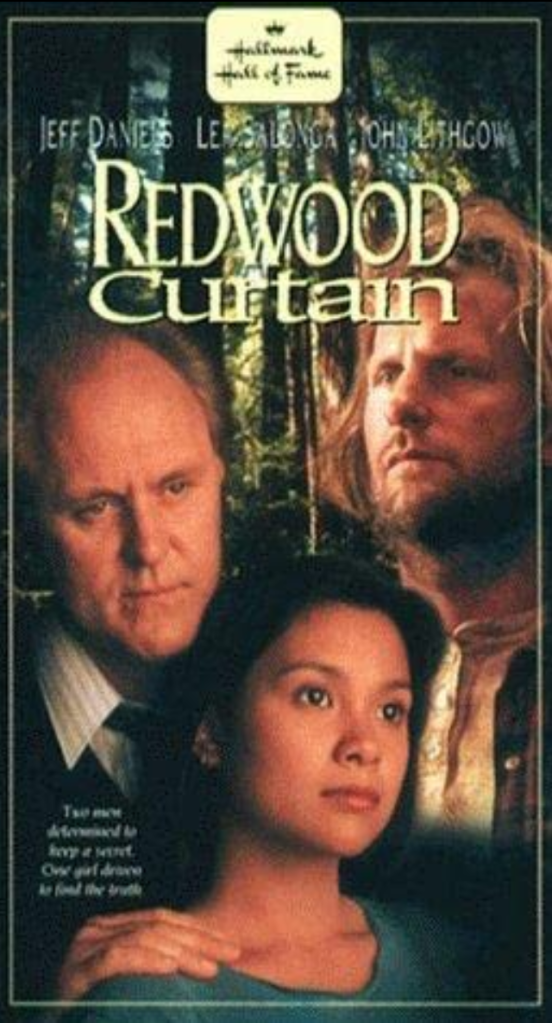
Location scouting is a film-making component also affected by a creative team’s budget. Like I said in my editorial, ‘Redwood Curtain’: From Stage to Screen, a location scout might not be able to secure a location similar to one described in the source material. Even if they succeeded, there’s a process in order to film at a residential building, especially if it’s someone’s real-life home. This process, along with the budget, is the probable reason why the funeral home has a different appearance in the movie than described in the book. Larry Baker’s novel gives the West Funeral Home the look of a “Southern plantation style house”, complete with white columns and Jeffersonian arches. The Home also contains a garage full of hearses and limousines. The Flamingo Rising’s adaptation gives the funeral home a different exterior. Referred to as the Knight Funeral Home in the movie, the facility boasts a bungalow style in a dark green hue. The Home’s garage is not shown on-screen. However, the Home itself does feature a full-sized porch. The funeral home’s interior has more appearances in the book than in the movie. In fact, the only time the Lee family enter the Knight Funeral Home is shortly after Edna dies. For those two scenes, the creative team may have filmed them on a set, away from the building that portrayed the funeral home.
For many years, Hallmark garnered a reputation for presenting themselves as a “family-friendly” company. This has been reflected in their programming, including their Hallmark Hall of Fame productions. As someone who’s read The Flamingo Rising book, I’ll be the first person to say there are some parts of the story that are not “Hallmark appropriate”. One of these parts is Louise’s social life. Abraham, in the novel, recalls how, one night at The Flamingo Drive-In, Louise snuck out with some male college students. During this interaction, these males attempt to take advantage of her. Even though Louise is saved just in time by some of the drive-in’s employees, the ordeal is a frightening one. This event is not included in the movie. The only older characters Louise is friends with are Polly and Alice, who all happen to work at the drive-in. It should also be noted that Abraham and Gary are the only male characters Louise hangs out with in the film.
Louise’s story was not the only one to change in Hallmark’s efforts to keep the adaptation “Hallmark appropriate”. Polly, an employee of The Flamingo Drive-In, is a very problematic character in the book. A reason for this is due to her racism. Polly expresses how she didn’t like her high school becoming integrated. She also thinks Abraham is “too brown”, causing Abraham to have self-image related issues. Even though Polly’s role in the movie is smaller, she never comes across as racist. In fact, racism is never addressed in the film. Polly, along with Alice, appear to get along with both Abraham and Louise. Alice, throughout her time at the drive-in, gives Abraham advice and looks out for him, like an older sibling would look out for their younger brother or sister.
When an author creates a story, they sometimes don’t consider how that work could be translated to film or television. If that author’s work does receive an adaptation, the casting can dictate how the story changes. Abraham describes Alice Kite, in the book, as being “as tall as my mother”. Edna is six feet tall in the novel. Because of her height, Alice wore baggy jeans and shirts, never shorts. Elizabeth McGovern and Angela Bettis were cast as Edna and Alice in the Hallmark Hall of Fame adaptation. According to IMDB, Elizabeth is 5’7, while Angela is 5’3. Alice wardrobe’s, in the movie, included tank tops and shorts. This creative decision was likely made to compliment Angela’s height.
In both the book and movie, Grace looks like her mother. Turner, Grace’s father, tells Edna, in the film, “she looks just like her”, referring to his daughter’s resemblance of his late wife. But Grace’s mother never makes an on-screen appearance, as she dies before the movie’s events. Therefore, The Flamingo Rising’s creative team cast an actress that resembled the actor portraying Turner. William Hurt portrayed the owner of Knight Funeral Home. He appears blonde in the film, despite his character having “coal-black hair” in the book. Erin Broderick was cast as Grace, though it isn’t known if Erin or William was recruited to the movie first.
Since The Flamingo Rising takes place in Florida, I figured featuring this screenshot was appropriate. Screenshot taken by me, Sally Silverscreen. Image originally found at https://www.youtube.com/watch?v=tiBkULOrf7Y.
When I reviewed the Hallmark Hall of Fame movie, O Pioneers!, back in July, I said that story should have been adapted into a multi-part mini-series or a television show. That’s because I felt an hour and thirty-seven minutes was not enough time to tell a story with that many moving parts. I feel similarly about The Flamingo Rising. Because Abraham, in the book, is reflecting on his life, there are a lot of characters and plot points included in the text. With the Hallmark Hall of Fame adaptation being an hour and thirty-four-minutes, Larry Baker’s story was forced to be condensed.
There are several parts of The Flamingo Rising book that were either omitted or changed in the adaptation, due to these parts not being “Hallmark appropriate”. With that said, it makes wonder why Hallmark Hall of Fame chose to adapt Larry Baker’s novel over a story that was more “Hallmark appropriate”? This situation kind of reminds me of when Hallmark Channel adapted At Home in Mitford. Last September, I reviewed the 2017 film for one of my double features. After reading the book and watching its adaptation, I came to the conclusion the network wasattempting to fit a round peg into a square hole, trying so hard to fit At Home in Mitford into their brand of film-making. Perhaps something similar happened to The Flamingo Rising, causing history to repeat itself sixteen years later?
While looking through some of my movie reviews from last year, I came to the realization I only wrote about two Christmas films. To make up for that, I will make a greater effort this year to review more Christmas movies. As it was Veteran’s Day two days ago, I decided the first Christmas film review of 2022 would be for USS Christmas! In the two years since its release, I’ve heard good things about this particular Hallmark picture. The network also has a pretty consistent track record when it comes to their military related Christmas titles. This is not the first time I’ve talked about USS Christmas. Back in 2020, I wrote a Word on the Street story about the project. I mentioned that the only Tiger Cruise movie I knew of was the 2004 Disney Channel movie, Tiger Cruise. Therefore, USS Christmas was filling a creative void that hadn’t been revisited in over ten years.
USS Christmasposter created by Crown Media Productions and Hallmark Movies & Mysteries
Things I liked about the film:
The acting: Jen Lilley portrays the protagonist, Maddie. Her reason for joining the Tiger Cruise was to spend Christmas with her sister, Amelia, who was portrayed by Stefanie Butler. I really liked the on-screen camaraderie between the sisters! While sharing breakfast at a local restaurant, Amelia and Maddie talk about a variety of subjects. Throughout their conversation, Jen’s and Stefanie’s facial expressions changed with fluidity. The actresses also had nice on-screen chemistry, giving the impression the sisters got along really well. It’s been a while since I’ve seen one of Trevor Donovan’s movies. However, I have always thought he was one of Hallmark’s strongest actors. In USS Christmas, Trevor portrayed Lt. Billy Jenkins. At the start of the story, Billy is distant with Maddie, maintaining a sense of professionalism. As the film continues, a kind hearted, more spontaneous side to Billy breaks forth. This progression in Billy’s personality was well executed through Trevor’s acting talents! The naturalness of this progression allowed Billy’s part of the story to be believable.
The set design: Like any Hallmark Christmas film, USS Christmas contained its fair share of seasonal décor. But it was the way this décor was incorporated into the set design that caught my eye. When Maddie’s family has their first dinner on the Tiger Cruise, the dining room is surrounded by white walls. White and blue Christmas decorations are placed in the background, from a blue garland to a white Christmas tree with blue ornaments. These complimentary hues added a sense of elegance to this space! Garland was a nice touch to other sets. A traditional green garland paired with red ornaments and bows was framed around the dark wood windows of the Jenkin family home. A similar looking garland framed the kitchen window of the Contino family home, a room that contained white cabinets. That garland shows how a simple Christmas decoration can complement various different spaces!
The mystery: Mysteries are uncommon in Hallmark’s Christmas films. So, the inclusion of a mystery in USS Christmas was a pleasant addition! In an effort to write a story about finding love on a Tiger Cruise, Maddie finds a journal written by a man named Sam. In this journal, Sam talks about falling in love with a woman named Dorothy. Maddie and Billy spend the rest of the movie searching for Dorothy and Sam, going on a journey to figure out what happened to this couple. While I won’t reveal what Billy and Maddie discover, I will say the mystery itself was intriguing! It gave me a reason to stay invested in the story.
The Tiger Cruise itself getting overshadowed: It’s been years since I’ve seen Tiger Cruise. From what I remember, the cruise itself was focused on to the point where it was its own character. With USS Christmas, I felt the cruise was overshadowed by the mystery of Sam and Dorothy. As I already said in this review, I liked the mystery in this story. However, that part was prioritized above everything else. When Maddie and Billy go to New York, I thought, “Wait, isn’t this movie supposed to be about the Tiger Cruise”?
Underutilized characters: On the Tiger Cruise, Charlotte is boarding alongside her brother, who is a member of the U.S.S. Polaris. Because Charlotte is also a writer, I assumed she would help Maddie in her quest to find Sam and Dorothy. Unfortunately, Charlotte and her brother briefly appeared in the film for about three scenes. These are just two characters I feel were underutilized.
Inconsistent use of Easter Eggs: The inclusion of Easter Eggs can be a nice treat for viewers and, if done right, can be cleverly woven into the story. There were some nice Easter Eggs in USS Christmas. But I was confused what the overarching direction for these Easter Eggs was. Toward the beginning of the movie, I found a few Easter Eggs related to It’s a Wonderful Life, as Maddie says that is her favorite Christmas film. Throughout the movie, there were at least two Easter Eggs referencing Top Gun. I even caught an Easter Egg connected to Hallmark itself. I wish the film’s creative team had chosen one topic for their Easter Eggs and consistently stuck with it.
As I said in the introduction, Hallmark has a pretty consistent track record when it comes to their military related Christmas titles. While some of these titles have been better than others, I haven’t seen a military related Hallmark Christmas movie that was bad or disappointing. With USS Christmas, it was a nice, pleasant film. It isn’t an instant classic for me or a new favorite movie. But, for what it was, USS Christmas was fine. Hallmark’s efforts to tell more creative stories seems to be an exception to the rule. So, I appreciate how the creative team behind USS Christmas strove to create a type of story that isn’t common in entertainment media. It also helps how a mystery was incorporated into the film, as mysteries aren’t often found in Hallmark’s Christmas offerings. I’ve heard Jen Lilley and Trevor Donovan have begun appearing in Great American Family’s (GAF) movies. I’ll have to check out their films from that network!
Overall score: 7.1 out of 10
Have you seen USS Christmas? Which military related Hallmark Christmas movie do you like? Let me know in the comment section!
Ok, so you probably read the title of my editorial and thought, “Sally, don’t you know Das Sound Machine is not a real musical group”? Readers who are familiar with Eurovision will likely think, “Isn’t Germany planning on hosting a national contest”? As of November 9th, 2022, Germany’s national broadcasters, NDR/ARD, have announced their plans to host a national final “in early March”, according to Eurovoix News. The application process for potential representatives is currently open. There’s even the likelihood of the broadcasters seeking out artists and their respective record labels to participate in the selection. With Germany still looking for a Eurovision representative, I think it would be really cool if the cast members who portrayed Das Sound Machine in Pitch Perfect 2 represented Germany in Eurovision next year! It sounds like a pipe dream on paper. But the more I’ve thought about it, the more I realized how my idea could realistically work. Before I explain how Das Sound Machine could compete in 2023’s Eurovision, I’d like to first explain why this plan should work.
Das Sound Machine image created by Gold Circle Films, Brownstone Productions, and Universal Pictures
Germany Desperately Needs a Showstopper
In 2023, there will be thirty-seven countries participating in Eurovision. Twenty-six of those countries will compete in the grand final, with Germany being one of them. Even though Germany automatically qualifies for the grand final, because they are one of the “Big Five” countries, they still need to stand out with a memorable entry. But if Germany is serious about their chances at Eurovision success, they need an entry that will stand out for the right reasons. In 2021, Germany placed second to last in the grand final, with a total of three points. This year, Germany received last place with only six points. As NDR/ARD searches for the perfect representative, they can use that desperation to not get a low score as motivation to submit the best entry possible. Germany was not the only country in 2021’s grand final to receive disappointing results. The United Kingdom didn’t receive any points, while Spain only got six points. The following year, Spain and the United Kingdom sent Chanel and Sam Ryder to Eurovision, who both placed in the top three.
There Has Never Been an A Capella Entry at Eurovision
Over Eurovision’s fifty plus year history, a variety of musical genres have been represented. But according to my research, no country has ever submitted an a capella entry. If Germany were to select Das Sound Machine to represent them next year, an original a capella number would not only bring something new to Eurovision’s table, it would give Germany a chance to try something different. According to an article from Wiwibloggs, this year’s national final, Unser Lied für Turin, was not met with favorable results. This is because of “the lack of variety within the songs but also for its production”. Before 2021, Italy had neversent an entry that was strictly rock. Sure, their entries may have contained elements of rock. ButMåneskin and their song, “Zitti e buoni”, was the first rock group Italy selected for Eurovision. This huge musical risk led to huge rewards, as Italy not only won Eurovision for the first time since 1990, but Måneskin has also found success after their song contest victory. The public’s response to Unser Lied für Turin and Italy’s recent Eurovision achievements should encourage Germany to think outside the box.
Das Sound Machine was given only two performances in Pitch Perfect 2: their Car Show number and their World Championship Finale number. Despite these limited performance opportunities, Das Sound Machine uses their talent to create what is, in my opinion, the best moments of the film! While reflecting on these two performances, there are three key elements that could help Das Sound Machine at Eurovision. The first is their energy! As I said earlier in this editorial, there will be twenty-six countries competing in the grand final. From what I’ve heard, the grand final’s run-time can reach up to four hours. Having performers who can consistently maintain a high energy level during their performance would keep viewers both in the stadium and at home invested in the show.
Das Sound Machine’s second key element is their mastery of the choreography! Because Eurovision is a live show, representatives need to give the audience something interesting to look at. Whether it’s dance routines, large scale props, or cool special effects, these ingredients could work in a representative’s favor. Based on Das Sound Machine’s aforementioned performances, each member displays control over their body, allowing every movement to stay parallel to the beats within the songs. This understanding between the physical and the musical showcase Das Sound Machine’s musicality. The third key element is the group’s creativity! During their World Championship Finale number, Das Sound Machine had very few props at their disposal. Instead of seeing it as a limitation, they used this as an opportunity to be creative! While performing Fall Out Boy’s “Light Em Up”, some Das Sound Machine members got into a strategic formation, coming together to create a ship. Other members of Das Sound Machine stood on either side of the formation, giving the appearance of water.
Das Sound Machine image created by Gold Circle Films, Brownstone Productions, and Universal Pictures
Built-in Enthusiasm
After seeing Pitch Perfect 2 for the first time, I remember thinking, “I wish Das Sound Machine was a real group”. Whenever I think about that movie, I always feel Das Sound Machine is the much stronger group than the Barden Bellas. If I get the opportunity to watch Pitch Perfect 2, I only watch the scenes featuring Das Sound Machine. It seems like I’m not the only one who feels this way. On the Youtube channel, King Samo, there are two videos featuring Das Sound Machine’s performances. In the comment sections of these videos, over a thousand commenters praised Das Sound Machine. Most of the comments were about how the group should have won the film’s World Championship. But there are other commenters who simply want to express their love for Das Sound Machine. Three commenters on the World Championship Finale video have made the following comments this year:
As a German person it’s insanely hilarious to me how every other country seams to think of us as this overly perfect nation when really, we’re not comparable with incredible groups like “Das Sound Machine“ at all. Just look at our contestants for the Eurovision Song Contest. We embarrass ourselves everytime. So can we please have them perform for us this year?
If DSM were a real group they would’ve won Eurovision and they would of deserved to win.
this would win the eurovision
As the comment section of the aforementioned videos show, there is built-in enthusiasm for Das Sound Machine. If Germany sent Das Sound Machine to Eurovision next year with a strong, original a capella number, that could translate well for grand final televoting.
According to official Eurovision rules, the maximum number of group members is six. This means Das Sound Machine couldn’t have the number of members they did in Pitch Perfect 2. From an a capella perspective, though, a six-person group could still create a strong original number. According to Wikipedia, only two Pitch Perfect 2 cast members are listed as official members of Das Sound Machine: Flula Borg and Birgitte Hjort Sørensen. NDR/ARD would recruit four German a capella singers to accompany Flula and Birgitte. If Das Sound Machine were selected to represent Germany at next year’s Eurovision, expenses related to the contest would be co-funded by NDR/ARD and Universal Music Group, as Das Sound Machine was created specifically for Pitch Perfect 2. Universal Music Group is Universal Studio’s music label. On their website, there are eight German music labels associated with Universal Music Group. If possible, more than one of these labels could help fund any Eurovision expenses.
As of early to mid November, 2022, only three participating countries have chosen their representative. About half of the participating countries are planning on hosting a national contest. With the weeks leading up to Eurovision, it’s exciting to hear who will be selected to compete. This anticipation reminds me of Willy Wonka and the Chocolate Factory, as the golden tickets are waiting to be discovered. Unlike Ronald Dahl’s story, receiving a “golden ticket” to Eurovision is not as simple as tearing open the wrapper of a candy bar. Each participating country has their own process of choosing their representative. Even if they do choose to host a national contest, various factors go into making that event a reality. My idea of Das Sound Machine representing Germany at 2023’s Eurovision is just that: an idea. Even if Das Sound Machine were selected to participate in Unser Lied für Liverpool, there’s no guarantee they’ll be granted that “golden ticket”. But no matter who ends up representing Germany next year, I still believe Das Sound Machine should receive their “standing ovation”. So NDR/ARD, if you’re reading this, will you consider giving Das Sound Machine their Eurovision “golden ticket”?
Have fun at Eurovision!
Sally Silverscreen
Here are the link to the sources for this editorial:
Even though Hallmark’s Christmas line-ups just started about two weeks ago, the network may be planning ahead for next year’s seasonal programming. While on IMDB recently, I stumbled upon a movie listing for what could be an upcoming Hallmark production. According to this listing, which I included a screenshot of in my article, there appears to be a third Gift to Remember film in the pre-production stage. As of the publication of this Word on the Street story, Hallmark has not made any official announcements about their film related projects for 2023. However, if ‘Gift to Remember 3’ (the project’s current working title) is going to be created, then this would fit a trend Hallmark has been practicing this decade. Since last year, Hallmark has been creating sequels for films that premiered several years ago. Some examples are the following:
The Nine Kittens of Christmas – Sequel to 2014’s The Nine Lives of Christmas
Debbie Macomber’s A Mrs. Miracle Christmas – Continuation of the Mrs. Miracle series, last film aired was 2014’s Debbie Macomber’s Mr. Miracle
A Cozy Christmas Inn — Sequel to 2014’s Christmas Under Wraps
Even though this IMDB listing says “announced”, Hallmark has not made any official announcements about film related projects for 2023. Screenshot taken by me, Sally Silverscreen.
The first film in the Gift to Remember story, A Gift to Remember, was released in 2017. Its sequel, Cherished Memories: A Gift to Remember 2, premiered in 2019. In place of ‘Gift to Remember 3’s poster, the cover for Melissa Hill’s stand-alone novel, The Gift of a Lifetime, is featured on IMDB. Since two of Melissa’s books, A Gift to Remember and The Charm Bracelet, have been adapted into Hallmark films, it would make sense if the network adapted The Gift of a Lifetime into a movie. But it does make me wonder if ‘Gift to Remember 3’ will incorporate elements from The Gift of a Lifetime’s story or if The Gift of a Lifetime will be its own film? While looking back on the aforementioned sequels, I realized they were continuations of movies that first aired in 2014. As of the publication of this Word on the Street story, nine Hallmark Channel Christmas movies from that year have not received sequels. I not only question why the network would choose 2014 specifically on focus their sequel efforts on, but also which 2014 film, if any, will be the next to receive a second chapter?
What are your thoughts on this potential piece of movie news? What book of Melissa Hill’s would you like to see adapted into a film? Please tell me in the comment section!
Have fun at the movies!
Sally Silverscreen
Here is the link to ‘Gift to Remember 3’s page on IMDB:
Last December, I was nominated for The Pick My Movie Tag by Gill from Realweegiemidget Reviews. My selected topic was “A list of must-watch Hallmark film star biopics”. In my quest to find these kinds of films, however, I found very few Hallmark titles about film stars, especially those I’ve seen. More often than not, I came across Hallmark movies that were based on true stories that were not celebrity related. Therefore, I decided for this tag I would write about the top five Hallmark films based on a true story! Before I list the tag’s rules, I’d like to thank Gill for the nomination, as Gill’s thoughtfulness is appreciated.
The Tag’s Rules
Nominate one or more people to review the film or films of your choice. Or you can request they review something from a certain year, genre, or star. Everyone can review the same thing, or you can request each person cover something different. As long as it’s something they haven’t written about yet, you’re good.
Nominees are allowed to request a different pick for whatever reason no more than five times. Stuff happens. We all know it.
Nominees must thank the person who nominated them and provide a link their blog.
Nominees may nominate others to keep the tag going. Picking the person who nominated them is allowed, or they can nominate someone else. Maybe both.
All participants need to include these rules in their post, whether they’re nominees or picking nominees.
All participants should use the “Pick My Movie” banner or something similar in their posts.
It’s been years since I’ve seen The Christmas Choir. From what I remember, I enjoyed this film! The cast as a whole is strong. Quality in acting talents and screenwriting allow the characters to come across as realistic and endearing. The Christmas Choir is one of Hallmark’s more unique Christmas titles, as it doesn’t follow a formula or contain a certain set of Christmas movie tropes and cliches. In fact, it’s surprising this film isn’t a Hallmark Hall of Fame production, as the story of a choir that started in a homeless shelter seems like the perfect material for that collection of movies. Another thing I remember about The Christmas Choir is the genuine good-heartedness the film exuded. As the Christmas season is on the horizon, this may be a movie I end up revisiting!
2. Hallmark Hall of Fame’s The Courageous Heart of Irena Sendler (2009)
I first talked about this film in my tier rank list of all the Hallmark Hall of Fame movies I’ve seen. In that list, I mentioned the film’s presentation, as the film itself felt like a theatrical release. However, that’s not the only strength The Courageous Heart of Irena Sendler contains. Historical accuracy is an element that Hallmark Hall of Fame productions have, more often than not, executed well. This film is no exception, as the movie appropriately reflects the story’s time period! Movies like The Courageous Heart of Irena Sendler make me wish Hallmark had created more period dramas. Yes, we have When Calls the Heart. But, to me, that feels like the exception to the rule.
3. Hallmark Hall of Fame’s A Smile as Big as the Moon (2012)
If you asked me to name a “space camp” movie, A Smile as Big as the Moon is the first one that comes to mind. As I said in my aforementioned tier rank list, this film is the perfect example of what a Hall of Fame title should be. I still stand by that statement, with the movie containing so many good components! Similar to The Christmas Choir, the strong acting performances and screenwriting brought to life characters that were worth rooting for. It was also interesting to see what it takes to be enrolled in space camp. The story’s messages and themes are just as relevant today as they were in 2012 or even the late 80s, when the story takes place. A Smile as Big as the Moon is a Hallmark Hall of Fame title that I consider a classic!
4. The Color of Rain (2014)
In my opinion, The Color of Rain is Lacey Chabert’s best film from Hallmark. One reason why is the story in this film is so different from those in Lacey’s other Hallmark movies. The Color of Rain does contain sadder moments, as both families are dealing with the death of a family member. But similar to films like Holly and Ivy, the movie’s creative team adopted a balance between sorrow and joy. It also helps how the cast’s acting talents were strong, as it allowed the characters to be memorable. The more I think about The Color of Rain, the more it feels like a Hallmark Hall of Fame title.
5. A Godwink Christmas: Meant for Love (2019)
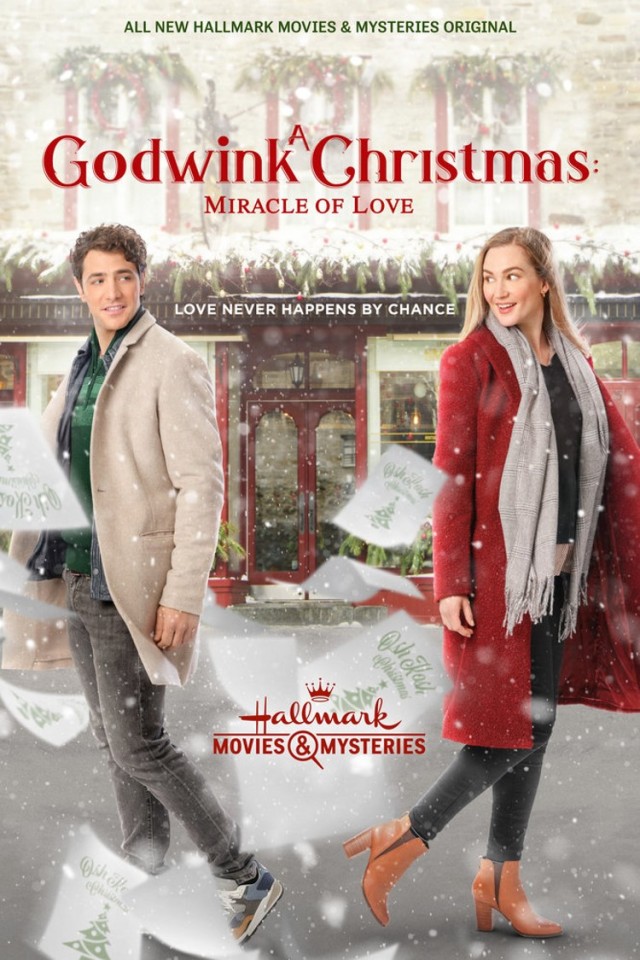
Personally, I enjoyed this sequel in the “Godwink” series more than the first film. A Godwink Christmas: Meant for Love does a better job at explaining and showcasing what a “Godwink” is. Like Holly and Ivy and The Color of Rain, this movie’s creative team successfully balances joy and sorrow. I also think Cindy Busby’s portrayal of Alice is one of her best performances, as it is well-rounded and contained emotionality. In a year when Hallmark premiered new films weekend after weekend, A Godwink Christmas: Meant for Love was, to me, one of their stand-outs. I may have to seek out the other two films in this series.
The films I reviewed in this double feature, The Legend of Billie Jean and Night of the Comet, were referenced by Dan, from the Youtube channel, This is Dan Bell. Because both movies were classified as “mall movies”, I assumed at least one of these titles would primarily take place in a mall. But after I watched The Legend of Billie Jean and Night of the Comet, I discovered this wasnot the case, as both stories featured a mall for a very short amount of time. This made me reflect on the idea of movies beingdefined by a singular location and the inconsistency of that idea. As I’ve already said, Night of the Comet and The Legend of Billie Jean are labeled “mall movies”, despite their respective malls not being the story’s primary setting. Yet, I have never heard anyone call Phantom of the Megaplex a “movie theater movie”, even though more than fifty percent of that film takes place at the Megaplex movie theater. This can also be said about the “destination film”. Whenever a protagonist in a Hallmark movie travels to somewhere other than their small hometown, “destination film” is the distinction these titles are given. But by Hallmark’s logic, wouldn’t the Fast & Furious films be considered “destination films”, especially since, more often than not, the characters are shown traveling to destinations outside the United States? The idea of movies being defined by a singular location and its inconsistency is a fascinating one that might be covered in a future editorial or double feature!
When I reviewed the 1982 Hallmark Hall of Fame movie, Witness for the Prosecution, back in July, I stated how I didn’t think I’d ever see the film. This was due to the movie’s lack of DVD or VHS release. But this is not the only Hallmark Hall of Fame production I didn’t think I would ever receive the opportunity to watch. One of these titles is the 1985 film adaptation, The Corsican Brothers. Similar to Witness for the Prosecution, the 1985 title didn’t receive a VHS or DVD release, as far as I know. Also similar to Witness for the Prosecution, I was able to locate the full movie on Youtube! Besides these similarities, both films star Donald Pleasence. In fact, Donald’s involvement in The Corsican Brothers is one of the reasons why I chose to review this film, as I’m participating in The Devilishly Delightful Donald Pleasence Blogathon!
The Corsican Brothersposter created by Hallmark Hall of Fame Productions, Norman Rosemont Productions, and CBS
Things I liked about the film:
The scenery: Within the movie’s introduction, there is a shot of the ocean surrounding Corsica. As the introduction continues, rocky terrains, rolling hills, and a city on a mountain are also showcased. The natural beauty of this island was captured well on film, making outdoor scenes visually appealing. When scenes took place in the town, quaint looking buildings met cobble stoned streets. A fountain was located in the town’s square. From a visual perspective, the town looked peaceful. It resembled Wanda’s hometown in the Hallmark Hall of Fame movie, In Love and War!
The historical accuracy: According to the film’s introduction, the story begins in 1820. Though the majority of the story revolves around Louis and Lucien’s life as adults, the film still takes place in the 19th century. While watching The Corsican Brothers, I was impressed by the historical accuracy shown on screen! Furniture is one example of this. In a scene where the camera pans over a section of a study room, a green embroidered chair with bolted upholstery was featured. An oil lamp was also included in the room. The windows boasted a lattice design, which highlighted an old-world charm to the titular characters’ home. These details provided a nice blend of the characters’ past and present!
The underutilization of Donald Pleasence: As I stated in the introduction, Donald Pleasence is one of the reasons why I chose to review this adaptation of The Corsican Brothers. As this is his second Hallmark Hall of Fame production I’ve seen and reviewed, I was eager to witness more of his acting talents. But, to my disappointment, Donald only appeared in about three and a half scenes. He did a good job with the acting material he was given. However, it made me wonder why he was cast in this movie in the first place, especially if the role didn’t allow his talents to be fully showcased?
Unexplained parts of the story: I have never read this film’s source material. Despite this, I expected The Corsican Brothers to be like other adaptations of Alexandre Dumas’ stories; exciting tales full of adventure and intrigue. With the 1985 Hallmark Hall of Fame project, however, I was, more often than not, confused by what was happening on screen. At the beginning of the movie, a voice-over talks about how the region of Corsica is overruled by a multi-generational long vendetta. What this voice-over forgets to mention is how and why this vendetta started. From time to time, a mysterious woman appeared in Corsica, giving some of the characters fates. No explanations are provided for who this woman is or why she wants to get involved in the story’s events.
Little to no sense of urgency: In the adaptations of Alexandre Dumas’ stories I’ve seen, a common ingredient is a sense of urgency. Since there is a sense of adventure found in these stories, an added element of urgency gives the audience a reason to stay invested in the characters and their journey. With The Corsican Brothers, though, this sense of urgency was almost non-existent. I’d say about fifty percent of this movie showed Louis attending fancy events in Paris. Even when parts of the story were meant to be exciting, they either came across as anti-climactic or were not shown on screen. A good example is the trial in Paris that Louis is a part of.
Limited use of lighting: In a few scenes, events took place at night. But because of the limited use of lighting, it was difficult to see what was happening on screen. It got to the point where I couldn’t see characters’ faces. I am aware cinematic technology in the mid-80s was not as advanced as it is today, especially when it comes to made-for-tv films. Had the creative team of The Corsican Brothers incorporated a little more light to the nighttime scenes, it would have remedied the issue.
When creating a book-to-film adaption, you should strive to create a movie that satisfies both the casual viewer and readers of the source material. As I stated in this review, I have never read The Corsican Brothers. Instead of being invested in the characters and their stories, I was, more often than not, confused by the events on screen. It felt like the creative team behind the movie expected the audience to have read the book prior to watching their presentation. Story related flaws are not the only flaws that stood out to me. Limited use of lighting made nighttime scenes difficult to see. The underutilization of Donald Pleasence also didn’t help. Not all Hallmark Hall of Fame movies are created equal, as some are bound to be better than others. Sadly, The Corsican Brothers isn’t one of the better ones.
Overall score: 5.5 out of 10
Have you seen The Corsican Brothers? What’s your favorite adaptation of Alexandre Dumas’ literary work? Let me know in the comment section!
This month, 18 Cinema Lane received 445 followers! Therefore, a Blog Follower Dedication Review is in order! Since October is typically known as the Halloween season, I wanted to select a film that was appropriate for this time of year. But I’m also participating in Genre Grandeur, where the theme this month is ‘Movies Directed by the Main Actor/Actress’. So, as the title of this review says, I have chosen to write aboutA Quiet Place! Prior to this review, I had heard of the 2018 film. Mixed results are what I have heard; either viewers have loved the movie or they thought the story’s logistics didn’t make sense. I’ve also heard A Quiet Place is a horror film that thinks outside the box. This is another reason why I chose to review this movie, as I don’t often talk about titles from the horror genre.
A Quiet Placeposter created by Platinum Dunes, Sunday Night Productions, and Paramount Pictures
Things I liked about the film:
The family dynamic: John Krasinski and Emily Blunt are two actors I am familiar with, primarily for their comedic performances. With John, I have seen clips of The Office, while one of Emily’s most notable performances was in The Devil Wears Prada. As I’ve said before on 18 Cinema Lane, I’ve seen more comedic actors successfully transition to dramatic acting. John’s and Emily’s performance definitely stuck the landing, as they were both able to convey a variety of emotions through facial expressions and body language! Portraying John and Emily’s on-screen children were Noah Jupe, Millicent Simmonds, and Cade Woodward. Adding their strong performances, the Abbott family had a really good family dynamic that felt believable and genuine. Toward the beginning of the film, Cade’s character, Beau, really wants a toy space shuttle. However, the toy makes noise, which is a no-no within the Abbott family’s world. Through sign language and facial expressions, John’s character, Lee, explains how Beau can’t have the toy. Beau’s response was a look of pure sadness and confusion on his face. Another memorable scene was when Regan refused a new cochlear implant. Throughout the film, Lee attempts to create a functioning cochlear implant for his daughter. When he gives Regan the implant, Lee is optimistic it will work this time, wide eyes and even a smile conveying this optimism. Regan is not impressed with the new implant, as she’s frustrated at the idea of another implant not working. She not only expresses frustration on her face, she even pushes away her father’s hand.
The atmosphere: As I mentioned in my point about the family dynamic, noise is a no-no in the Abbott family’s world. That’s because unidentified extraterrestrial creatures have taken over their environment, destroying anyone or anything that makes noise. Right in the very first scene, the audience can see how these creatures have driven people away from a small town. It looks like what most people would call a “ghost town”; cars frozen in the street and leaves slowly blowing through the air. The store where the Abbott family visits appears to be an urban explorer’s dream. Natural light from the store’s windows provides the facility’s only source of light. Products are strewn on the floor, waiting for someone to finally pick them up. Cinematography and inclusion of light help create a film that feels very atmospheric!
Use of sound: Even though the Abbott family try to create as little sound as possible, the film itself was not devoid of sound. At various moments in the story, natural sound could be heard whenever the family traveled from place to place. One notable example is when Noah’s character, Marcus, and Lee walk near a river. Sounds could also be heard through headphones or earbuds. In a scene where Lee and Emily’s character, Evelyn, are slow dancing, Evelyn puts one of her earbuds in Lee’s ear. Not only can the song be heard through the earbud, the song is amplified so the audience can hear it too. It serves as a reminder how sound, even noise, plays a role in our lives.
A film that doesn’t feel like a horror film: Like I said in my introduction, A Quiet Place is a horror film. Even the poster bears the hallmarks of a typical horror production. But, to me, A Quiet Place didn’t feel like a horror movie. Sure, there were terrifying moments in the story. But, if anything, the film felt like a dystopian/apocalyptic film with sci-fi elements. As I watched A Quiet Place, it reminded me of a more creative version of Signs.
Questions that are left unanswered: While I appreciate the film’s creative team respecting the audience’s intelligence, there were some questions I wish were answered. For instance, why did the Abbott family choose not to wear shoes? During Lee and Marcus’ hike, they cross paths with an elderly couple. Who were they and why did the elderly man want the creatures to capture him? Couldn’t the couple join the Abbott family and seek safety together?
The science’s confusing logic: As Marcus and Lee attempt to catch fish in a river, Lee explains how it’s ok to make small sounds. While big sounds are bad, they can be cancelled out with bigger sounds. With this logic in mind, why aren’t the extraterrestrial creatures congregating near the river? Why would they even bother trying to capture people, animals, and objects that make noise? Statements like Lee’s made the story somewhat confusing.
Before I share my overall impression of A Quiet Place, I’d like to thank all of 18 Cinema Lane’s followers! You are the reason why I continue to write and publish so many Blog Follower Dedication Reviews! Now, on to my thoughts on A Quiet Place. I will admit this is a fine, ambitious film that is one of the more unique titles of this nature. However, some aspects of the project could have been stronger. Like I said in my review of Night of the Comet, you need to explain the science in your science fiction story, especially in a way that satisfies the audience. While some of the science in A Quiet Place was explained, other parts of the story were confusing. The movie, to me, felt less like a horror movie and more like a dystopian/apocalyptic film with sci-fi elements. This makes the film’s marketing, as well as its horror classification, somewhat misleading. I am aware there is a sequel to A Quiet Place. Because I thought the movie was just fine, I’m not rushing to see the sequel anytime soon.
Overall score: 7 out of 10
Have you seen A Quiet Place? What movie do you like to watch around Halloween? Please tell me in the comment section below!
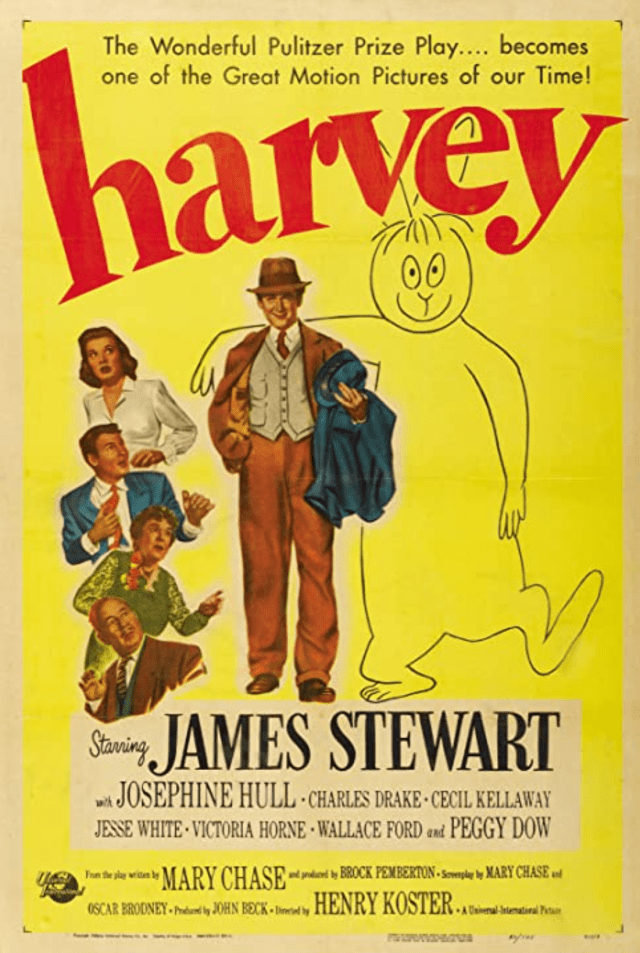
One of the first movies I reviewed this year was the 1950 film, Harvey. Since publishing my review back in January, that movie has become the most disappointing one I’ve seen this year, so far. Jillian, from The Classic Film Connection, recommended I give this story a second chance by checking out the 1972 Hallmark Hall of Fame production. Since this title is a remake and since I’m participating in The “Take Two!” Blogathon (which focuses on remakes), I found the perfect opportunity to watch this movie! When I reviewed 1950’s Harvey, I questioned what the point of the story was. This is because I was confused by what the movie’s creative team was trying to say through their project. Will I be less confused by the 1972 adaptation? Keep reading if you want to find out!
Harvey(1972) poster created by Foote, Cone and Belding Productions, Hallmark Hall of Fame Productions, Talent Associates-Norton Simon, and National Broadcasting Company (NBC)
Things I liked about the film:
Changes from the original film: As I said in my review of the 1950 film, there were things about Harvey I didn’t like. One of them was the medical negligence Veta experiences at Chumley’s Rest. In the 1972 version, that specific scene plays out differently. When Veta is being interviewed by Dr. Lyman Sanderson, he notices how distressed Veta appears. Her body language, tone of voice, and tears are noted by the doctor as he listens to what Veta has to say. This leads Dr. Lyman to admit Veta into the hospital for her well-being. The mix-up is presented as an example of good intentions leading to bad results. The film’s dramatic tone also helps elaborate how terrifying Veta’s experience would be.
A sense of magical realism: An element I thought was lacking in the 1950 version of Harvey was a sense of ‘magical realism’. Because the story featured a 6 foot 3 ½ inch, invisible white rabbit, I thought that aforementioned element would be automatically included in the film. In the 1972 adaptation, there was a stronger sense of ‘magical realism’ within the overall story. At the hospital, a hat with two holes on top is found in Dr. Lyman Sanderson’s office. The staff question who this hat could possibly belong to. Since the holes on the hat would allow rabbit ears to stick out, the hat itself implies Harvey does exist. This along with other strange occurrences in the story show how the film’s creative team put more effort into including ‘magical realism’.
The acting: When I reviewed the 1950 version of Harvey, I talked about James Stewart’s portrayal of Elwood P. Dowd, saying it was “laid-back” and “somewhat philosophical”. Reprising this role in the 1972 version of the story, James brought these same elements to his performance. But this time, his portrayal of Elwood reminded me of Mister Rogers from Mister Rogers Neighborhood. What I mean by this is Elwood came across as the type of man you’d want to spend hours having a conversation with. Elwood’s approachable and pleasant persona make him such a fascinating individual. If Elwood P. Dowd existed in the real world, I’d like to think he’d come up with an interesting TED Talk!
Despite appearing in the film for a limited period of time, I liked Madeline Kahn’s portrayal of Nurse Ruth Kelly! Her pleasant on-screen personality allowed her to stand out and give a memorable performance! Her interactions with the other characters also came across as realistic. After Veta was admitted to the hospital, Dr. Lyman has difficulty finding her. In a state of panic, he thinks Veta escaped. Sensing Dr. Lyman’s panic, Ruth becomes concerned. Her face has fallen from the smile she usually carries and her tone of voice contains a sense of dread. There’s even an ounce of timidness to her overall demeanor. Scenes like this one make me wish Madeline was given more on-screen appearances.
Most of the story being rehashed: When creating a remake of a pre-established story, it’s important to do two things: respect the source material that came before your project and bring your own voice to the table. In the case of Hallmark Hall of Fame’s version of Harvey, more emphasis was placed on respecting the original film. While this idea isn’t a bad one, the 1972 movie’s creative team didn’t allow themselves to create a unique identity for their project. The sets in this film looked almost exactly like they did in the 1950 film. The story, more often than not, followed the 1950 movie’s narrative, making very few deviations. While watching the 1972 version of Harvey, I wondered, at times, why this remake exists?
A televised version of a play: In my review of Hallmark Hall of Fame’s Foxfire, I talked about how that title felt more like a televised play. This is because the 1987 film contained a smaller cast and a condensed story. The 1972 adaptation of Harvey also felt like a televised version of a play. Fewer locations are a reason why. In the 1950 version, Elwood is shown taking Harvey to Charlie’s Pub. Elwood simply recalls this experience in the 1972 version. What’s also important to note is how the 1972 story takes place in either the hospital or the Dowd family home.
The underutilization of Betty Chumley: At one point in the 1972 story, Elwood makes plans with Dr. Chumley’s wife, Betty, to meet at Charlie’s Pub and share drinks. But because this trip was never shown on-screen, Betty received one less on-screen appearance. Within the story, she only appeared in two scenes. Personally, I think Betty should have had a stronger significance in the film.
After publishing my review of the 1950 version of Harvey, Jillian, from The Classic Film Connection, explained how the story’s point was “about the right to be uniquely yourself and live life on your own terms”. Now that I’ve seen the 1972 version of this story, I think the Hallmark Hall of Fame film did a better job at executing this idea. What worked in the movie’s favor was how the story was just a drama instead of trying to be both a drama and comedy. Scenes like Veta’s hospital admittance elaborated how terrifying her situation would be. There was also a sense of ‘magical realism’, something I thought was lacking in the 1950 film. However, the majority of the 1972 movie was a copy of the 1950 movie. In 1993, Hallmark Hall of Fame released the film, To Dance With the White Dog. Based on what I know about the story, it sounds like a version of Harvey. But this time, a man sees a white dog only he can see. Maybe I’ll write about that movie in a future review.
Overall score: 6.1 out of 10
Have you seen any version of Harvey? Are there any Hallmark Hall of Fame movies you’d like to see me review? Let me know in the comment section below!