Take 3: Blackbeard, the Pirate Review

Pirate films are rarely covered on 18 Cinema Lane. In fact, the only three I’ve reviewed are The Princess and the Pirate (which I liked), Captain Sabertooth and the Treasure of Lama Rama (which I found disappointing), and China Seas (which was just ok). This is one of the reasons why I chose to write about the 1952 movie, Blackbeard, the Pirate! The other reason is Linda Darnell’s involvement, as she is the subject of the Linda Darnell Centennial Blogathon, hosted by Musings of a Classic Film Addict! Blackbeard, the Pirate is the second film of Linda’s I covered on my blog. The first one was The Song of Bernadette, which was also reviewed for a blogathon. The 1943 film was one of the best I saw last year! But because Linda’s role was smaller in that movie, I had to remind myself which character she portrayed. Since her role in Blackbeard, the Pirate was bigger, it was easier for me to remember her performance!

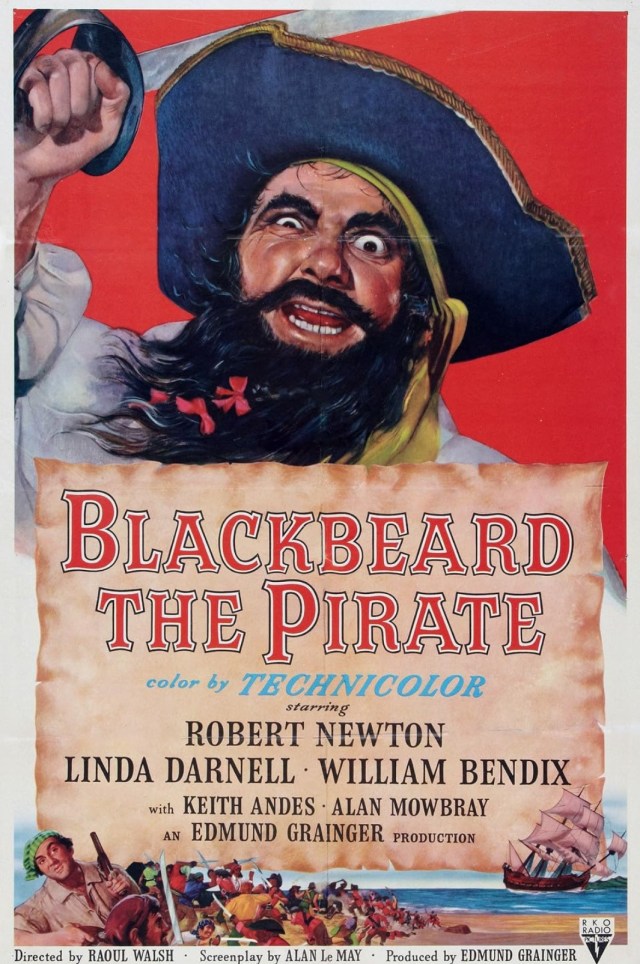
Blackbeard, the Pirate poster created by RKO Radio Pictures

Things I liked about the film:

The acting: Since Linda Darnell is one of the reasons why I reviewed Blackbeard, the Pirate, I’ll talk about her performance first. Linda was cast as the lead female protagonist, portraying a character named Edwina. Throughout the film, she consistently carried her character with confidence that radiated off the screen! Edwina was also a head-strong character, going toe-to-toe with characters like Blackbeard and sharing banter with them. Speaking of Blackbeard, Robert Newton shined in this role! What made his portrayal work was how animated and energetic it was. That consistent energy made Blackbeard interesting to watch! Linda shared a lot of scenes with Keith Andes, who portrayed Robert Maynard. I liked his performance for two reasons. The first reason is how calm Robert appeared while under pressure, a protagonist who didn’t let his feelings get the better of him. The second reason is how Keith’s on-screen chemistry with Linda was nice!

Clever dialogue: There were some moments in Blackbeard, the Pirate where I found the dialogue cleverly written! A great example is when Edwina meets Blackbeard for the first time. During this introductory encounter, Blackbeard asks Edwina what her name is. She then says Blackbeard’s name, in disbelief because she’s standing in his presence. Blackbeard replies by telling Edwina she can’t have the name ‘Blackbeard’, as that is his name. That scene was not only funny, it was also an interesting glimpse into Blackbeard’s perspective!

Historical accuracy: Most pirate films take place prior to the 19th century. This means the historical accuracy of the project can make or break that story. In the case of Blackbeard, the Pirate, it looked like the creative team cared about the presentation of their film! There are many ways historical accuracy can be featured in a movie. One way is through the cast’s wardrobe. While trying to escape from Blackbeard, Edwina asks Robert to untie her dress. This is so she can navigate around the ship in less layers. This scene reveals how Edwina was wearing a corset, an article of clothing that was common in the 17th century. Edwina’s outfit alone showed how much research was done to make this project look and feel historically accurate!

The Linda Darnell Centennial Blogathon poster created by Samantha from Musings of a Classic Film Addict

What I didn’t like about the film:

A misleading synopsis: According to a synopsis I read, Blackbeard, the Pirate is about Sir Henry Morgan’s attempt to capture Blackbeard and stop his pirating ways. This synopsis turns out to be a lie, as Henry doesn’t appear until fifty-seven minutes into this hour and thirty-eight-minute movie. Even while Henry is involved in the story, he isn’t given much to do. It made me wonder why Henry was included in the film in the first place?

An unclear story: Like any genre, there are several types of stories that can be told in a pirate film. But in Blackbeard, the Pirate, the movie’s creative team tried to tell several types of stories in one production. These include a quest for treasure, a “cat and mouse” chase between Henry and Blackbeard, and the hero rescuing the female protagonist from the villain. The creative team’s attempt to incorporate different types of stories prevented their movie from developing its own identity. The story itself isn’t clearly defined because of this creative choice.

A meandering protagonist: I’ve stated before how some Hallmark movies will center around a protagonist who says they’re going to do something, but spends most of the movie not doing the thing they said they were going to do. This isn’t just an issue in Hallmark films, as that was also an issue in Blackbeard, the Pirate. Through a voiceover toward the beginning of the movie, Robert claims he wants to bring Henry to the authorities, as he wants to receive the reward money. Unfortunately, Robert doesn’t make any attempts to capture Henry. In fact, he does everything but make Henry face accountability for his past actions. This meandering subplot is the result of the creative team trying to tell too many types of stories at once.

Ship steering wheel pattern image created by Jemastock at freepik.com. <a href=”https://www.freepik.com/free-photos-vectors/background”>Background vector created by jemastock – http://www.freepik.com</a>. Image found at freepik.com.

My overall impression:

I mentioned in my review’s introduction how I don’t talk about pirate films often. So, it’s disappointing when one of these movies turn out less than stellar. Blackbeard, the Pirate was, sadly, underwhelming. This was due to the weak screenwriting. Too many story ideas were incorporated into one script, preventing the film from adopting its own identity. That creative decision also caused the protagonist to not reach his goal. However, there were aspects of the movie I liked, such as the acting and the historical accuracy. But, in my opinion, the cast deserved better material. I’d like to check out more films from Linda’s filmography. Hopefully, I’ll find a movie better than Blackbeard, the Pirate.

Overall score: 5.3 out of 10

Have you seen Blackbeard, the Pirate? Are there any pirate films you like to watch? Let me know in the comment section!

Have fun at the movies!

Sally Silvrescreen

Take 3: The Third Man Review

When the terms “American Film Institute”, “classic”, and “Austria” are put in the same sentence, most people would think of the 1965 film, The Sound of Music. While that movie has become a beloved staple in cinema, there’s another title that fits the aforementioned criteria; 1949’s The Third Man. This film also fits the criteria for Hometowns to Hollywood’s Celluloid Road Trip Blogathon: International Edition. I’ve seen several movies from American Film Institute’s list of the top one hundred films of all time. Some of these films have, in my opinion, earned their respective places on that list. Other films have left me confused, questioning why a given film is on the list in the first place. While American Film Institute’s list comes across as objective, I have learned that almost any movie list is subjective. Therefore, I’m checking out The Third Man for myself, determining if I think the 1949 film should be on American Film Institute’s list!

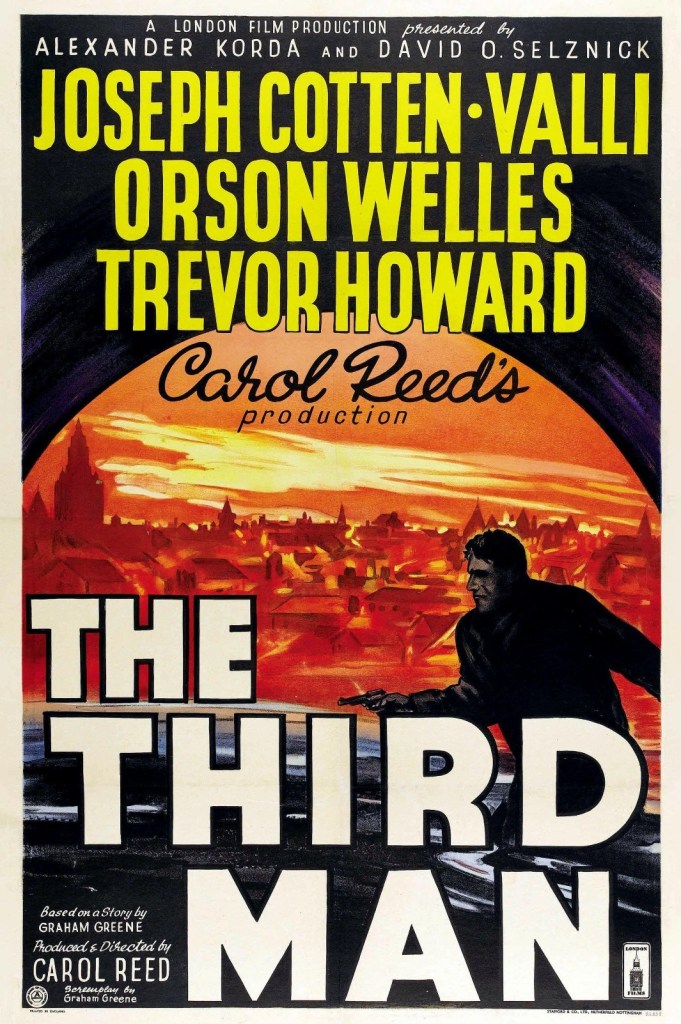
The Third Man poster created by London Film Productions, StudioCanal International, and Selznick Releasing Organization

Things I liked about the film:

The acting: In The Third Man, Ernst Deutsch portrayed Baron Kurtz, a friend of Harry Lime. Despite appearing in the film for a limited period of time, Ernst, in my opinion, stole the show! Anytime he appeared on screen, Ernst’s facial expressions were very fluid and expressive, allowing his character’s reactions to be on point. His performance makes me wish he had more appearances in The Third Man! Individual portrayals were not the only memorable performances, as I liked the on-screen chemistry between Joseph Cotten and Alida Valli. One scene shows Holly and Anna discussing Holly’s friend, Harry. This scene gave Alida and Joseph the opportunity to give their characters genuine emotion, from Anna shedding tears over how the world grew up around Harry to Holly smiling over a past memory of his friend. Their performances made their characters feel like they were meant to be together.

The set design: As mentioned in the introduction, The Third Man takes place in Austria. With the story set in Vienna, the landscape is urban, boasting a European charm that is reflective in the set design. Toward the beginning of the film, Holly goes to a restaurant in the middle of the city. The crown jewel of this location is the marble columns holding up the ceiling. Carved detailing bordered the edges on the ceiling, adding quaint elegance to the restaurant. Even the police station featured elegant design choices, such as the patterned wallpaper. The set design of The Third Man serves as a visual example of timeless beauty, still holding up 74 years later!

An honest glimpse of post-World War II Europe: The story of The Third Man takes place after World War II. Through visual presentation and the dialogue, the state of Vienna, Austria is showcased in an honest way. In one scene, Holly is being chased through the city. During this chase, Holly runs over rubble and hides in an abandoned car. Holly’s hiding place, as well as the rubble, are remnants of the war. Featuring these remnants prominently in the chase scene highlights the aftermath Vienna, Austria faced.

The Celluloid Road Trip Blogathon: International Edition banner created by Annette from Hometowns to Hollywood

What I didn’t like about the film:

Tilted angles: The role of a cinematographer is to present a scene in visually appealing ways. Creative decisions relating to cinematography can make a scene memorable, allowing the audience to bring up specific moments. In The Third Man, several scenes stood out because of cinematography, as these scenes were delivered at a tilted angle. However, there was no reason for those scenes to be presented that way. In fact, the tilted angles came randomly. It felt like those scenes were filmed that way simply for the sake of it.

Tonally unfit music: Acoustic guitar served as the only soundtrack for The Third Man. While this sound was pleasant to hear in some scenes, it was jarring to hear in other scenes. When the police, in one scene, dig up a grave in order to solve a mystery, the acoustic guitar sound gave off a cheerful tone. Yet, the scene itself was very serious in tone, as the film’s mystery is a murder mystery. This is just one example of the music being tonally unfit.

Inconsistent sense of urgency: As I just mentioned, the mystery in The Third Man is a murder mystery. In these types of stories, there is typically a strong sense of urgency, as the protagonist wants to stop the guilty party from hurting other people. But in The Third Man, the sense of urgency was inconsistent. Chase scenes and the climax are where the urgency was present. However, these moments were far and few between. Most scenes featured characters talking with one another. While there can be urgency included in these moments, urgency was not prioritized in the script.

My overall impression:

In 2008, the American Film Institute released a revised list of their one hundred films of all time. On this list, The Third Man was replaced by other titles. However, it does make me wonder why this film was on American Film Institute’s original list in the first place? As I stated in my review of The Bridge on the River Kwai, movies that appear on lists such as American Film Institute’s should, in my opinion, fit one of two categories; those that represent the time they were released and those that brought something new to the cinematic table. The only explanation I can think of is how The Third Man shows Europe post-World War II. Yet Roman Holiday takes place in Italy post-World War II and never appeared on any of American Film Institute’s lists. As for bringing something new to the cinematic table, I can’t think of how The Third Man achieved that. Similar to The Bridge on the River Kwai, this movie has left me confused.

Overall score: 6-6.1 out of 10

Have you seen The Third Man? How many movies from American Film Institute’s lists have you watched? Please share your thoughts in the comment section below!

Have fun at the movies!

Sally Silverscreen

Sunset Over Hope Valley: A Jar Full of Potential

The Governor election on When Calls the Heart is just around the corner. The town raises money for Mr. Cunningham, the man who is running against Governor Balfour, collecting donations in a big jar. But over the course of the episode, plans end up changing, meaning all those donations will be used elsewhere. To me, that jar of money was more than just election donations. It represented the potential those dollars could bring. The residents of Hope Valley raised funds for Mr. Cunningham because they believed he could make Hope Valley a better place. Even though that money would have likely been put toward election expenses, I’d like to think if Cunningham won the election, some of that money could be used for good. Maybe some of those funds could go to Mountie training, ensuring the safety of towns like Hope Valley. Or perhaps literacy programs in under-funded Canadian regions. Though these are merely ideas, they might lend themselves to new stories and new character introductions in future seasons of When Calls the Heart!

Just a reminder: If you did not see this episode of When Calls the Heart, there will be spoilers within this re-cap.

When Calls the Heart season ten poster created by Crown Media Family Networks and Hallmark Channel

Season: 10

Episode: 11

Name: Long Time Running

Major stories:

Everyone in Hope Valley is excited for the upcoming Governor election, as a man named Mr. Cunningham is running against Governor Balfour. But shortly after some of Hope Valley’s residents have made donations toward his campaign, Mr. Cunningham pulls out of the race due to “health concerns”. Thinking Mr. Cunningham’s resignation has something to do with Governor Balfour himself, Lee and Rosemary try to find another candidate. But with three weeks until the election, no one volunteers as a replacement. Mr. Mitchell suggests Lucas become the new candidate, due to his new-found fame after exposing Governor Balfour’s scheme. With the support of Elizabeth, Lucas decides to accept Mr. Mitchell’s suggestion. From being interviewed by several newspapers to preparing a nomination acceptance speech, Lucas is looking forward to this new chapter in his life. Meanwhile, Elizabeth is having doubts about her future. While confiding in Rosemary one evening, Elizabeth confesses the reason why she became engaged to Lucas. She says Lucas was a “safe” choice, as she didn’t want her heart to get hurt again. She also states how she can’t imagine living in Capitol City, where the Governor resides. As Lucas is about to board the train to the election convention, Elizabeth calls off their engagement. She explains how her home and her life are in Hope Valley, refusing to hold Lucas back from his potential. Lucas admits how he knew they were pulling apart, but wanted to believe they could make their relationship work. Despite the heartbreak, Lucas embarks on his new journey.

Bill and Nathan learn there’s been an injunction placed on Governor Balfour’s scheme. This means all water related projects have paused for the time being. But according to Robert, Montague’s camp has been stationed just outside Hope Valley. When confronting Montague and his employees, Nathan and Bill discover the injunction only applies to privately owned land. Montague and his employees are currently working on public land and they act like Governor Balfour will win the election again, as they think he’s running unopposed. When Montague and one of his employees ride through Hope Valley, however, they discover Lucas has become Governor Balfour’s opponent.

Breaking heart image created by Kjpargeter at freepik.com. <a href=’https://www.freepik.com/free-vector/broken-heart-valentine-background_1041991.htm’>Designed by Freepik</a>. <a href=”https://www.freepik.com/free-photos-vectors/background”>Background vector created by Kjpargeter – Freepik.com</a>. Image found at freepik.com.

Minor stories:

Rosemary and Lee make several phone calls, trying to find a replacement candidate. During their phone conversations, their roof starts leaking, as the phone calls were made while it was raining outside. The next day, Henry visits Lee and Rosemary’s office to fix their roof. While there, Rosemary asks Henry to watch Goldy so she can get her newspaper article published. As soon as she leaves, Goldy wakes up and starts crying. Rosemary’s article is published just in time! Even though Lee is happy for Rosemary, he wonders who is looking after their daughter. Rosemary tells him Henry is watching Goldy, both of them seeing Henry rocking Goldy and singing to her through their office window.

Mei and Mike cross paths at the Mercantile. Because he’s holding a romance book, Mei asks questions about the book. Mike claims he has not only read the book, it’s a favorite book of his. Mei is intrigued by Mike’s praise, agreeing to borrow the book. Later in the episode, Mei tells Mike she loved the book. When she asks Mike what his thoughts on the book are, Mike confesses he hasn’t read it. Mei gives the book back and encourages Mike to read it. She suggests they discuss the book after he has read it.

Financial donation image created by Rawpixel.com at freepik.com. <a href=”https://www.freepik.com/free-photos-vectors/background”>Background vector created by rawpixel.com – http://www.freepik.com</a>. Image found at freepik.com.

Some thoughts to consider:

  • On social media, Hearties have expressed their dislike for the creative team’s decision to break up Elizabeth and Lucas’ relationship. In fact, Lucas and Elizabeth’s break-up has been talked about more than the Governor election. This creative decision reminds me of Dr. Ian Malcolm’s quote from Jurassic Park, where he said “your scientists were so preoccupied with whether or not they could that they didn’t stop to think if they should”. To me, it seems like When Calls the Heart’s creative team was so focused on adding a dramatic story to their milestone season, they may not have thought about how that decision would affect the fans or their show in the long run. As I recently told a fan of Lucas Bouchard, the only way to fix this story is to bring Jack Thornton back and provide a logical explanation for his absence.
  • In my re-cap post, I said the injunction only applies to privately owned land. The injunction doesn’t affect Montague and his employees because they are working on public land. I found this part of the story confusing. If public land isn’t affected by the injunction, how are the Mounties, publicly funded employees, supposed to do their jobs? I hope this part of the story is clarified in the season finale or in season eleven.
  • As I said in this re-cap, Henry was responsible for watching Goldy while Rosemary got her article published. When Rosemary shares this information with Lee, they discover Henry rocking Goldy and singing to her. In my opinion, this was the best scene on this episode! It serves as a good visual for how far Henry has come. The moment itself was also very sweet!
Sunset image created by Photoangel at freepik.com. <a href=”https://www.freepik.com/free-photos-vectors/background”>Background image created by Photoangel – Freepik.com</a>.<a href=’https://www.freepik.com/free-photo/red-sunset-clouds-over-trees_1254327.htm’>Designed by Freepik</a>. Image found at freepik.com.

What are your thoughts on this episode? What do you think the results of the Governor election will be? Tell me in the comment section below!

Have fun in Hope Valley!

Sally Silverscreen

Revisiting my Hallmark Hall of Fame Tier Rank List!

Three years ago, I created a tier rank list of every Hallmark Hall of Fame movie I’d seen. These films were categorized by my overall impression of each presentation. In honor of 18 Cinema Lane turning five, I promised my readers I would revisit one of my past articles. I’ve seen more Hallmark Hall of Fame movies since I published my original tier rank list, so that’s the article I’ve selected! Along with adding more Hallmark Hall of Fame productions, I changed the names of each tier category. This decision was made to better reflect whether a film is worth its retail price of twenty dollars a DVD compared to its quality. The new tier category names are the following:

Bottom of the Barrel – Not Even Worth a Dime

Ok – Catch it on TV/Youtube

Decent/Fine – Bought It at a Garage Sale for a Dollar

Good – Get It On Sale for Half Off

Great – Where Do I Pay Full Price?

For each movie I added or moved to a different tier, I will share my thoughts on them. If I wrote about a movie on my blog, I will add the link to this article.

Screenshot taken by me, Sally Silverscreen

Bottom of the Barrel – Not Even Worth a Dime

Durango

Reviewed for the Legends of Western Cinema Week Blogathon, I stated Durango should have been a David and Goliath story. That’s because a David and Goliath reference was placed within the last nineteen minutes of the movie, the creative team’s attempt to include a higher stake into the story. But this attempt didn’t work because the majority of the film had lower stakes. The protagonist and his plan to transport cattle worked out perfectly, too perfectly for the standards of the western genre. This takes away any room for concern the audience could have for the characters and their well-being.

Take 3: Hallmark Hall of Fame’s Durango Review

Journey

As I explained in my list of the top ten worst movies I saw in 2022, the audience was not given a reason to care about the characters and their story in Journey. This flaw was achieved because the film’s creative team didn’t provide explanations for the characters’ choices. It also did not help how annoying Grandpa Marcus was, his photography hobby becoming an obsession. A major theme of Journey is memories being irreplaceable. That theme was poorly delivered in Journey, as Marcus’ hobby creates a plot hole within the story. Also, I’ve seen Hallmark Hall of Fame movies express this theme better, such as The Lost Valentine.

A Place for Annie

When it comes to movies that are products of their time, they can fit into one of two categories: movies that serve as visual time capsules and those that are dated on arrival. A Place for Annie, sadly, falls into the latter category. The majority of the story focuses on the medical information of HIV/AIDS that was known during the late ‘80s to mid ‘90s. That focus causes the film to show its age more obviously. The way foster care/adoption is discussed in this story is so oversimplified, I couldn’t take that part of the movie seriously. Similar to what I said about Journey, the theme of adoption is expressed better in other Hallmark Hall of Fame stories, like Redwood Curtain.

The Corsican Brothers

Alexandre Dumas’ stories are, more often than not, filled with adventure, intrigue, and suspense. But in the case of The Corsican Brothers, these elements were lacking. Granted, I still haven’t read the book this movie is based on. Though I do wonder how similar the 1985 adaptation is to the source material? If the original story primarily revolves around Louis attending fancy events in Paris, that would explain why the adaptation is so underwhelming. However, the original story could explain some of the confusing parts of the movie, such as the woman giving some of the characters fates.

Take 3: Hallmark Hall of Fame’s The Corsican Brothers Review

Ok – Catch it on TV/Youtube

The Summer of Ben Tyler

The 1996 movie, The Summer of Ben Tyler, feels like Hallmark Hall of Fame wanted to create their own version of To Kill a Mockingbird. Upon reflection of this film, it doesn’t seem like the creative team displayed a strong understanding for what made Harper Lee’s story work. If anything, it feels like ideas are copied from Harper’s novel and pasted into the Hallmark Hall of Fame presentation, making The Summer of Ben Tyler a little too similar to To Kill a Mockingbird. This is a case of if you’ve seen one movie, you’ve basically seen the other. So, if you’ve seen the adaptation of To Kill a Mockingbird, you’ve already seen The Summer of Ben Tyler.

Decoration Day

The way I feel about Decoration Day is similar to Promise; the majority of the story is very “slice-of-life”. To me, this makes both films less memorable than other Hallmark Hall of Fame titles. However, I did find Gee Pennywell’s dilemma over receiving the Congressional Medal of Honor the most interesting part of the movie. In fact, I wish Decoration Day had solely revolved around that dilemma.

Foxfire

Hallmark Hall of Fame has a history of adapting plays into films. Sometimes, a movie’s creative team will take advantage of the expansive nature of cinema, allowing the story to move beyond the boundaries of the stage. For Foxfire, though, the story was confined to the four walls of Annie’s house. A smaller cast and a condensed story also caused the 1987 Hallmark Hall of Fame project will feel more like a televised play. If I choose to watch Hallmark Hall of Fame film, I expect to watch a film. Foxfire subverted my expectations, but in a disappointing way.

Take 3: Hallmark Hall of Fame’s Foxfire Review

Calm at Sunset

Calm at Sunset is one of those movies where better, more interesting ideas were woven into the fabric of this story. One example is when the protagonist spots a cruise ship and imagines the types of people aboard that ship. Honestly, I wish Calm at Sunset was about that cruise ship instead. Similar to what I said about The Corsican Brothers, I haven’t read the book this movie is based on, so I don’t know which parts of the production came straight from the source material. If the book is pretty close to the film, it would explain why the adaptation was lackluster.

Witness for the Prosecution

Based on the adaptations of Agatha Christie’s books I’ve seen, the protagonist will play an active role in solving the mystery. Witness for the Prosecution is the exception to this statement, as Wilfred focuses more on the legal case he’s working to resolve. In a story where the protagonist doesn’t actively solve the story’s mystery, it can be difficult to get the audience invested in the story itself. Because Wilfred’s case is the primary focus of the story, the film is more dialogue heavy, putting emphasis on telling instead of showing. Hallmark Hall of Fame’s Witness for the Prosecution is a mystery that is light on the mystery.

Take 3: Hallmark Hall of Fame’s Witness for the Prosecution (1982) Review

The Flamingo Rising

In my editorial about the adaptation of The Flamingo Rising, I explained how the story should have been adapted into a television show or a multi-part mini-series. This is because the story itself is drawn out over the course of the protagonist’s life. Reflecting on the adaption, it felt like Hallmark Hall of Fame tried to fit The Flamingo Rising into their brand of storytelling. In this attempt, several parts of the source material were omitted or changed due to them not being “Hallmark appropriate”. As I did in the aforementioned editorial, I questioned why Hallmark Hall of Fame would choose to adapt Larry Baker’s story over a story that was more “Hallmark appropriate”?

Four Reasons Why ‘The Flamingo Rising’s Adaptation is Different from its Book

O Pioneers!

Having read the source material and seen the adaptation of O Pioneers!, I can say the movie is respectful toward the book. With that said, if you’ve seen the film, you’ve already read the novel. Speaking of the adaptation, I said in my review how the story should have been adapted into a mini-series or a television show. With so many characters and so many parts of the story, maybe O Pioneers! would have benefitted from receiving more time. The 1992 Hallmark Hall of Fame presentation is a western that didn’t leave a memorable impression on me.

Take 3: Hallmark Hall of Fame’s O Pioneers! Review

Harvey

I’ve stated before on 18 Cinema Lane how the 1972 adaptation of Harvey is better than the original from 1950. While this statement is still true, the 1972 and 1950 versions of this story felt like a copy of one another. It makes me wonder why Hallmark Hall of Fame would choose to adapt Harvey if they knew they were going to make a lot of the same creative decisions as the original film? Despite the similarities, I did like the changes in the 1972 adaptation. One example is how the made-for-tv movie chose a dramatic tone for their version of the story instead of being both a drama and comedy.

Take 3: Hallmark Hall of Fame’s Harvey (1972) Review

Decent/Fine – Bought It at a Garage Sale for a Dollar

The Locket

For a movie titled The Locket, the locket itself is treated as an afterthought. What the story focuses on instead is the protagonist and his hardships. But from what I remember, the 2002 project addressed the importance of elder care. Since that topic is rarely brought up in Hallmark’s programming, I appreciate that creative decision. Marguerite Moreau is one of the reasons why I chose to watch The Locket. Her performance was so good, she ended up outshining the other actors in the movie! Unfortunately, Marguerite was kind of under-utilized in this film, as her on-screen appearances were not as consistent as I expected.

Take 3: Hallmark Hall of Fame’s The Locket Review + 225 & 230 Follower Thank You

Saint Maybe

I said in my review of Saint Maybe how the adaptation is faithful to the source material. However, there are changes the film made from the book. One notable example is how religion/faith is downplayed in the Hallmark Hall of Fame presentation. Meanwhile, religion/faith played a significant role in the novel. For years, Saint Maybe was included in Hallmark Movies & Mysteries’ ‘Miracles of Christmas’ marathon. Now that I have seen the adaptation, I understand why the network would make this decision. Personally, I wouldn’t call Saint Maybe a Christmas story/movie, as the story itself takes place over several years.

Take 3: Anne Tyler’s Saint Maybe Review (National Read a Book Day Double Feature Part 1)

The Lost Child

The Lost Child serves as a good introduction to Native American culture, specifically the Navajo culture. Through dialogue and character interactions, the audience receives a glimpse into life on a Navajo reservation. For the story itself, The Lost Child didn’t leave a strong impression on me. The most interesting part of the film, Rebecca’s search of her family, wasn’t emphasized as much as her adjustment to reservation life. Also, Rebecca’s search for her twin brother was abandoned after she meets her biological family.

Take 3: Hallmark Hall of Fame’s The Lost Child Review + 395 Follower Thank You

Loving Leah

I’ve finally seen Loving Leah in its entirety! The way I feel about the 2009 movie is similar to The Lost Child; it’s a good introduction to Jewish religion and culture. Throughout the story, the audience receives a glimpse into the many aspects of Jewish life. Like The Lost Child, Loving Leah didn’t leave as strong of an impression as other Hallmark Hall of Fame titles. From what I remember, the story was a little too drawn out. But from what I also remember, it was nice to see the protagonists’ relationship unfold. With all that said, the movie was pleasant!

Good – Get It On Sale for Half Off

An American Story/After the Glory

Since publishing my review of An American Story/After the Glory, it has become one of my most popular reviews, garnering 1,838 views and counting! The innovative and compelling nature of the project is likely the reason why this particular title is so well-received on 18 Cinema Lane! Like I said in my review, An American Story/After the Glory felt kind of ahead of its time. This feeling is achieved by incorporating the discussion of veterans’ mental health into the script. The way veteran related topics are included in the story is reverent and respectful. An American Story/After the Glory is definitely one of Hallmark’s better military themed productions!

Take 3: Hallmark Hall of Fame’s After the Glory Review + 195 Follower Thank You

The Love Letter

The Love Letter is one of Hallmark Hall of Fame’s more unique titles, as fantastical elements are rarely found in this collection of films. Yet this part of the story worked in the 1998 movie, helping to create a love story that was simple yet intriguing! The characters were not only well written, but also well-acted! Since the protagonists were multi-dimensional, their connection throughout the film was interesting to watch. I also liked the historical accuracy in The Love Letter, as the attention to detail was handled with care!

Take 3: Hallmark Hall of Fame’s The Love Letter Review

Redwood Curtain

In my five years of movie blogging, I have discovered very few films that were better than their respective source material. Hallmark Hall of Fame’s Redwood Curtain is one of those films, as I found myself liking it over the play! The movie’s creative team took advantage of the expansive nature of cinema, broadening the horizons in Geri’s life. More characters were added to the story, giving them characterization that the play didn’t provide. Geri’s personality was more likable in the movie, which made me like her as a character. Redwood Curtain is a Hallmark Hall of Fame presentation I wish was re-released on DVD.

‘Redwood Curtain’: From Stage to Screen

Great – Where Do I Pay Full Price?

Caroline?

As of the publication of this list, Caroline? is, so far, the best movie I’ve all year! That’s because the 1990 production is a close to perfect example of what a Hallmark Hall of Fame presentation can and should be. From the younger actors’ performances to the differentiation of time, I could tell there was a lot of effort and care put into this project! Even though the story of a long-lost family member’s return is nothing new, the way Caroline? was written was creative, allowing this story to have its own identity. This movie is one I wish more Hallmark fans acknowledged!

Take 3: Hallmark Hall of Fame’s Caroline? Review + 460 Follower Thank You

A Tale of Two Cities

During my blogging years, I have seen Charles Dickens adaptations I have liked. The 1980 version of A Tale of Two Cities is definitely one of those films! Despite the movie being two hours and thirty-six minutes, the story never felt too long. The immersive nature of the story helped the pacing, as I was invested in what was happening on screen. This Hallmark Hall of Fame production was so good, it makes me want to read the source material! It’s also another film from this collection that deserves more recognition!

Take 3: Hallmark Hall of Fame’s A Tale of Two Cities Review

Have fun at the movies!

Sally Silverscreen

Another Day, Another Buzzwordathon Fail

Last year, when I participated in the Buzzwordathon readathon for the first time, I experienced several fails. One of those fails took place when I read All the Light We Cannot See by Anthony Doerr, as I didn’t finish reading that book within the month of September. Once again, I didn’t finish September’s book for Buzzwordathon within that month. But I’m still going to review the book I chose, like when I reviewed The Grapes of Wrath. Since September’s theme was ‘game related words’, I read The Selection by Kiera Cass, as the contest in the story shares the name of the book’s title!

The Selection book cover found on Goodreads

Sometimes, the YA (young adult) genre receives a bad rap. One reason is how romantic relationships are portrayed, from the unrealistic to the unhealthy. While inconsistent, there were times in The Selection where more realistic perspectives on romantic relationships are shared. An example came from the protagonist’s father. When America asked her father if people of a different social status can marry, her father told her “you should know that love can wear away under the stress of being married”. This quote alone emphasizes how much work goes into maintaining a romantic relationship, especially a marriage. From what I can remember, I haven’t seen or heard of many YA stories that discuss the time, effort, and care that romantic relationships require. Therefore, I found this part of the story refreshing!

Princess tiara image created by Freepik at freepik.com. <a href=’https://www.freepik.com/free-vector/ornamental-princess-crowns_1109199.htm’>Designed by Freepik</a>. <a href=”https://www.freepik.com/free-photos-vectors/gold”>Gold vector created by Freepik</a>. Image found at freepik.com.

Toward the beginning of the novel, America learns she’ll become an “elite” if she places in The Selection’s top ten. If she wins, she and her family will become Ones, the highest level in the book’s social hierarchy. Because of the titles of The Selection’s sequels, as well as the titles of the novellas, the outcome of the contest is spoiled. This creative choice also prevents The Selection from being a suspenseful and intriguing story with an element of surprise. The majority of the story revolving around conversations between America and the prince, Maxon, also prevented the book from being intriguing. Even though conversations between characters are an important component of storytelling, there was no room in The Selection for a conflict or problem solving because of the priority placed on the aforementioned conversations.

Pink themed image created by Freepik at freepik.com. <a href=”https://www.freepik.com/free-photos-vectors/mockup”>Mockup psd created by freepik – http://www.freepik.com</a>. Image found at freepik.com.

When I published by TBR tag post three years ago, I talked about wanting to read The Selection. Since the series seems to be divisive on Booktube (the book community on Youtube), I wanted to check the first book out for myself, so I could form my own opinion on it. Now that I have read The Selection, I can understand why this series has received mixed results. The story had so much potential to stand out from other YA or even dystopian books. Instead, that potential was not reached, focusing on conversations between America and Maxon instead of showing the characters solving problems and seeking resolutions to conflicts. Even the young ladies participating in The Selection aren’t given much to do, preventing them from accomplishing challenges and showcasing their talents and skills. As I mentioned in this review, the titles of the sequels and novellas spoil the competition’s outcome. With that said, I’d rather read a book series where the story’s outcome is a surprise to the reader.

Overall score: 1.2 out of 5 stars

Have fun during Buzzwordathon!

Sally Silverscreen

Disclaimer: The Selection contains subject matter that some readers may find offensive, including:

Some swearing within the dialogue

Mention of a miscarriage

Some violence in the story

A drunken character

While learning more about The Selection, America is led to believe her consent won’t be respected. This implication turns out to be false.

Sunset Over Hope Valley: The Selflessness of Lucas Bouchard

Ever since Lucas Bouchard stepped into Hope Valley for the first time, he has been nothing but selfless. Think about it; any time there has been a new addition to the town, from the library to the radio, it was for the benefit of all of Hope Valley’s residents. Even when Lucas hosted events, like the Christmas festival in When Calls the Heart: Home for Christmas, everyone was invited. He has always put others before himself. But sometimes, I feel like Lucas’ selflessness is underappreciated. To me, Lucas is more than just a photogenic, wealthy man in a suit. He represents the best Hope Valley can be. From season six until now, Lucas has tried to make his home a better place than how he found it, not just for himself, but for all the people who made Hope Valley a place to stay. Everything I’ve said is why I believe Lucas Bouchard is one of the most valuable characters in When Calls the Heart history!

Just a reminder: If you did not see this episode of When Calls the Heart, there will be spoilers within this re-cap.

When Calls the Heart season ten poster created by Crown Media Family Networks and Hallmark Channel

Season: 10

Episode: 10

Name: All Dressed Up

Major stories:

Lucas has come up with a plan to reveal Montague’s scheme to the Governor. Not only is Lee a participant in this plan, but so is Nathan, as he is tasked with guarding the Governor during his stay. Before the Governor’s tour of Hope Valley begins, Montague tags along, possibly ruining Lucas’ plan. When the group arrives at the hot springs, they discover the water levels have returned back to normal. Knowing Montague likely had something to do with the water levels, Lucas pulls Montague aside for a private conversation. Meanwhile, Lee and Nathan escort the Governor to the lumber mill. During the trip, Nathan and Lee confess Montague’s scheme to the Governor. Appearing appalled by this news, the Governor agrees to look into the matter. But later, at the black-tie gala, Elizabeth shares with Lucas how the Governor has worked with Montague in the past, information she discovered from Bill. In a private meeting in Lucas’ office, Bill, Elizabeth, and Lucas confront Montague and the Governor about Bill’s claims. The Governor shows his true colors by siding with Union City, expressing how there is growth and potential in the city. Another private conversation with the Governor and Montague gives Lucas a chance to expose the truth, telling them he’d like fifty percent of the shares from the recently purchased land. But during Hope Valley’s first radio broadcast, Lucas reveals their “business deal”, sharing the next two towns that could have their water stolen. After the Governor and Montague angrily leave Hope Valley, Mr. Mitchell congratulates Lucas for standing up to the Governor.

Bill received word from the land office how Madeleine never submitted the official papers from the land purchase. This means Bill’s land still belongs to him. Bill plans on finding Madeleine to reclaim the papers, learning she is in Buxton from Elizabeth. When he arrives in Buxton, Bill learns no one by the name of Madeleine St. John signed into the hotel. But Jaime shortly appears, along with Madeleine. In a one-on-one conversation, Madeleine confesses to Bill how Montague was a business partner with her late husband. Since her late husband was a gambler, he squandered most of the family’s money. While the St. Johns had some savings, that money was controlled by Montague. Madeleine claims if she didn’t purchase the land for Montague, he wasn’t going to give her the money. Yet she didn’t want to get involved with Montague’s scheme because she didn’t want to hurt the people of Hope Valley. Later in the episode, Madeleine hands over the land papers to Bill. She also reveals how the Governor has worked with Montague.

Image of high school students dancing at prom created by Jan Sundstedt at freeimages.com. Photo by <a href=”/photographer/jansun-33414″>Jan Sundstedt</a> from <a href=”https://freeimages.com/”>FreeImages</a&gt;. Image found at freeimages.com.

Minor stories:

Everyone is excited for the black-tie gala. But Florence hasn’t found a dress for the event yet. Helping where help is needed, Elizabeth and Rosemary agree to let Florence borrow one of their dresses. But when they arrive at the saloon with their dresses, Rosemary and Elizabeth learn other women need dresses for the gala. They allow these women to borrow their dresses too, happy to assist where they can. Among the flurry of excitement, Mike wants to ask Mei to the gala. But she gets asks by Harry instead. The night of the event looks, sounds, and feels like a success. Everyone is well dressed and enjoying each other’s company. Even Mike gathers up the courage to ask Mei to dance.

Elizabeth’s wedding dress has arrived from Hamilton. While Rosemary is excited for her friend, Elizabeth is more reserved. As they transport the box from the Mercantile to Elizabeth’s house, Rosemary and Elizabeth hide the box from Lucas’ view, as they don’t want him to see the dress before the wedding. When it’s time to see the dress, Elizabeth and Rosemary discover they received the wrong dress. Elizabeth thinks this is a bad sign. She’s also overwhelmed by everything that has happened in Hope Valley recently. Rosemary agrees to help Elizabeth fix her dress. But during this process, Nathan pays Elizabeth a visit, seeing Elizabeth in her dress. Meanwhile, Nathan received an award from the Governor. This means he’ll have to make a speech. In an effort to help Nathan, Elizabeth suggests looking for a friendly face in the crowd and pretend like he’s talking just to them. At the gala, when Nathan has to make his speech, he looks at Elizabeth the entire time. Nathan’s speech is received with an applause.

Pocket watch with confetti image created by Freepik at freepik.com. Christmas clock photo created by freepik – www.freepik.com

Some thoughts to consider:

  • I’m really happy Harry was in this episode! Not only did Harry look nice in his suit, I also liked how he had a date for the gala! Even if he and Mei don’t form a romantic relationship, I’m glad Harry went to the gala at all. As long as Harry makes new friends and gets involved in Hope Valley’s community, that’s all that matters!
  • I’ve heard Chris McNally, the actor who portrays Lucas Bouchard, might consider leaving When Calls the Heart. If this is true and if Lucas becomes Governor, he may sell the saloon. This makes me wonder if the saloon will be converted into a theater? Based on what is presented on the show, the saloon is the biggest building in Hope Valley. Since Hope Valley has a smaller population, there would be enough room to comfortably fit a theater audience.
  • In past seasons, a wedding dress would typically not be shown on screen until the wedding itself. So, I’m surprised Elizabeth’s dress was shown in this episode at all. Granted, the dress was the wrong one. But with specific camera angles, the show’s creative team could have hidden Elizabeth’s dress, leaving an element of surprise when her dress is finally revealed.
Sunset image created by Photoangel at freepik.com. <a href=”https://www.freepik.com/free-photos-vectors/background”>Background image created by Photoangel – Freepik.com</a>.<a href=’https://www.freepik.com/free-photo/red-sunset-clouds-over-trees_1254327.htm’>Designed by Freepik</a>. Image found at freepik.com.

What are your thoughts on this episode? What do you think Lucas’ future will look like? Please tell me in the comment section!

Have fun in Hope Valley!

Sally Silverscreen

Sunset Over Hope Valley: A Promise Made is a Promise Kept

Rosemary wants the Governor to visit Hope Valley. She writes a letter to the Governor himself, making her town look impressive and worthwhile. When Rosemary gets her wish, she is both excited and overwhelmed, due to the Governor’s arrival happening sooner than anyone expected. In order to get the Governor to come to Hope Valley, Rosemary makes several promises. Throughout this episode, she is a woman of her word, trying to keep as many promises as realistically possible. Rosemary is not the only character to keep a promise on When Calls the Heart. Hope Valley’s residents try to make their words have meaning, giving other characters and viewers a reason to trust them. When this happens, problems get solved and goals are achieved!

Just a reminder: If you did not see this episode of When Calls the Heart, there will be spoilers within this re-cap.

When Calls the Heart season ten poster created by Crown Media Family Networks and Hallmark Channel

Season: 10

Episode: 9

Name: Deep Water

Major stories:

Rosemary receives the exciting news of the Governor’s visit to Hope Valley! However, she is concerned about how she will deliver on all the promises she made to the Governor. This is because the Governor plans to arrive the following day. Keeping her word, Rosemary recruits as many residents to help her deliver her plan. Because Rosemary promised a radio broadcast, Fiona is in charge of locating a microphone. Meanwhile, Mike and Mei are responsible for creating an original song. Joseph and Lee volunteer to build a grandstand. Even Lucas helps organize a black-tie gala during the Governor’s first night in Hope Valley. But after Mr. Mitchell, one of the town’s guests, informs Lucas of the missing water in Hope Springs, he also informs Lucas of the Governor’s change of plans. Now, the Governor will arrive in Hope Valley in three hours. When Lucas asks Mr. Mitchell how he knows this information, Mr. Mitchell reveals he works closely with the Governor. Determined to make things as perfect as possible, Rosemary strives to bring her promises to life, especially upon hearing the Governor’s new plans. As the Governor arrives, everything runs smoothly. Hope Valley’s choir performs an original song, created by Angela and Ally. The Governor seems impressed with this introduction. But during his visit, he’s interested in meeting with Lucas.

Nathan receives a mission to settle a dispute between a farmer and a group of Pinkertons. When he arrives at the farmer’s house, Nathan agrees to trade places with the farmer’s hostage. After the hostage and Nathan switch places, the farmer accuses Nathan of working with Montague. While convincing the farmer how this accusation is false, Nathan learns how Montague is attempting to buy the farmer’s land. Because the Pinkertons are trying to hurt Nathan and the farmer, they escape from the farmer’s property, with Bill’s help. The three return to Hope Valley unharmed. Both Nathan and Bill learn more about Montague’s plans from some of the other characters. Lee reveals how he received a huge lumber order from Montague, with plans to build large wooden structures. Elizabeth comes to the conclusion Montague is building aqueducts, used for stealing water from other sources. They also become suspicious of Madeleine and Jaime’s whereabouts. Elizabeth finds it strange how Jaime mailed the library’s book about geology, even though he claimed he and his mom were returning to Hope Valley in a few weeks. Mike confesses how Montague told him he isn’t sure where Madeleine is, making Mike believe Montage and Madeleine aren’t engaged.

Wish list image created by Vectorjuice at freepik.com. Task list vector created by vectorjuice – www.freepik.com

Minor stories:

Because this episode’s stories revolved around the Governor’s arrival and the conflict involving the Union City Holdings company, there were no minor stories.

Heart shaped balloons image created by Katemangostar at freepik.com. <a href=”https://www.freepik.com/free-photos-vectors/background”>Background vector created by katemangostar – http://www.freepik.com</a>. Image found at freepik.com.

Some thoughts to consider:

  • On Twitter, I saw one fan ask why Rosemary isn’t the mayor of Hope Valley. Reflecting upon this question, I realized how much of a good idea that would be! It’s been several seasons since a woman has become Hope Valley’s mayor. Plus, Rosemary has proven of multiple occasions how she can accomplish anything her heart desires when she sets her mind to something. At this point, there’s no knowing what’s in store for season eleven. However, I hope When Calls the Heart’s creative team strongly considers making Rosemary Hope Valley’s next mayor!
  • During Hope Valley’s preparations for the Governor’s arrival, Henry volunteers to build a stage for the choir. Rosemary replies by saying “Hope Valley will finally get a stage”. For years, fans have been waiting for Rosemary to receive her theater. While Lucas has brought movie nights to Hope Valley, Henry’s construction of the stage is the closest step to creating that theater. With Henry taking the time to build the park’s plant boxes and the stage, I wonder if he’ll choose to build a theater for Hope Valley?
  • Ever since Hope Valley’s choir was formed, some of its members seem eager to pair Mei and Mike together. This makes me wonder if Mike and Mei will start a romantic relationship? I think they would make a nice couple. I also think Amanda Wong and Ben Rosenbaum have pleasant on-screen chemistry. As I’ve said before, there’s no knowing what’s in store for season eleven. However, Mei and Mike falling in love could lend itself to an interesting subplot!
Sunset image created by Photoangel at freepik.com. <a href=”https://www.freepik.com/free-photos-vectors/background”>Background image created by Photoangel – Freepik.com</a>.<a href=’https://www.freepik.com/free-photo/red-sunset-clouds-over-trees_1254327.htm’>Designed by Freepik</a>. Image found at freepik.com.

What are your thoughts on this episode? Where do you think Madeleine and Jaime are? Please tell me in the comment section!

Have fun in Hope Valley!

Sally Silverscreen

Take 3: No Country for Old Men Review

Recently, I wrote about a movie that was recommended by one of my readers. That film was the 1998 romantic comedy, You’ve Got Mail, a title I chose to review for a recent blogathon! But that’s not the only film recommendation I’m talking about for a blogging event this month. Because September’s Genre Grandeur theme is ‘Movies That Take Place in Mexico’, I had to research titles that would be eligible for the event. When I discovered one of these movies was No Country for Old Men, I remembered how Annlyel, from Annlyel Online, had once recommended the film to me. Finding another good opportunity to review a recommended title, I selected the 2007 film for this edition of Genre Grandeur! No Country for Old Men is a movie I had heard of, as it was nominated for several awards during “awards season”. But since I hadn’t seen the film until this blogathon, I couldn’t form an opinion on it. Now that I have checked out No Country for Old Men, I can finally share my thoughts on the 2007 picture!

No Country for Old Men poster created by Paramount Vantage, Miramax, Scott Rudin Productions, and Mike Zoss Productions

Things I liked about the film:

The scenery: In some scenes, the story takes place in a desert. Through screen-writing and cinematography, the desert looked photogenic on film! One of my favorite shots is when Llewelyn is returning to his truck. While he does this, a huge gray storm-cloud is slowly overtaking the sand-colored desert in the background. Thunder can also be heard. This shot looked striking on screen, as well as serving a visual representation of what was to come in the story.

Showing instead of telling: The script of No Country for Old Men doesn’t rely on dialogue. This is to emphasize the visual presentation of the story. Choosing to show instead of tell also allows the audience to figure things out for themselves. Throughout the story, Llewelyn is being chased by Anton. During this chase, it is unknown how Anton knows where Llewelyn is. Until Llewelyn makes a discovery that explains Anton’s knowledge of his whereabouts. This discovery and its connection to Anton are visually presented, with no dialogue included. The audience is given the opportunity to piece the story together because of this creative decision.

Hiding causes of suspense: As I already explained, No Country for Old Men emphasizes showing instead of telling. Another way this is accomplished is by hiding characters that cause suspense. When Llewelyn discovers a crime scene, he sees another truck is parked next to his truck, with characters entering and exiting their vehicle. Because this takes place at dawn, only the silhouette of the characters and their truck is shown. Later in the movie, Llewelyn is being chased through a small town. During the chase, the film’s antagonist can be seen in the reflection of a nearby store window. But only their silhouette is shown in this window, causing suspense to take place in the story. Both suspense and intrigue were incorporated into the film because of the use of showing instead of telling!

Joshua Tree National Park in California image created by Welcomia at freepik.com. <a href=”https://www.freepik.com/free-photos-vectors/tree”>Tree photo created by welcomia – http://www.freepik.com</a>. Image found at freepik.com.

What I didn’t like about the film:

The run-time: No Country for Old Men is a movie that boasts a run-time of a little over two hours. While a competently written, directed, and acted story can be captured in a two-hour time-frame, I don’t think it was necessary for the 2007 film to be this long. Scenes were either drawn-out or added for the sake of satisfying this run-time. This creative decision caused the story to take longer to get to its intended point. In my opinion, No Country for Old Men could have benefitted from having a shorter run-time, say an hour and twenty or thirty minutes. The story would have reached its point sooner and the script would have been a bit tighter.

Almost no sense of urgency: Like I just mentioned in this review, No Country for Old Men has a run-time that, in my opinion, is longer than necessary. The film’s run-time caused the story to contain almost no sense of urgency, making suspense and intrigue far and few between. No Country for Old Men has a “cat and mouse” type narrative, with the protagonist constantly trying to get away from the antagonist. The chase between these characters felt like it was taking place in slow motion because of the drawn-out story. This resulted in the picture, sometimes, feeling boring.

Some things left unexplained: While I appreciate the script respecting the audience’s intelligence by allowing them to figure things out for themselves, there are some parts of the story I wish had been explained. One example is when Anton stops at a gas station. He explains to the gas station’s owner how he has a special coin that he’s carried for 22 years, stressing how his coin was meant to be at that specific place in time. Throughout the movie, however, there are no explanations provided for the coin’s significance. In fact, Anton never brings up that coin again after his stop at the gas station.

Money image created by Freepik at freepik.com. <a href=’https://www.freepik.com/free-vector/bills-and-coins-in-isometric-design_1065328.htm’>Designed by Freepik</a>. <a href=”https://www.freepik.com/free-photos-vectors/business”>Business vector created by Freepik</a>. Image found at freepik.com.

My overall impression:

Throughout cinema, there have been movies that have received an abundance of praise. Some of these films have left me confused, questioning why it has achieved its positive recognition. For me, No Country for Old Men is one of these movies. While it’s not a bad title, it does leave me wondering why it won Best Picture, let alone get nominated at all? The film has a run-time of a little over two hours. Instead of benefitting the story, the run-time caused the movie to feel too drawn-out and, sometimes, boring. There are strengths within No Country for Old Men, such as utilizing the storytelling technique of showing instead of telling. However, these strengths do not outweigh the flaws. Looking back on the movies from the western genre I’ve reviewed, I haven’t found a film from this genre I actually liked. Similar to made-for-tv movies from the 1970s and my choice for a “so bad it’s good” title, I guess it’s time to go back to square one and continue the quest.

Overall score: 6 out of 10

Have you seen No Country for Old Men? Are there any movies from the western genre you’d like to see me review? Please tell me in the comment below!

Have fun at the movies!

Sally Silverscreen

Take 3: You’ve Got Mail Review

Every so often, I try to review a movie that has been recommended by one of my readers or a fellow blogger. It’s a wonderful opportunity when I can write about a recommended film for a blogging event. This is what happened when I joined the Everything Is Copy Blogathon! When I learned Rebecca’s, from Taking Up Room’s, event centered around the Ephron family, I realized no one had chosen You’ve Got Mail as their blogathon entry. Since the movie was recommended by Janis from Momshie Diaries, I found the perfect excuse to finally see the film in its entirety! You’ve Got Mail is far from the first romantic comedy (rom-com) I’ve talked about on 18 Cinema Lane. Several Hallmark Channel films have received their own review, ranging from terrible to the best I’ve ever seen. So, where does You’ve Got Mail rank among those Hallmark titles? Log in to this review to find out!

You’ve Got Mail poster created by Warner Bros.

Things I liked about the film:

Tom and Meg’s on-screen chemistry: An ingredient to a successful rom-com is casting an actor and actress who share strong on-screen chemistry. This ingredient creates an on-screen relationship that feels believable. In You’ve Got Mail, Tom Hanks and Meg Ryan portray Joe Fox and Kathleen Kelly; two literary business owners who have different perspectives on the world of bookselling. Yet, whenever they’re together, Kathleen and Joe share a spark between them, learning over time how they have more in common than they initially believed. The on-screen chemistry between Meg and Tom makes it feel like their characters have known each other for many years. It also helps how Tom and Meg brought a strong sense of likability to their characters. Even though Joe was a businessman who felt there was a time and a place for “big box stores”, his personality was more jovial than some of the businessmen who appear in a typical Hallmark Channel rom-com. Meanwhile, Kathleen’s personality was fun and fancy-free, trying to find a silver lining during autumn in New York City.

The set design: One of the conflicts in You’ve Got Mail was a bigger, chain bookstore affecting the business of a smaller, locally owned book shop. The interior design of the bigger bookstore was meant to imply how impersonal that store’s shopping experience was. But I actually liked the interior design of both stores! At the smaller book shop, the pale yellow walls paired nicely with warm wood shelves. With string lights circling near the store’s ceiling, the space itself felt cozy and quaint. At the bigger bookstore, white supporting columns, dark gray granite countertops, and shiny silver railings boasted a modern space that looked and felt heavenly. Quirky décor, such as a large, spinning silver globe and a replica of the Statue of Liberty reading a book prevented the store from being dull. Even the bookstore’s bakery section was promoted as a hip gathering space, a curved countertop with tall stools providing an area for readers to come together and enjoy each other’s company. Both spaces looked inviting and appeared photogenic!

The dialogue: The strength of dialogue can create or break a script. While the dialogue can be elevated through delivery, its believability and memorability lie in the writing talent. Within You’ve Got Mail, there was dialogue that I thought was cleverly written! One example was when Kathleen and Joe met each other at a restaurant. Using advice from her anonymous pen pal, Kathleen shared what was on her mind with Joe. Frustrated by Joe’s inability to see how his bookstore prevented other bookstores from thriving, Kathleen told Joe his brain was replaced by a cash register and his heart was taken over by the bottom line. While her statement was meant to be insulting, Kathleen’s quote was an eloquent way of illustrating how she saw Joe. Her quote also stressed how her love of literature helped her choose words that made her opinion sound mature and intelligent.

The Everything Is Copy Blogathon banner created by Rebecca from Taking Up Room

What I didn’t like about the film:

Forgettable secondary characters: In a rom-com, the main male and female character are not the only characters who can make a story work. A collection of secondary characters who interact with the protagonists can add humor, wit, and even thoughtful insight to the film. The story of You’ve Got Mail revolved so heavily around Kathleen and Joe, all of the movie’s secondary characters seemed like an afterthought. This group of actors and actresses did a good job with the material they were given. But the characters they portrayed weren’t as 3-dimensional as Joe and Kathleen. Some rom-coms will give at least one secondary character a subplot. However, no subplots were given to the secondary characters in You’ve Got Mail. Even when there was the possibility for a secondary character to receive their own piece of the story, this opportunity didn’t lead anywhere. It felt like You’ve Got Mail was the world according to Joe and Kathleen, where every other character was simply given permission to exist in it.

The protagonists’ love interests: I have seen some Hallmark rom-coms where the main male and female characters are already in a romantic relationship, only for these characters to end their previously established relationships in order to fall in love with each other. This trope is not limited to Hallmark’s films, as it appeared in You’ve Got Mail. At the beginning of the movie, the story established Kathleen is living with her boyfriend, Frank. Meanwhile, Joe is considering proposing to his girlfriend, Patricia. Because You’ve Got Mail is a rom-com, there is a greater likelihood Kathleen and Joe will fall in love. I’ve also mentioned in this review how, in my opinion, Tom and Meg had strong on-screen chemistry. Therefore, Joe and Kathleen’s previously established relationships feel pointless.

The run-time: You’ve Got Mail has a run-time of one hundred and twenty minutes. This is almost the same run-time as a typical Hallmark movie. Like I mentioned in this review, none of the story’s secondary characters were given a subplot, as the film revolved heavily around Joe and Kathleen. You’ve Got Mail’s plot includes anonymous pen pals desiring to connect in the real world. With the story being so simple and easier to follow, the movie’s run-time feels excessive. Some scenes are drawn out to likely satisfy the film’s run-time. In my opinion, You’ve Got Mail should have shown the anonymous pen pals meeting sooner. That way, they could not only help each other with their professional dilemmas, but the story itself could have become a contemporary retelling of Pride and Prejudice.

Envelope with hearts image created by Freepik at freepik.com. <a href=’https://www.freepik.com/free-photo/hearts-and-pink-envelope-for-mothers-day_1950691.htm’>Designed by Freepik</a>. <a href=”https://www.freepik.com/free-photos-vectors/love”>Love image created by Freepik</a>. Image found at freepik.com.

My overall impression:

Before and after the release of You’ve Got Mail, rom-coms have found their place in the world of film. Like any genre, there’s a variety of titles, some good and some bad. For me, You’ve Got Mail falls somewhere in the middle. The main romance was well written, directed, and acted. This combination allowed the protagonists to form a relationship that felt believable and charming. While the dialogue and set design certainly helped this picture, it wasn’t enough to outweigh the film’s flaws. From none of the secondary characters receiving their own subplot to the run-time, these things held the movie back from being a stronger story. With the film titled, You’ve Got Mail, and with the anonymous pen pals exchanging emails and instant messages, I’m surprised none of the story’s bookstores brought up the possibility of selling their merchandise online. In fact, I’m shocked the internet wasn’t a bigger topic/theme in this movie! I would say that was a missed opportunity. But with the film itself being just fine, I guess I don’t have much to complain about.

Overall score: 7.2 out of 10

Have you seen You’ve Got Mail? What’s your favorite rom-com? Tell me in the comment section below!

Have fun at the movies!

Sally Silverscreen