Hi, I'm Sally Silverscreen!
As long as I can remember, I have loved movies and the movie-going experience. Talking about movies, something dear to my heart, brings me so much joy. I am a fan of Hallmark and do enjoy watching their movies from time to time. When Calls the Heart is one of my favorite television shows and I am proud to call myself a Heartie! I look forward to sharing my thoughts about movies, When Calls the Heart, and Chesapeake Shores with you. To everyone who visits this blog, I hope you have a great experience when you come to 18 Cinema Lane!
-- Sally Silverscreen
Profile picture created by K from K at the Movies
https://katthemovies.wordpress.com/2019/03/30/graphic-design-is-my-passion/
The Gold Sally Awards recognizes the crucial role screenwriting plays in the filmmaking process. Among the best movies I saw in 2020, you can choose which film contained the best story! Even though you can only vote once per person, you are able to vote for more than one nominee. As I’ve said before, the link to the poll is featured under the list of nominees. This poll starts today, March 15th, and ends on March 21st.
In case you’re wondering, this is a screenshot from the Murder, She Wrote episode, ‘The Legacy of Borbey House’. Screenshot taken by me, Sally Silverscreen.
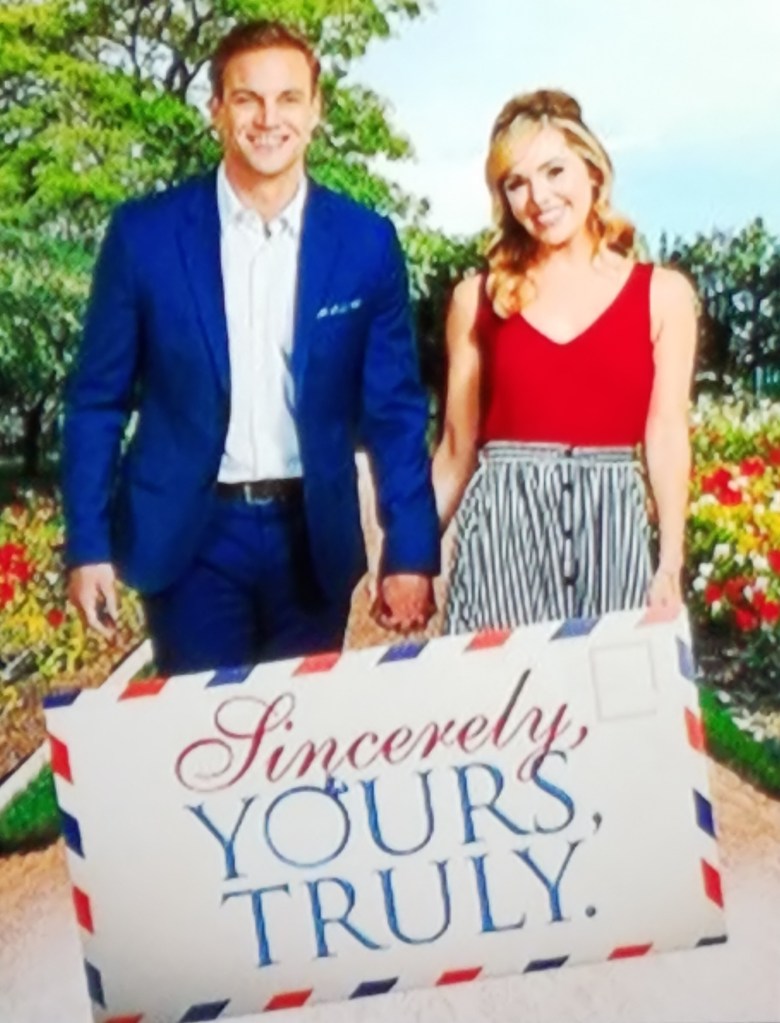
I know this review has been long overdue. With several projects on my plate last month, I wasn’t able to get to my review as soon as I had wanted. Like I mentioned in my Peer Pressure Tag post, I am using March as the month where I catch up on important articles. This includes the newest blog follower dedication review. This time around, I wanted to choose a movie that was different from the film I wrote about for my last review; Perry Mason: The Case of the Telltale Talk Show Host. Even though there is a mystery in Sincerely, Yours, Truly, the overall story is more light-hearted in tone. It’s rare for an Up Network film to be covered on 18 Cinema Lane. This is because I just haven’t gotten around to watching many of them. Beginning at the start of 2021, Up Network has been releasing a new movie almost every Sunday night. Since Sincerely, Yours, Truly has been on my DVR for about a month, I finally had an excuse to watch it!
I took a screenshot of the film’s poster from my television. Screenshot taken by me, Sally Silverscreen.
Things I liked about the film:
The acting: Even though Natalie Hall has starred in Hallmark Channel movies since 2011, the only film of Natalie’s I have seen is A Winter Princess. The reason I bring this up is because it shows how Natalie has experience when it comes to working on films of this nature. Throughout Sincerely, Yours, Truly, Natalie was very expressive, which is reflective of her time appearing in Hallmark’s rom-coms and one of the Love Saga (Love Comes Softly) films. Toward the beginning of the movie, Natalie’s character, Hayley, and her friend, Elisa, have received good news about a potential grant for their non-profit, Growing Out. They dance around Hayley’s kitchen and squeal in delight, as they can’t contain their excitement. While we’re on the subject of Elisa, I also liked Nicki Whitely’s performance in Sincerely, Yours, Truly! Like Natalie, Nicki was also expressive. She had a good on-screen personality as well. Anytime Elisa interacted with Hayley, their friendship came across as realistic. The moments when they read the love letters are a good example. This was my first time watching any of Marshall Williams’ projects, so I didn’t know what to expect from Marshall, talent-wise. I have to say that I was very impressed by his portrayal of Josh! In the movie, he was charming, with his reactions and expressions appearing natural. Having good on-screen chemistry with Natalie also helped Marshall. One of Marshall’s best scenes was when Josh discovers a letter about a lost item. Josh receives his mail when he is on his way to work, not thinking twice about the task. As soon as he sees the letter, a look of curiosity immediately appears on his face.
The witty banter: In order to make any movie, let alone a rom-com, work, there needs to be good dialogue among the characters. Sincerely, Yours, Truly contained witty banter, which was one of the strongest parts of the film! Hayley and Josh meet when they argue over who should receive the last two jars of rhubarb jam. During this interaction, Josh lies about his reasons for wanting the jam. At first, he says he needs it for his sister because she’s having a bad day. Then he says he needs the jam because his sister is sick. Hayley comes back with witty remarks, calling out his falsehood in the process. After hearing both explanations of Josh’s, she asks him which one is true. This back-and-forth banter between these two characters was consistent, being both quick and sharp. Another example of this banter is when Josh is asking Hayley to put out her incense at their shared office facility. Because he’s entering her part of the office, Hayley responds by telling him not to spy, a reference from an earlier conversation. Not only do these interactions work because of the script, but also because of Natalie and Marshall’s talents!
The process of a grant proposal: A overarching narrative in Sincerely, Yours, Truly is Josh and Hayley attempting to win a financial grant for their respective non-profits. Throughout the film, the audience gets to see the entire process, from Josh and Hayley’s initial meeting to the final results. I found this part of the story interesting, as it allowed the characters to use problem solving skills and creativity. Even though Hayley’s non-profit was featured in the film more than Josh’s, I liked seeing her ideas come to life! This kind of insightful story-telling is what I’ve come to enjoy in stories like this.
Revealing the mystery too early: A mystery surrounding a collection of love letters was one of the major stories in Sincerely, Yours, Truly. This is one of the reasons why I wanted to watch this film. Within the first twenty minutes, a narration from a character the audience already met recites one of the love letters. The narration reveals the identity of the letters’ author. The mystery should have been drawn out for longer than twenty minutes, with the author’s identity remaining a secret for at least half the movie. This would give the audience more time to stay invested in the mystery.
No subplots for the supporting characters: While I liked the major stories in Sincerely, Yours, Truly, I didn’t find subplots for any of the supporting characters. What’s even more frustrating is how there were opportunities for subplots to take place. One example is Hayley’s mom, Camille. Over lunch between mother and daughter, it is revealed that Camille has a crush on a local butcher. However, this relationship is never explored and we only see Camille in two scenes. In the story, Elisa shares how she’s dating a dog-walker, whose profession is affecting her allergies. This conflict was not resolved anywhere in the movie.
Josh and Hayley never coming across as enemies: A classic rom-com trope that is found within the movie is “enemies to lovers”. Even though I enjoyed seeing Hayley and Josh’s interactions, I never felt like they were enemies. Sure, there were aspects of the other person they didn’t like. But their banter came across as playful than antagonistic. This made me question why the creative team behind Sincerely, Yours, Truly adopted this specific trope if they weren’t going to fully utilize it?
I’m glad to see Up Network releasing newer films on their channel! It gives their audience something to look forward to and allows the network to compete alongside their competitors. With Sincerely, Yours, Truly, it was a film I ended up liking! While the movie does have its flaws, its sincerity and genuineness make up for that. I didn’t bring this up in my review, but Sincerely, Yours, Truly successfully avoided the “it’s not what you think” cliché. There were two instances where this cliché could have been used in the story. However, the film’s creative team subverted my expectations and chose not to use it, which made me enjoy the movie more! I want to take the time now to thank all of my followers. Reaching 300 followers is a big deal for me, so I appreciate all of the support!
Overall score: 7.8 out of 10
Have you seen any of Up Network’s newer films? If so, which one has been your favorite? Please tell me in the comment section below!
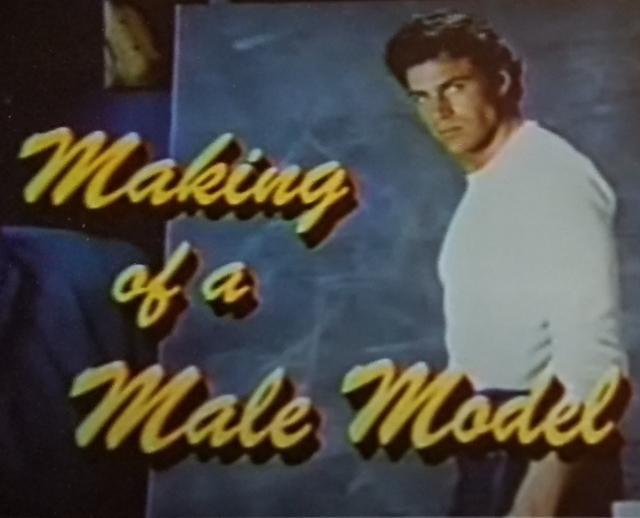
Any time I participate in a blogathon, I try to choose a film or topic that brings something different to the event. This allows my entry to stand out, as well as offer a sense of variety to the blogathon’s subject. When searching Joan Collins’ filmography, for Realweegiemedget Reviews’ Joan Collins Blogathon, I came across the 1983 television movie, Making of a Male Model. What intrigued me to the point of wanting to watch it was how it told a story from a completely different perspective. In films that revolve around modeling or the fashion industry, the story usually focuses on a female protagonist. With Making of a Male Model, a man is entering the modeling world. Out of the films I’ve seen involving modeling, the only one featuring a male model in the starring cast is the Disney movie, Model Behavior. Add the fact I’ve haven’t seen many of Joan’s projects, I am definitely eager to start this review!
Here is a screenshot I took with my phone of the movie’s opening title. Screenshot taken by me, Sally Silverscreen.
Things I liked about the film:
The acting: Because Joan Collins’ involvement in this movie is one of the reasons why I chose to review this film, I’ll talk about her performance first. In stories where the head of a fashion or modeling firm is one of the main characters, they either have an obvious self-centered personality or they come across as emotionally distant. With Joan’s portrayal of Kay Dillon, she brought something different to a role like this. For most of the film, Kay appeared genuinely kind-hearted and nurturing. The only times Kay sounds self-centered is when she is upset. When Kay and Tyler discuss their plans over lunch is a perfect example, as she explains how she can’t spend much time with him because she had spent ten years building her career. Speaking of Tyler, I enjoyed watching Jon-Erik Hexum’s performance! He did a good job portraying a character in his specific situation. At the beginning of the movie, Tyler is a “fish out of water”, overwhelmed by the modeling world and taken aback by some of the things that take place in that world. As the film progresses, Tyler gains more confidence and his perspective begins to change. I also liked Jeff Conaway’s portrayal of Chuck Lanyard! It was dramatic and emotional without being over-the-top. One of Jeff’s best scenes is when his character is comparing the modeling world to a stage play. That scene proved to me Jeff has the talents for a Broadway show!
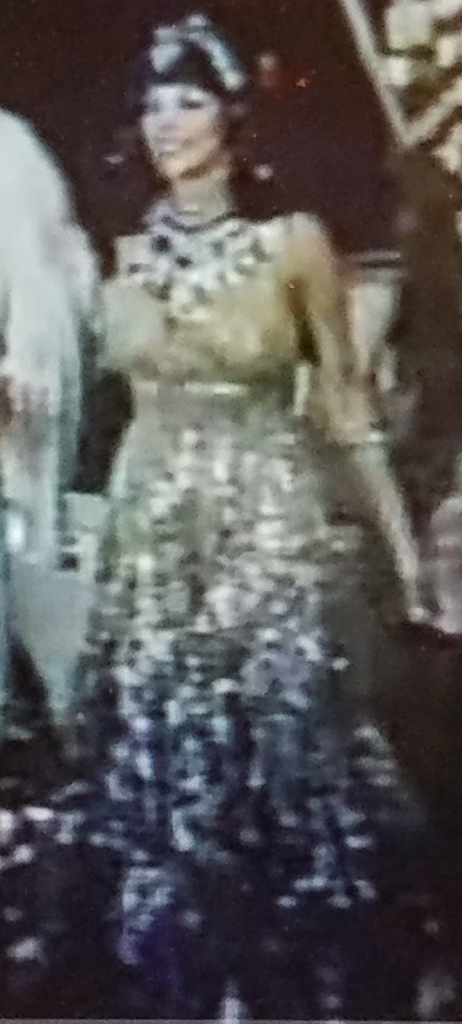
The costume design: In one scene, Tyler and Kay attend a costume party. The costumes were so elaborate and detailed, I honestly thought they were going to the Met Gala! One of the party goers wore a large hat in the shape of eyes. The piece around the blue eyes appeared periwinkle, with the hat portion blending into a pretty purple. Kay’s dress was absolutely gorgeous! It was covered in sparkles, allowing the dress to shine whenever Joan moved. The top of the dress was gold, with the skirt adopting an ombre design of blue and purple. A clear jeweled collar completed the look. During a photo shoot, one of the models was wearing a hat with a bird on it. The bird was covered in purple jewels, sparkling anytime the model moved her head. It was such a cool piece that I’d love to have in my wardrobe!
An insightful look into the world of modeling/advertising: Out of the episodes of Murder, She Wrote I’ve seen, my favorite one is ‘Film Flam’. One of the reasons is the behind the scenes look at how a movie premiere is organized. Throughout Making of a Male Model, the world of modeling and advertising is explored. When Tyler goes to apply for a catalogue modeling job, he is turned down due to his appearance and his lack of a portfolio. This instance shows how fast-paced this particular world can be and how one must always be prepared to bring a good first impression. At one point in Tyler’s journey, Tyler takes part in television commercials. Before a commercial for cologne was filmed, the director conducted a practice run in order to help Tyler remember what to do. It was interesting to see how the sets were constructed, how far the crew was willing to go to create an image or an idea. It was also interesting to see the prep work that goes into creating a commercial.
What I didn’t like the film:
Lack of on-screen chemistry: During the film, Tyler and Kay form a romantic relationship. However, I never sensed a spark between them. Jon-Erik and Joan worked well together from an acting perspective. But when it came time for their characters to become intimate, it felt like they were following story points within a script instead of allowing their characters to form a connection. Tyler and Kay’s relationship comes to fruition after the costume party I mentioned earlier. But up until that moment, Tyler and Kay did not express any interest in falling in love with each other. So, the formation of their relationship, from a story telling perspective, felt forced and random.
Following the same beats: As I said in the introduction, I wanted to watch Making of a Male Model because it told a model’s story from a man’s perspective, which is not often explored in the world of cinema. Because of this, I was expecting the movie to tell a different kind of story from others of this nature. Sadly, it was just more of the same. The story followed a lot of the same beats as other modeling/seeking fame films. Making of a Male Model featured tropes such as “the two-faced boss”, “a cautionary tale about fame and fortune”, and “a friend in crisis”. This movie had an opportunity to take different avenues of the modeling or advertising world that either haven’t been or are rarely discussed in film. But that opportunity was not taken advantage of.
Telling more than showing: There were some moments in Making of a Male Model where characters told more than showed what was happening. As I already mentioned, Chuck compares the modeling world to a stage play. I did like Chuck’s monologue and Jeff’s performance. However, because this monologue was given before Tyler’s modeling career began, it denied the audience a chance of seeing Tyler’s journey firsthand, without being spoiled. At the costume party, a man named Ward accuses Kay of breaking a contract. It gets to the point where Ward starts causing a scene. Since this accusation is presented as hearsay, it is never determined who was telling the truth.
I apologize for the poorer quality of this photo, but it was one of the few complete shots of the dress this movie presented. Screenshot taken by me, Sally Silverscreen.
My overall impression:
I know that stories are bound to get repeated overtime. But there is a fine line between telling similar stories and rehashing material. Making of a Male Model fits into the latter category, as the same tropes are adopted from other films of this nature. Honestly, this disappoints me because I was expecting more from this movie. Despite finding Making of a Male Model to be just ok, there are aspects of the film I liked. One of them is the insightful look at the modeling/advertising world. This part of the story held my interest, as I found it to be a fascinating exploration. With that in mind, I think the concept of this movie would have worked better as a television show or documentary.
Before I finish this review, I’d like to let my readers know I did choose another book from my TBR Tin. For those who don’t know, I announced in January how I would choose which book to read next from a hot chocolate tin I won last year. My second TBR Tin book of the year is
(insert drumroll here)
Closed for the Season by Mary Downing Hahn!
Yes, this is a book I said I was going to read in 2019. But I’m glad to finally get around to reading it!
Overall score: 6.1 out of 10
Have you seen Making of a Male Model? Which projects of Joan Collins’ have you watched? Let me know in the comment section!
Jesse’s new haircut. Henry presenting yellow roses to Florence. Clara and Rosemary opening a box of inventory from Dottie. What do these things have in common? They are all small details that make a big impact! When it comes to writing, it’s the little things that count. With Jesse’s haircut, it maintains the consistency within the show’s overarching story. Yellow roses symbolize friendship, which Henry was seeking after the accusations he made in the previous episode. Dottie is a character that hasn’t appeared on the show in several seasons, so hearing Clara and Rosemary say her name was a pleasant surprise. Throughout this season, I will be on the lookout for more small details that stand out in the script. In the meantime, let’s start this re-cap of When Calls the Heart!
Just a reminder: If you did not see this episode of When Calls the Heart, there may be spoilers within this re-cap.
When Calls the Heartposter created by Crown Media Family Networks and Hallmark Channel.
Season: 8
Episode: 3
Name: From the Ashes
Major stories:
When attempting to remove more oil from the geyser, Mike suggests to Lucas that the crew should drill another 50 feet. Even though it is a risky move, Lucas agrees to the idea. As the crew continues to drill, they feel a rumbling beneath the ground. After the crew runs away from the geyser, oil begins to burst out of the hole. All of the sudden, the geyser explodes into flames. This was caused by a high-pressure blowout that took place during the initial drilling. Lucas and Jesse try to figure out what to do, while also trying to keep the other crew members safe. They are eventually joined by Bill, Henry, Ned, and Nathan. Henry suggests dynamite be used to distinguish the fire, an idea the rest of the men agree to. Right before this plan is put into place, Fiona shows up to lend a hand. The group gathers all the dynamite they can find and push them from a cart into the fire. Their plan works, causing no fatalities or major injuries. The fire also causes little to no damage.
While Rosemary and Elizabeth discuss Elizabeth’s potential relationship between Nathan or Lucas, Lucas crosses paths with them on his way to the library. After Elizabeth ends her conversation with Rosemary, Lucas tells Rosemary how he noticed his mother appeared different than usual. This causes him to want to call his father in an attempt to surprise his mother. At this point in the episode, Lucas still doesn’t know about his parents’ situation. While editing Elizabeth’s manuscript, Elizabeth shares how it’s difficult to keep Helen’s secret from Lucas. She suggests Helen tell her son what’s been going on. When Elizabeth looks out the window in Helen’s room, Helen addresses Elizabeth’s feelings for Nathan and Lucas. After the geyser explosion, Lucas meets Helen at the Café. When he asks her where his father is, she tells him she’ll find out where he is. Eventually, Lucas finds out the truth about his father. He approaches Elizabeth and asks her why she kept this secret from him. She says Helen told her not to say anything to him. A few scenes later, Helen visits Elizabeth at her home. She feels overwhelmed by her relationship issues. Elizabeth reminds Helen how she needs to show her husband her vulnerable side and fight for her marriage. Helen pauses the editing process on Elizabeth’s manuscript to go home and rekindle her relationship with her husband. Meanwhile, Lucas is still upset with Elizabeth. She tells him what she told his mother. Lucas feels Elizabeth doesn’t know what she is talking about because she is currently not in a relationship.
At the Mercantile, Lee receives a package. This package contains a chair he purchased on his and Rosemary’s South American vacation. Jesse, who also happens to be at the Mercantile, tries to sit in Lee’s chair. Lee discourages this, as he says it’s bad luck if he isn’t the first person to sit in the chair. To take Jesse’s mind off of the chair, Lee instructs Jesse to take Lee’s motorcycle to the lumberyard, as Lee plans on selling it. When Jesse goes to Lee and Rosemary’s house, he chooses to ride on the motorcycle, discovering how much he likes it. However, Clara disapproves of the motorcycle when Jesse pays his wife a visit at the dress shop. Jesse decides to buy the motorcycle from Lee. After Lee sells it for $20, Jesse takes a trip to a neighboring town on the motorcycle. During his journey, the motorcycle runs out of gas, causing Jesse to walk with the motorcycle to his destination. Meanwhile, in Hope Valley, Rosemary takes a seat in Lee’s chair while he is at work. Unfortunately, Lee’s chair breaks due to a cracked leg. When Lee comes home, Rosemary apologizes for breaking Lee’s chair. Lee then reveals how he and his grandfather built a chair like the one Lee bought when he was younger. He also shares how he misses building things. At the end of the episode, Rosemary creates a work station for Lee, so Lee can get back to building again.
Bill asks Nathan if he’s still interested in purchasing his land, as Bill says there is another buyer interested in the property. Nathan replies he has changed his mind. Andrew, a Mountie who mentored Nathan, informs him of an inquiry that is about to take place. Because a Mountie was killed in last season’s prisoner transfer, Andrew is investigating Nathan’s involvement in the Mountie’s death. Because Andrew was mentored by Bill, Bill notices the tension between Nathan and Andrew. At Nathan’s office, Bill asks Nathan why he doesn’t like Andrew. Nathan doesn’t provide any details. Andrew visits Bill, in order to inspect the potential courtroom for the inquiry. Bill asks Andrew the same question he asks Nathan. Just like Nathan, Andrew doesn’t provide any additional information.
The day after the geyser explosion, Florence notices how Ned appears in pain whenever he walks. Florence volunteers to take him to the Infirmary. While at the Infirmary, Faith discovers Ned has an internal ankle fracture due to Ned’s foot falling into a hole. However, Carson says Ned has an external ankle fracture. Frustrated by this experience, Faith shares her feelings with Clara and Fiona after Ned’s visit. Later in the episode, Faith shares with Carson how her recent experience is similar to what she went through in medical school, where she wasn’t taken seriously and no one seemed to listen to her. She tells Carson how she wants to be heard and seen as a doctor.
Even though I liked the storyline involving the geyser, I wish it had lasted a little longer and raised the stakes a bit higher. This could have been one of the most suspenseful moments in the show’s history, with the audience questioning certain characters’ outcomes and wondering what the explosion’s aftermath will look like. I will say this particular storyline was more interesting than most of the subplots in the season premiere.
I heard a theory of Jack possibly returning to Hope Valley after his identity was mistaken and he experienced amnesia. Because Jack is brought up in the preview for next week’s episode and after Bill mentioned the other buyer interested in his property, maybe this theory could be true? It would provide a convenient way for Elizabeth not to choose Nathan or Lucas. However, nothing has been confirmed or denied by anyone associated from the show.
Now that Lee is going to start building again, I wonder if he’ll finally build Rosemary that theater she wanted since season two? It could provide the show’s creative team with a story to give Rosemary and Lee. The theater would also create growth in Hope Valley.
What are your thoughts on this episode? Are you looking forward to the Canfield family’s introduction in the next episode? Tell me in the comment section!
To celebrate the anniversary of 18 Cinema Lane’s beginning, I host a movie awards to highlight the best films I saw in the previous year. As I had several projects on my plate in February, the Gold Sally Awards were pushed back. However, the Gold Sally Awards are still happening, starting with the Best Movie category! In this division, all of the films that were featured on my Top 10 Best Movies I Saw in 2020 list will compete for the title of Gold Sally Awards’ Best Movie. Like in years past, you are allowed to vote for more than one nominee. But you can only vote once per person. This poll starts today and ends on March 14th. On the bottom of the poll, there is a link where you can submit your vote. If you’re having technical difficulties, please don’t hesitate to speak up in the comment section.
I usually don’t show this anniversary image on my blog. However, I thought it would make sense for the start of this year’s Gold Sally Awards! WordPress Anniversary image created by WordPress.
Back in February, Ospreyshire, from Iridium Eye Reviews, tagged me as part of the Peer Pressure Tag. Because the first two months of 2021 have been busy months for me, I’ve been using March as the time to catch up on important posts that I need to publish. Now, I’m finally getting around to participating in this tag! Thank you, Ospreyshire, for choosing me for this tag. Thank you also to that one crazy girl from Random Thoughts of my Fandoms for creating The Peer Pressure Tag.
-Have you ever been pressured into watching/reading something and told to like it?
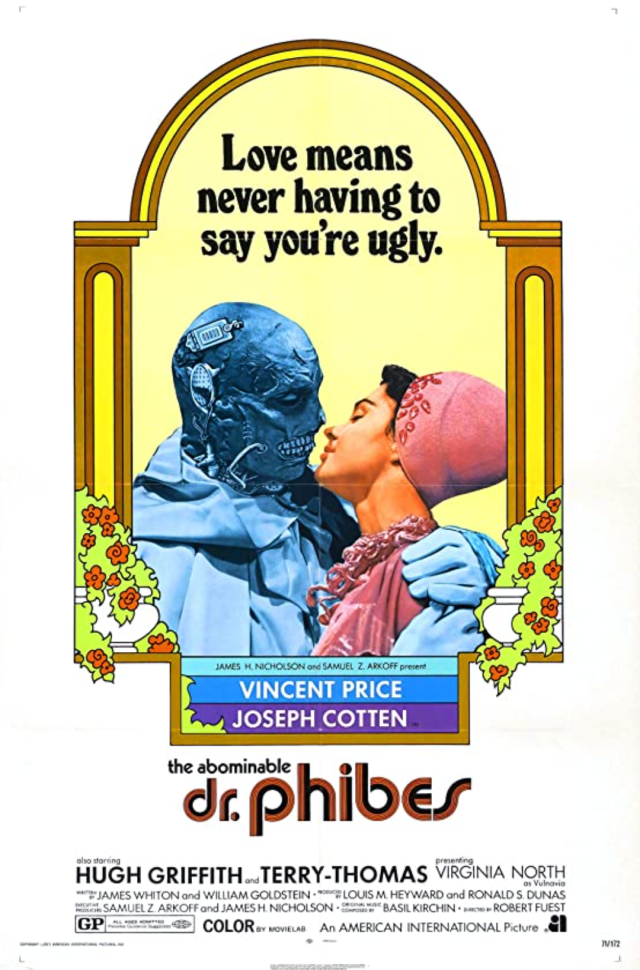
I haven’t been pressured into watching/reading and/or liking something. However, I have been recommended films by readers on several occasions. The most recent film I reviewed, The Abominable Dr. Phibes, was recommended by a reader named Michael.
-Have you ever been pressured into hating something that you normally like?
If I like or dislike something, it’s because I choose to do so. Therefore, I have never been pressured to hate something I normally like.
-How do you deal with peer pressure when it happens to you?
During my three years as a movie blogger, I haven’t experienced peer pressure. But, as I’ve mentioned before, I have been given recommendations by my readers. I have a board on Pinterest where I post movie posters of the films that have been recommended to me. This is to help me keep track of these suggestions.
-What crosses the line between recommendations and peer pressure for you? When someone is constantly telling you to do something, that, to me, would be considered peer pressure. Recommendations are when people mention a particular subject on a few occasions. Using The Abominable Dr. Phibes as an example, I was informed about that movie by one person. There have been times when more than one person has recommended a movie. But these instances have been rare.
-What is one interest or hobby that you got into that you never thought you would like?
I have recently become more serious about American Girl doll collecting. Before I made that decision, I never thought I’d become a doll collector. Even though I began this hobby in January, I’ve already found much enjoyment! It has boosted my confidence and helped me retain my creativity.
When Lee goes to the Infirmary after he injured his back, Joseph Canfield, a new character on When Calls the Heart, tells Rosemary he’ll pray for Lee. Not only was the gesture thoughtful, but it also highlights an important component of the show. Since the show’s beginning, faith has been interwoven throughout the overall story. Whether it was Elizabeth’s students putting on a Nativity play during Christmastime or the characters adding Biblical values to their lives, faith is one of the cornerstones of Hope Valley. It has been a while since services were shown in the church or since a pastor has stayed in the town for more than a few episodes. Adding a new pastor to When Calls the Heart’s growing cast of characters would continue to emphasize the importance of faith. It would provide the town with someone to turn to whenever someone is struggling. The pastor’s journey of faith could also be explored. In the meantime, let’s start this week’s re-cap of When Calls the Heart!
Just a reminder: If you did not see this episode of When Calls the Heart, there may be spoilers within this re-cap.
When Calls the Heartposter created by Crown Media Family Networks and Hallmark Channel.
Season: 8
Episode: 2
Name: Honestly, Elizabeth
Major Stories:
Helen Bouchard spends her morning reading Elizabeth’s manuscript. When Lucas visits her at the Queens of Hearts Saloon, Helen expresses no interest in leaving her room. Later that day, as Elizabeth is on her way to the Infirmary to visit Lee, Lucas asks Elizabeth if she’ll visit Helen. After Lucas explains how Elizabeth is easier to talk to, Elizabeth agrees. At the Saloon, Elizabeth arrives at Helen’s room, bringing a basket of homemade muffins. Helen refuses the muffins and also frowns upon Elizabeth’s lateness when it came to handing in her manuscript. When Helen asks if Elizabeth can meet with her the next morning to look over Elizabeth’s manuscript, Elizabeth agrees. The following day, Elizabeth and Helen work on editing the manuscript. They have difficulty seeing eye-to-eye, as they only finish the first page. To resolve this issue, Elizabeth suggests they take a break by going for a walk. On this walk, Helen reveals that she likes Elizabeth’s honest writing. She also confides in Elizabeth how her husband left her. Helen says her husband was in London the last time he was located. She tells Elizabeth not to tell Lucas about this news. When Lucas arrives to invite Elizabeth to dinner, she turns down the invitation. Instead, she recruits Lucas to help plan a special night in for Lee and Rosemary. Throughout the episode, Helen takes notice of Lucas’ feelings for Elizabeth.
A box for the Coulters arrives at their house. Joseph Canfield comes to help Lee bring the package into the home. During this procedure, Lee hurts his break. He is taken to the Infirmary by Rosemary, Joseph, and Jesse. At the Infirmary, Carson discovers Lee has sprained his back. He tells Lee and Rosemary how Lee will have to rest at the Infirmary until the afternoon, when Lee will be able to go home. Back at home, Lee is still in pain. He plans to take it easy by sitting on the sofa. Later that evening, Elizabeth surprises Lee and Rosemary by planning a special night in. She gives them wine and a record that have something to do with Hawaii. As they dance to the music, Lee confesses to Rosemary how he has always wanted to visit Hawaii. The next day, they discover what the box contained. While the majority of the contents consist of coffee, they also give a sombrero and poncho to Elizabeth’s son, Jack.
Nathan visits Bill with the intention of starting the process of Ally’s adoption. Even though Bill thinks it is a bad idea with Ally’s father in prison, Nathan explains how this is the perfect time to start the process. As Bill fills out the necessary paperwork, Nathan finds a map of Bill’s property. Bill explains how the land is for sale, as he doesn’t spend much time using it. Later in the episode, Nathan tells Elizabeth how he plans to visit Bill’s land. He also shares his desire to settle down. Before the episode ends, Nathan expresses his feelings about Bill’s property to Elizabeth, saying how it would the perfect place to build a house. Elizabeth tells him how she cares about him and is concerned about the future of their relationship. She doesn’t want to lose him like she lost her husband. Even when Nathan explains how he’d quit being a Mountie, that doesn’t dispel any of Elizabeth’s concerns. After Nathan tells her he loves her, Elizabeth rides away on her horse, Sergeant.
Toward the beginning of the episode, Fiona opens her barber shop, which is called Nichols and Dimes. She explains how she incorporated her former boss’ name into her business, as a symbolic gesture to show how she is more than just “a small spoke in a big wheel”. When she is seeking customers, Henry, Jesse, and Mike turn down the offer. As the episode progresses, Mike comes to the barber shop after he lost a bet with Jesse. As Fiona is giving Mike a haircut, she explains why she re-opened the barber shop. During this process, she accidently cuts Mike’s ear with the trimming scissors. Horrified by the ordeal, Mike rushes to the Infirmary. Later in the episode, Mike returns to the barber shop. He apologizes for abruptly leaving. Fiona tells him both of them are equally to blame. She then becomes surprised when Clara and Faith bring Jesse and Carson to get a trim.
While driving through the country roads, Joseph Canfield experiences car trouble as the car’s engine stops working. He goes to Hope Valley in search of help. When he enters town, Joseph finds Jesse and asks him for help, an offer Jesse accepts. When Jesse finishes fixing Joseph’s car, they witness Robert’s horse-riding adventure. As Robert loses control of the horse, Elizabeth chases after him while riding her own horse. When revisiting Hope Valley, Joseph expresses interest to Bill about purchasing the gas station. Joseph also shares how he’d like to call Hope Valley his home. Bill and Henry take Joseph to Henry’s house, which is currently for sale. Even though the house needs some repairs, Joseph purchases the house, claiming it will be the perfect place for his family to live. After this exchange, Henry visits the mercantile. When he discovers his letter has been returned and partially opened, Henry demands to know who is responsible. Carson, who just so happened to come to the Mercantile at that very moment, suggests Henry leave in order to prevent the conflict from escalating further. As Henry is leaving, he collapses on the stairs. While Carson reminds Henry of his troubling blood pressure, Henry tells Carson how nothing he does will ever be good enough. Carson takes Henry to the Infirmary in an attempt to resolve this issue.
This episode was much stronger than the season premiere! I liked how the overall story placed more emphasis on the plots and conflicts of the characters instead of the love triangle and relationships. Within the episode, interesting storylines were either revisited or introduced. Nathan’s plan to adopt Ally is one example. After Nathan explained why he wants to adopt Ally now, I have gained an understanding for the creative team’s decision to not use Ally’s father to serve a multi-episode storyline.
Why is Mollie suddenly interested in Bill romantically? For seven seasons, Mollie has never expressed any desire to be in a relationship with anyone. In this episode, she seemed jealous of Helen when Mollie spotted Helen and Bill at the Saloon. To me, this part of the story feels random.
Similar to the previous season, there is a lot of mystery surrounding Henry’s character. Not only do we not yet know the significance of the letter, but also why Henry is suddenly interested in getting back into the petroleum business with Lucas. I hope we start receiving answers as this season continues.
The Abominable Dr. Phibes was recommended by one of my readers named Michael. When I found out the movie was considered a horror-comedy, I thought it’d be a perfect entry for MovieRob’s Genre Grandeur, as horror-comedies are the theme for February. Then I discovered the film was released in 1971. Because Kim and Drew, from Tranquil Dreams and Drew’s Movie Reviews, are hosting the 6th Annual Ultimate Decades Blogathon, where the subject is movies premiering in years ending in 1, I decided to review The Abominable Dr. Phibes for both blogathons! As of early 2021, this is the fifth film of Vincent Price’s I’ve seen and written about. Most of these movies have either belonged in the horror genre or have been mysterious in nature. With The Abominable Dr. Phibes, this will be a little different, as part of the story is a comedy. Out of the movies of Vincent’s I have seen, none of them have featured a large amount of humor. So, by choosing this film for the aforementioned blogathons, I am given an opportunity to see Vincent work with slightly different material!
The mystery: In horror movies, there is usually a mysterious element that can come in a variety of forms. One of these forms is a mystery. Throughout The Abominable Dr. Phibes, the detectives at Scotland Yard are attempting to figure out why several doctors in their neighborhood are dying of mysterious causes. The way the mystery is presented allows the audience to solve it alongside the characters. This presents the idea of the audience sharing an experience with the detectives in the film. Even though we see what is making these doctors die, it doesn’t take away from the intrigue of the mystery. In fact, it keeps the audience invested in what is about to happen next. Seeing how all the pieces of the story connected was interesting to see. It definitely kept my attention as I watched the film!
The craftmanship: There were several items in this movie that caught my eye due to their quality and artistry. A frog mask is just one example. The head covering mask is covered in three different shades of green, allowing it to shine from many different angles. Gold piping can also be found on the mask, assisting in distinguishing its shape. Jewels add finishing touches as the mask features gold gems around the frog’s eyes and an emerald clasp in the back. Dr. Phibes’ mask also boasts incredible craftsmanship! The eye covering mask is shaped like a bird and is coated in shiny shades of green, bronze, and gold. Both masks were two of the most beautiful I’ve ever seen!
The set design: The Abominable Dr. Phibes features several interesting set designs that are worth noting. Despite Dr. Phibe’s house only being shown at night and only part of its exterior could be seen, it was a magnificent structure! Its Victorian style brightened the night with its white frames and cherry wood doors. The house features a grand white marble staircase paired beautifully with chandeliers and crystal sconces. I wish more scenes had taken place by this staircase, as it is an impressive part of Dr. Phibes’ residence! Other locations in the story also displayed memorable set designs. Dr. Vesalius’ apartment is a great example. Near the front door is a curved, frosted window. The door itself was covered in a light and dark wood that ending up complimenting the faded yellow walls. This location looked reflective of the late ‘60s to early ‘70s due to its color scheme and furniture selections.
The underutilization of Vincent Price: As I said in my introduction, this is the fifth film of Vincent Price’s I’ve seen. Therefore, I, as an audience member, know what he is capable of, talent wise. Despite being the top billed actor in The Abominable Dr. Phibes, Vincent wasn’t given much material to work with. He didn’t have any speaking lines in this movie. While there is an explanation given within the story, the only time we hear Vincent’s iconic voice is through recordings. It also doesn’t help that the different ways Dr. Phibes went after his victims overshadows Vincent’s performance. The more I think about it, the more I wonder if the creative team behind this film cast Vincent Price simply to get more people to see the movie?
Weak on comedy: The Abominable Dr. Phibesis classified as a horror-comedy. When I made this discovery, I was expecting the movie to be more like Young Frankenstein. Even though there were a few times I found myself giggling, the film didn’t contain much humor. The Abominable Dr. Phibes relies more on the horror genre. It also contains a mystery within the overall plot, which would make it a horror-mystery. I felt misled after these reveals.
Depiction of demises partially used for shock value: Strictly from a story-telling perspective, it was interesting to see how Dr. Phibes carried out his plan. But when the plan is put into practice, the depiction of his victims’ demises comes across as more gross than scary. Within a segment of the story involving rats, there was a brief shot of a rat chewing on what looks like a bloody bone. I won’t spoil The Abominable Dr. Phibes, in case any of my readers haven’t seen it. But parts of the film like the one I described feels like the movie’s creative team just wanted to shock their audience.
When I think of the term “horror-comedy”, Young Frankenstein immediately comes to mind. Even though I haven’t seen this film, I am aware of its premise. Because of my expectations, I was somewhat let down by The Abominable Dr. Phibes. Sure, its mystery was intriguing and kept me invested in the overall story. But as I look back on this movie, I find myself expecting more. Despite its classification as a horror-comedy, it ended up being a horror-mystery, with very little comedy to be found. I was also disappointed to see Vincent Price underutilized in The Abominable Dr. Phibes. While he was given different material to work with, he didn’t have any speaking lines. The way Dr. Phibes’ victims met their demise overshadowed Vincent’s performance. These factors make his portrayal of the titular character feel like a part of an ensemble instead of someone leading a film. This is an interesting movie, but I can think of stories of this nature that are stronger than this one. I still prefer a picture like The Crow over The Abominable Dr. Phibes.
Overall score: 7-7.1 out of 10
Have you seen a horror-comedy? Which film of Vincent Price’s would you recommend? Share your thoughts in the comment section!
Originally, I was going to review a different movie for the 3rd Annual So Bad It’s Good Blogathon. But when I found a DVD copy of Scarlett at a local consignment store, I couldn’t pass up an opportunity to review the film! Last year, I discovered Gone with the Wind received a sequel many years after its release. While I’m not a fan of the sequel’s predecessor, I thought the 1994 film would be perfect content for the aforementioned event. According to IMDB, Scarlett premiered as a TV mini-series. This gives the sequel a run-time of six hours, which is even longer than the first movie. I never thought Gone with the Wind needed another chapter, as everything ended on a definitive note. However, curiosity got the best of me, as I wanted to find out if this could finally be the “so bad it’s good” movie I’ve been looking for!
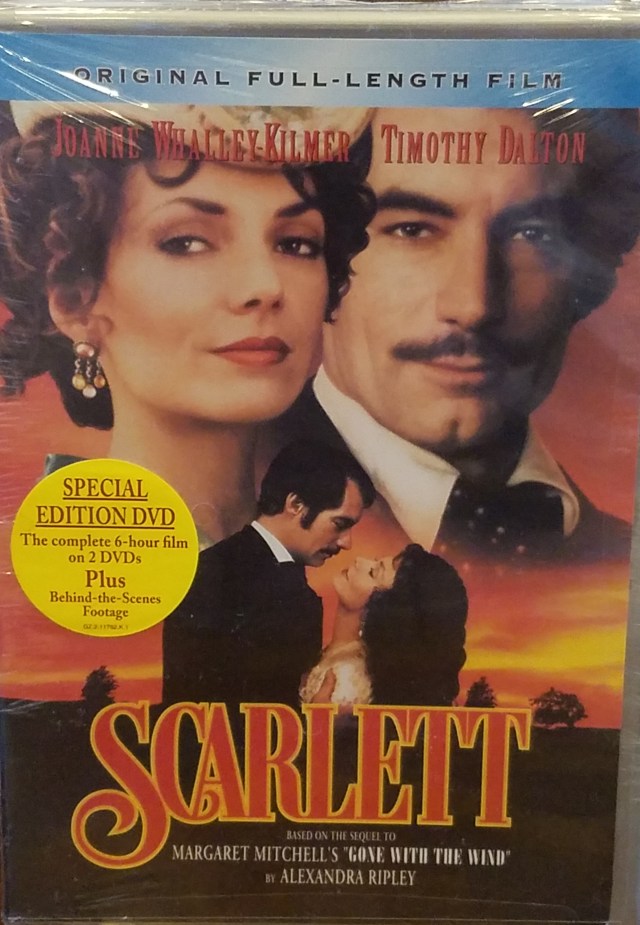
This is the DVD I purchased from a local consignment store. Even the packaging calls Scarlett a six hour film. Screenshot taken by me, Sally Silverscreen.
Things I liked about the film:
The acting: While I like the acting overall, there were three performances that were stand-outs. The first one came from Sean Bean. I haven’t seen much from his filmography, but I remember his portrayal of Ian Howe from National Treasure. Based on these two movies, it seems Sean is very talented when it comes to portraying on-screen villains! Without spoiling the film, I will say Lord Richard Fenton is a despicable individual. However, it was interesting to see how Sean carried his character in each scene he appeared in. Whenever in public or around Scarlett, Richard comes across as a dashing gentleman. But behind closed doors, he reveals himself to be selfish and controlling, which makes Richard’s overall persona very ugly. In all my years of watching movies, I’ve seen few actors effectively portray characters that had likable and unlikable qualities. Within the film, Scarlett, Sean single-handedly accomplished this; making the audience despise Richard, but appreciate Sean’s acting abilities! The second stand-out performance was Annabeth Gish’s! In historical fiction/period stories, few female characters from a wealthier background contain a personality that is gentler in nature. With the way Annabeth approached her character, Anne, she brought something to the table that isn’t seen often. This not only provided a contrast to Scarlett, but allowed Anne to be her own character. Anne’s gentleness came across on screen very naturally as well! Tina Kellegher’s portrayal of Mary Boyle is the third stand-out performance! A strong sense of emotionality worked in Tina’s favor. This component to her performance presented her character as a believable individual, as if Mary had actually existed at some point in time. Miss Boyle experiences some difficult situations throughout the movie. However, Tina pulled off a performance that appeared flawless!
The costumes: In period films, one of the notable aspects is the costumes. They are one example of a physical representation of the story’s respective time period. The costumes in Scarlett not only looked historically accurate, but also impressive! It also helps how the costumes compliment the actors wearing them. Scarlett’s wardrobe was amazing! It featured a color palette that never appeared over-the-top. Each piece featured patterns and textures that felt fitting for the 1870s, with color combinations working well together. I honestly can’t choose a favorite outfit, as it was fun to discover what outfit Scarlet would wear next! While I realistically don’t have any place to wear one of Scarlett’s outfits, it’s nice to think about which piece I’d like to own in real-life.
The conflict between the British and Irish: Within the overall story, there was an ongoing conflict between the British and Irish. According to the Irish characters, this was due to the British wanting to take over Ireland. I’m not familiar with this particular period in world history. Despite that, I found this part of the story to be fascinating! Because of Scarlett’s Irish heritage and the fact she had family living in Ireland, it gave Scarlett a reason to be aware of the political and social environment around her. Her interactions with Richard also highlight the different sides of the conflict itself. There were other people in this story who were directly connected to this conflict as well. One of Scarlett’s cousin’s, Colum, is a priest. However, he is also a member of a group of Irish people fighting for freedom against the British. It was interesting to see how Colum navigated his own struggles of religious duty and standing up for his people.
Scarlett and Rhett’s on-again/off-again relationship: I am not a fan of Scarlett and Rhett’s relationship. Even when I try to give it a fair chance and watch it with an open mind, I still do not like their relationship in this movie. One of the reasons why is how it was continually on-again/off-again. This was so repetitive, it became tiresome. It was also difficult to determine if Joanne Whalley and Timothy Dalton, the actor and actress who portrayed Scarlett and Rhett, had any on-screen chemistry. Scarlett and Rhett’s relationship problems did not need to be explored, especially after Gone with the Wind’s ending. In fact, seeing Scarlett and Rhett’s on-again/off-again relationship diminishes one of the most famous scenes and quotes in cinematic history, where Rhett says “Frankly, my dear, I don’t give a damn”. In my opinion, this situation took place simply to justify the sequel’s existence.
Unnecessary stories: As I already mentioned in my previous point, Scarlett and Rhett’s on-again/off-again relationship felt like it was taking place simply to justify the sequel’s existence. This wasn’t the only story within the film to make me feel this way. In the first half of Scarlett, Ashley is struggling to keep his business afloat. Scarlett recruits Sam, a former slave of the O’Hara household, to assist Ashley in building more homes, in order to save Ashley’s business. That storyline is one I found myself not caring about. It also didn’t lead anywhere, as it didn’t have a consistent presence in the overall film. Scarlett’s feud with her sister was another story I thought was unnecessary. Throughout the film, they refused to see eye-to-eye about the future of Tara. While Scarlett’s sister was still living in the house, Scarlett was considering selling it. I thought it was odd for Scarlett to think about selling Tara. In the first movie, she loved Tara so much, Scarlett slapped a woman in the face for expressing her opinion against the place. For Scarlett to completely change her mind without any explanation seemed random.
Choppy scene transitions: At some points in the movie, there were scene transitions that were so abrupt, it caused the film’s overall flow to feel choppy. When visiting a family member, Scarlett is about to share how she became so wealthy. Right as she was about to tell her story, the next scene started, showing another family member walking toward his house. It seemed like parts of the movie were missing. Some of these scene transitions were so jarring because the change of tone was so drastic. One scene showed Colum speaking with an Irish neighbor about their plans to fight the British. This dramatic and serious moment was met with a light-hearted scene where Scarlett goes to a horse fair. The journey from point A to point B needed a bridge.
I can’t call Scarlett “so bad it’s good”. In fact, I would never consider it a bad movie. Objectively, this is a competently made project, where the creative team behind it clearly knew what they were doing. Subjectively, Scarlett is a mixed bag. The conflict between the British and Irish was the best part of this story! It was fascinating to see it unfold and discover how the characters were involved. With the parts of the story directly referencing Gone with the Wind, I found those to exist simply to justify the sequel. Until Scarlett went to Ireland, I was questioning why the movie was made. Personally, I would rather watch a miniseries about the British and Irish conflict over the one I just did. As I wrap up this review, I realize I still haven’t found my “so bad it’s good” movie. Time to go back to square one.
Overall score: 6.1 out of 10
Do you have a movie in your life that you’d consider “so bad it’s good”? If so, what is it? Let me know in the comment section!
When I found out Hamlette, from Hamlette’s Soliloquy, was hosting another blogathon, I knew there would be a tag. I was curious what questions would be asked when I discovered the blogathon would be pirate themed. However, I was looking forward to creating another tag post! Last year, I participated in The Legends of Western Cinema Week, which was partially hosted by Hamlette. During that event, I was introduced to my first blogathon tag! While I don’t watch a lot of westerns, I still answered the tag questions based on the films and television shows I have seen. Because I’ve seen and read more pirate related content, I found it easier to answer the questions in the We Heart Pirates Week Tag than those from The Legends of Western Cinema Week Tag. So, hop onboard this ship as we set sail through my answers!
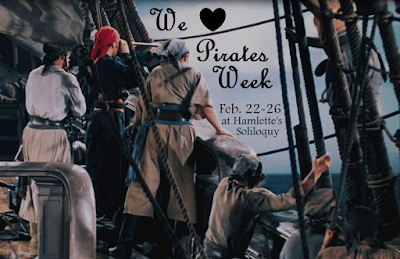
We Heart Pirates Week blogathon banner created by Hamlette from Hamlette’s Soliloquy
What are your favorite pirate movies or books?
While I haven’t seen these movies in a while, I have enjoyed the Pirates of the Caribbean trilogy! I remember them being a lot of fun and intriguing. Each character is memorable and the stories are well written. When it comes to pirate books, I recall liking To Catch a Pirate by Jade Parker! It was so good, I could honestly see it adapted into a film!
2. Who are your favorite fictional pirates?
My favorite character from the Pirates of the Caribbean trilogy is Calypso/Tia Dalma! I know she’s not a pirate, but she does play an integral role within that series. Naomie Harris did such a great job portraying Calypso/Tia Dalma, which is one of the reasons why she’s my favorite character from a pirate movie!
3. What do you like best about pirate stories? (Themes, costumes, aesthetic, etc.)
I’d say the adventure the characters embark on. In any of the pirate movies I’ve seen, there is always a journey that is filled with adventure. It’s interesting to see where the story goes and how the characters deal with their conflicts along the way.
4. If you were going to play a pirate on the stage or screen, what would your costume look like?
I don’t know what it would look like exactly. However, I do know I want it to be elegant. In my review of China Seas, I talk about how beautiful the pirate captain’s costume is. This is because two pieces of his costume were a silk blouse and a detailed jacket. Pieces like those would definitely be in my pirate wardrobe!
5. What pirate ship would you like to serve on?
The Black Pearl from the Pirates of the Caribbean trilogy, of course! It’s too iconic of a ship not to catch a ride.
For this tag post, I thought this picture was appropriate. Screenshot taken by me, Sally Silverscreen.
6. Any favorite sea shanties or pirate songs?
I don’t listen to sea shanties or pirate songs. However, I do like the Nightcore version of Lady in Black by Blackmore’s Night, which sounds like it could fit in a pirate movie.
7. Have you ever participated in International Talk Like a Pirate Day?
No, I haven’t.
8. Would you like to go sailing on a real tall ship?
I don’t sail, but the idea of boarding on a real tall ship sounds fun!
9. Have you ever learned anything about real pirates, or do you tend to stick to the fictional kind?
I’ve learned there were several female pirates who roamed the Seven Seas. However, I don’t spend a lot of time learning about real pirates because I’ve been focusing on the fictional ones and their stories, such as Calypso/Tia Dalma and Davy Jones’ relationship.

















 18 Cinema Lane